|  Botany Botany
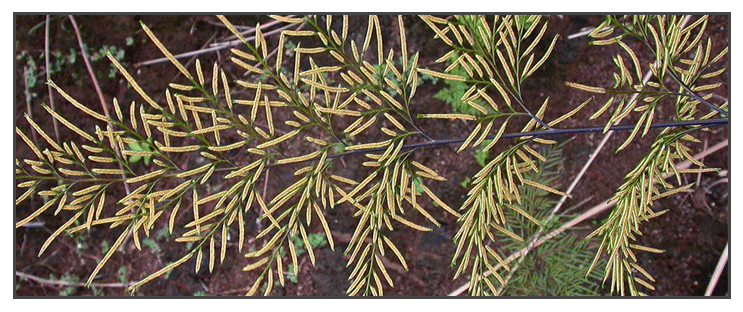
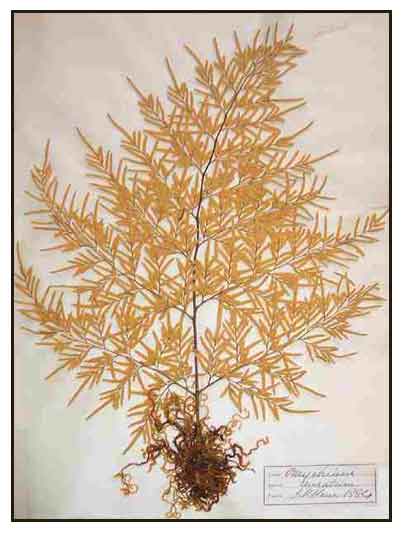
Pakong-anuang has rhizomes that are short, stout, and covered
with lanceolate, brown, and spreading scales. Stipes are naked,
erect, pale, and occasionally brownish, 10 to 30 centimeters long. The fronds
are 15 to 40 centimeters long, finely 3- to 4-pinnately divided. Pinnules are
small, narrow, and numerous; sterile ones usually spatulate, less than
5 millimeters long, often toothed at the apex; the fertile ones are podlike, linear,
entire, acuminate, 5 to 20 centimeters long and 1 to 2 millimeters wide. The indusium
and sori are of a rich golden-yellow color.
 Distribution Distribution
- Along banks
of streams.
- In northern and central Luzon, and from Leyte to Mindanao.
- Also found from India to China, and southward to Malaya.
Constituents
- Phytochemical screening yielded two new compounds: onitinoside and onysilin along with known compounds, pinostrobin, onitin, onitisin, campesterol, sitosterol, and n-alkanes. (1)
- Flavanone 9-methoxyliriodenine (4) and (2S)-5-hydroxy-6,7-dimethoxy avanone has been reported from Onychium siliculosum. (WuTS,Kuoh CS,Ho ST,Yang MS,Lee KK. Flavanone and other constituents from Onychium siliculosum. Phytoche- mistry 1981; 20:527-9.) (8)
Parts utilized
Rhizomes and young leaves.
Uses
Folkloric
• Juice of crushed leaves are used
for thinning or falling hair.
• Decoction of fronds used for dysentery.
• In Nepal,
juice of rhizomes used for fever. (7)
• In Bangladesh,
root decoction taken thrice daily used to treat dysentery
. For earaches, leaf juice is applied as eardrops.
• In India, fronds use for the treatment of dysentery and hair fall. (9)
Studies
• Phytochemicals / Flavanone:
Study yielded two new compounds: onitinoside and onysilin along with known compounds, pinostrobin, onitin,onitisin, campesterol, sitosterol, and n-alkanes. (1)
• Onitin / Antispasmodic / Smooth Muscle Relaxant:
Onitin was found to be an active principle of the plant Onychium siliculosum. A rat and guinea pig study showed onitin is a non-specific smooth muscle relaxant similar to papaverine, but of a lesser extent. (2) Study investigated the pharmacologic properties of three phenolic pterosins - onitin, onitinoside and onitisin - isolated from O. siliculosum. The predominant effect was inhibition of contraction of isolated guinea-pig ileum. Of the three, onitin was the most potent, inhibiting both D and M receptors of 5-HT. (3)
Availability
Wild-crafted.
|