Gen info
- Tabernaemontana is a genus of flowering plants in the family Apocynaceae. The genus was first described by Carl Linnaeus and published in Species Plantarum in 1753. The type species is T. citrifolia. (7)
- Tabernaemontana pandacaqui is a species of plant in the dogbane family Apocynaceae.
- Etymology: The genus name commemorates the "father of German botany" Jakob Theodor von Bergzabern, a.k.a. Jacobus Theodorus Tabernaemontanus, Tabernaemontanus being a compressed form of the original Medieval
Latin name Tabernae Montanus of the botanist's home town of Bergzabern - both the Latin and German forms of the town's name meaning "tavern/s in the mountains". (7)
- Tabernaemontana pandacaqui, called windmill bush and banana bush, is a species of plant in the dogbane family Apocynaceae.
 Botany Botany
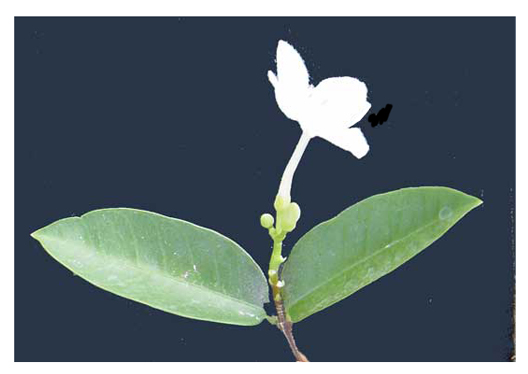
• Pandakaki is an erect, branched and smooth
shrub, 1 to 4 meters high. Leaves are elliptic-lanceolate
to oblong-elliptic, 5 to 12 centimeters long, narrowed at both ends, shining and short-stalked. Inflorescences
are axillary and terminal, peduncled, and have rather few flowers. Calyx is green, ovoid,
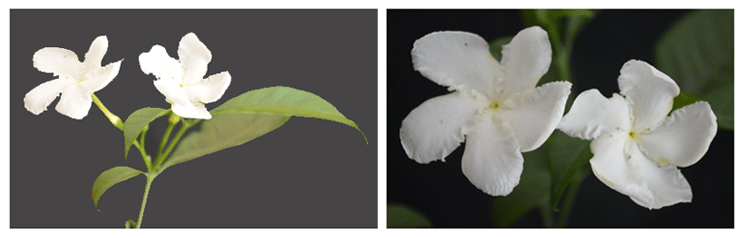
and short. Corolla is white, tinged with green, slender-tubed, 1.7 centimeters long and slightly enlarged upward; limb is 2 to
2.5 centimeters in diameter, composed of five, spreading, falcate, lanceolate
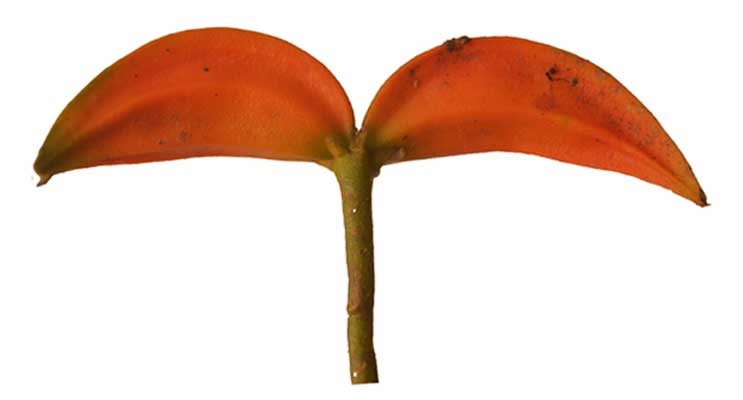
lobes. Follicles are red or yellowish-red, oblong, 2 to 4 centimeters long, and longitudinally ridged or keeled.
• Growth form: Shrub or small tree to 14 m tall Folliage: Leaves elliptic or obovate, 3 - 14.1cm (-25cm) long by 1 - 6.5cm (-10cm) long wide, papery or slightly so, mid-dark green above, mid rib and lateral veins a lighter shade of green. Flowers: White to pale yellow, faintly scented or not. Corolla tube (0.8-) 1.8-2.3cm long; corolla lobes Fruit: Follicles yellow, orange or red, with distinct longitudinal ridges, 0.9 - 7.1cm long by 0.5 - 3cm wide, slightly reflexed at the apical portion. Seeds with bright red aril.
Distribution
- Native to the Philippines.
-
Common in thickets
at low altitudes at low altitudes from the Babuyan Islands and Luzon to Mindanao, in most Islands and provinces.
- Also native to Borneo, China South-Central, China Southeast, Fiji, Jawa, Lesser Sunda Is., Malaya, Maluku, Marianas, New Caledonia, New Guinea, New South Wales, Northern Territory, Queensland, Samoa, Society Is., Sulawesi, Taiwan, Thailand, Tonga, Tuamotu, Vanuatu, Western Australia.
(11)
 Constituents Constituents
- Phytochemical screening of leaves yielded terpenoids, flavonoids, and anthraquinones while stems yielded alkaloids, and terpenoids. (see study below) (16)
- Ethanolic leaf extract yielded
carbohydrates, tannins, and flavonoids. (see study below) (21)
- Phytochemical screening yielded terpenoids and polyphenols in stems and leaves; the leaves also yielded flavonoid. (see study below) (22)
- MeOH percolation and fractionation of air-dried stems yielded nine alkaloids, namely: tabernaemontanine (1), ervatomine (2), voacangine (3) voacristine (4), voaluteine (5) and pandine (6).
Air-dried leaves yielded six alkaloids viz., 3, 4 , 6, akuammicine (7), vallesamine (8), and vallesamine 17-O-acetate (9). The major alkaloids were tabernaemontaine (1) from stems and akuammicine (7) from leaves. (23)
- Study of dichloromethane extract of flowers isolated α-amyrin acetate (1), a mixture of α-amyrin acetate (1), lupeol acetate (2) and β-amyrin acetate (3) in about 4:2:1 ratio, α-amyrin fatty acid ester (4), a mixture of ursolic acid (5) and oleanolic acid (6) in about 1:1 ratio, and β-sitosterol (7). (30)
Properties
• Caution: Some reports of toxicity attributed to the milky
sap.
• Fruit reported to be highly poisonous, with its many seeds with
red fleshy covering.
• Studies have shown analgesic, antiprotozoal, anti-inflammatory, antipyretic, hypotensive, bradycardic, cytotoxic, CNS depressant, pesticidal, wound healing, anthelmintic, gastroprotective, antibacterial, antimalarial, acetylcholinesterase inhibitory properties.
Parts utilized
Leaves, roots, bark, sap.
Uses
Folkloric
· In the Philippines, leaves used as cataplasm on the belly to induce menstruation. Poultice of leaves used to hasten parturition. Decoction of leaves added to bath of women after parturition. Decoction of root and bark drunk to relieve various stomach and intestinal complaints. Latex is applied as emollient to bruises, wounds, and swellings. (32)
· For eczema: Boil
3 cups of chopped leaves in one gallon of water for 10 minutes; add
2 gallons of hot water.
· Fresh leaves are fried in oil and applied to
itchy skins lesions for symptomatic relief.
· Leaf juice applied for wound healing.
· Hot Foot Baths: A local immersion bath covering the feet, ankles
and legs used for a variety of conditions: To relieve head, chest and
pelvic congestion; to stop nosebleeds; to relieve spasms and pains of
feet and legs; to induce sweating; to relieve menstrual cramps and headaches.
· Poulticed leaves applied on the abdomen to hasten childbirth.
· Ifugao-migrants in the foothills of the Sierra Madre used the plant latex for wounds,
· Erectile dysfunction: In Tiaong, reportedly used as "herbal viagra."
Boil 15-25 leaves in 3 glasses of water for
10 minutes; drink the decoction. (Note: Like many of the herbal medicines touted as "herbal viagra," kampupot use is rural folkloric with no known scientific or pharmacologic basis for its claim.)
· Decoction of root and bark used for a variety of stomach and
intestinal ailments.
· The white sap of the stem is applied to thorn injuries and
to hasten the surfacing of the thorn fragment.
· In Thailand, roots used to treat fever, pain and dysentery.
· The Ayta people of Porac, Pampanga use as repellent against hematophagous insects. Decoction of fresh leaf and roots is drunk, while leaves and stems are hung inside the house. (15)
· In Papua, New Guinea, root scrapings rubbed into nose sores. Sap from ripe fruit applied to ringworm. In Fiji, plant poultice applied to swellings and abscesses. (32)
Studies
• Analgesic
/ Hypothermic: Vulcanian was isolated from T pandacaqui which exhibited significant
analgesic and hypothermic effects in mice. (1)
• Antiprotozoal: In a study of 18 plants traditionally used in South Pacific archipelago Vanuatu, 15 plants showed strong cytotoxic effects specific for only one cancer line. T. pandacaqui leaves displayed activity against Trypanosoma cruzi. (6)
• Anti-Inflammatory
/ Antipyretic / Antinociceptive / Stems: Study of alcoholic extract of Tabernaemontana pandacaqui stems using carrageenan-induced rat paw edema, yeast-induced hyperthermia in rat, and acetic acid induced writhing response showed significant antiinflammatory, antipyretic and antinociceptive activities
attributable to alkaloidal components. (2)
• Hypotensive / Bradycardic / Stem:
Effects of a crude alkaloidal fraction from the stem of Tp on blood pressure and heart rate were investigated in rat models. Results showed a hypotensive and bradycardic
responses that might involve cholinergic, central mechanisms, biogenic
amines, acetylcholine and histamine. (3)
• Cardiovascular / Hypotensive / Stem, Leaf and Flowers: Intravenous injection of ethanol extracts of stem, leaf and flower exhibited a hypotensive activity not mediated through histaminic and muscarinic stimulation, α-adrenoceptor blockade or interference of sympathetic transmission. (5)
• Neuropharmacological
/ CNS Depressant: Study of crude alkaloidal fraction from the stem of Tp suggested CNS depressant activity in rats and mice through reduction in spontaneous motility, potentiation of pentobarbital sleeping time and antinociception. (4)
• Cytotoxicity: Study evaluated a methanol extract for cytotoxic
activity. Results showed potent activity against renal cancer cells, with an IC50 of 4.62 µg/ml. An ethyl acetate extract reduced the viability of lung cancer cells.
• Pesticidal / Stems and Leaves / Rice Bugs: Study evaluated the effectiveness of leaves and stems of T. pandacaqui in eradicating rice bug during the milky stage of the rice cycle. Results suggest the pure pandacqui extract is as effective as commercial pesticide in the eradication of rice bugs, also providing a cheaper and eco-friendly alternative compared to chemical pesticide. (12)
• Antibacterial / α-Amyrin Acetate / Leaves: A previous study showed the leaves to yield a bioactive constituent against Bacillus subtilis. Study yielded a major compound from
a hexane/chloroform fraction and identified as α-amyrin acetate. (13)
• Cytotoxicity Screening of Alkaloids / Leaves: Study evaluated the cytotoxic activity of alkaloids from T. pandacaqui and Voacanga globosa leaves using Brine Shrimp Lethality Assay.
The alkaloid content of the extracts were quantified as milligrams of Vincristine Sulfate Equivalent (mg VSE) using Bromocresol Green Assay. TP yielded an alkaloid content of 46.7 mg VSE translating to a yield of 0.234%, with a LC50 value of 167 ppm. (14)
• Antimalarial Screening: In a screening of Indonesian plants for antimalarial activity against Plasmodium falcifarum, Tabernaemontana pandacaqui leaves showed 38.6% ± 5.6% inhibition, while stems showed 37.6% ± 4.0% inhibition. (see constituents above) (16)
• Antinociceptive / Leaves: Screening of crude ethanol extract of leaves for antinociceptive activity produced significant writhing inhibition in acetic acid induced mice in doses of 250 and 500 mg/kbw (p<0.05, p<0.01), respectively. Results were comparable to standard drug diclofenac.
(17)
• Anti-Inflammatory / Indole Alkaloid / Stem and Leaves: Study of alcoholic extracts and isolated indole alkaloid from stem and leaves of pandakaki-puti for anti-inflammatory
activity using carrageenan induced inflammation model in mice. Results showed anti-inflammatory activity, with the highest mean percent inhibition at 93.9% and 94.68% with a concentration of 100:0 indole alkaloid: distilled water at dosage of 0.05 mg/g BW of mice. (18)
• Wound Healing: Study evaluated the wound healing efficacy of Tabernaemontana pandacaqui, Phyllantus niruri, and Peperomia pellucida crude extracts in incised wound model in white mice (Mus musculus). Results showed crude extracts of the three plants have active constituents than can heal incised wounds of white mice. Phytochemical screening yielded flavonoids, tannins, triterpenes, proteins, and carbohydrates. (19)
• Gastroprotective
/ Ethanol-Induced Ulcerations / Leaves: Study of a methanolic extract of T. pandacaqui exhibited gastroprotective activity in male Swiss mice model of ethanol-induced ulcers. Omeprazole was used as standard drug. (20)
•
Anthelmintic / Leaves: Study evaluated an ethanolic leaf extract of T. pandacaqui for in vitro effect on adult Caenorhabditiss elegans. Results showed statistically significant difference in anthelmintic activity between length of exposures with lower survival rates following longer exposures ( 24 hours vs 48 hours) at concentrations of 250 µg/mL and 1000 µg/mL. (21)
• Free Radical Scavenging /
Leaves and Stems: Study of six Indonesian plant extracts of leaves and stems, including Tabernaemontana pandacaqui, were evaluated for free radical scavenging using DPPH assay. T:C-autography showed all samples have free-radical scavenging activities. TP showed an IC50 of 90.23. (see constituents above) (22)
• Wound Healing / Antimicrobial / Leaves: Study evaluated the antimicrobial activity of T. pandacaqui leaves against wound-infecting pathogens. Results showed antimicrobial activity against a variety of pathogens. Highest inhibition zone was against Candida tropicalis with 17.73 mm, followed by Staphylococcus aureus with 14.73 mm. The leaf extracts showed no inhibitory activity against Pseudomonas aeruginosa and methicillin resistant S. aureus (MRSA). (24)
• Antibacterial / Roots, Leaves, Stems: Study evaluated the antibacterial activity of extracts of various plant parts against Pseudomonas aeruginosa and Staphylococcus aureus. Phytochemical screening showed phenols and tannins were only present on leaves and stems, while triterpenoids were present in all plant parts. Results showed zones of inhibition against both bacterial strains but most against P. aeruginosa. (25)
• No Activity Against Candida albicans / Stems: Study d the antifungal activity of 75% Pandakaki-tigpod stem extract against Candida albicans. Results showed the stem extract does not possess in vitro activity against Candida albicans. (27)
• Alternative Pain-Relieving Foot Pad: Study formulated an alternative pain-relieving foot pad using an adopted and modified Ames (2020) protocol. Pandakaki leaf extracts were misted with Epsom salt, sea salt, and baking soda, filtered and applied to sticky paper. Diclofenac sodium was used as control. Results showed food pad treatments and positive control exhibited analgesic properties evidenced by decreased number of writhes in mice. Further studies using various concentration were suggested to compare tolerability and toxicity. (28)
• Acetylcholinesterase Inhibitory / Flowers: Inhibition of acetylcholinesterase (AChE) is a strategy in the treatment of Alzheimer's disease. Study evaluated methanol extracts of fresh flowers of Tabernaemontana pandacaqui and n-hexane and ethyl acetate fractions for AChE inhibitory activity. Fractionation of EA fraction, which showed strongest AChE inhibitory activity, isolated 6 compounds (1-6), of which Astragalin (6) was the major active constituent. Results suggest that T. pandacaqui flowers and its flavonoid compounds have potential for use in treatment of Alzheimer's disease. (32)
Availability
Wild-crafted. |