Gen info Gen info
- Pangium is a monotypic genus in the family Achariaceae; a large tree native to the mangrove swamps of Southeast Asia. The sole species in Pangium edule. (24)
- It produces a large poisonous fruit, the football fruit or pangi, which can be made edible by fermentation. (24)
-
Buah keluak in Malay and Indonesia means "the fruit which nauseates."
 Botany Botany
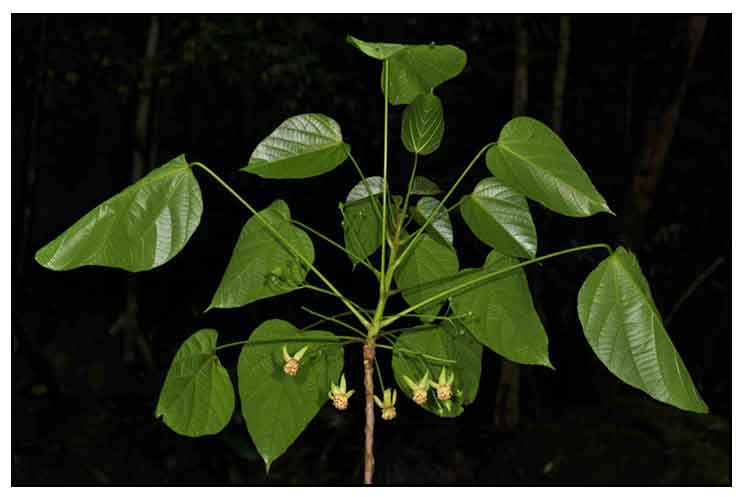
• Pañgi is a large, widely spreading tree reaching a height of 25 meters. Leaves are very large, smooth, leathery, broadly ovate or rounded, about 20 centimeters long, with pointed tip and heart-shaped base. Petioles are as long as the leaves. Flowers are yellowish-green or whitish, having a faint odor, about 4 centimeters across. Fruit is pendant upon thick, brown stalks, ovoidly rounded, 10 to 20 centimeters in diameter, brown and rough, containing seeds which are 3 to 5 centimeters across, compressed, somewhat angular, embedded in a yellowish, sweet, aromatic and edible pulp.
• The Pangium edule Reinw. (1828) is an up to about 40 m tall tree, in the oldest specimens in the wild, with trunk, up to 1 m of diameter, with grey brown bark, slightly fissured longitudinally, and dense pyramidal crown. The leaves, on a 15 cm long petiole, are spirally arranged, cordate-ovate or subrounded with pointed apex and entire margin, 15-40 cm long and 10-25 cm broad, of glossy intense green color. The species is polygamous-dioecious, with male and female inflorescences on different individuals, but with male inflorescences that may have one or two hermaphroditic flowers. The male flowers are united in axillary racemes with calyx formed by 2-3 concave sepals, coriaceous and covered by a reddish down, corolla with 5-7 oblong-ovate petals, about 2 cm long, of greenish color, and 20-25 stamina. Female flowers, on 7-8 cm long peduncle, usually solitary, axillary, almost equal to the male ones, but with sterile stamina. The fruits are indehiscent ovoid to pyriform capsules, 15-28 cm long, covered by a thick brown down containing several almost ovoid seeds, about 5 cm long and of 2,5 cm of diameter, covered by a fleshy white cream aril, highly poisonous. (Monaco Nature Encyclopedia) (33)
Distribution
- Native to the Philippines.
-
In primary and secondary forests at low and medium altitudes in Camarines and Sorsogon Provinces in Luzon, and in Palawan, Samar, Leyte, Panay, Negros and Mindanao.
- Also occurs in the Malay Peninsula and Archipelago.
Constituents
 - Leaves yield a cyanogenetic glycoside, gynocardine, identical to that found in Gynocardia odorata. - Leaves yield a cyanogenetic glycoside, gynocardine, identical to that found in Gynocardia odorata.
- An emulsion-like enzyme, gynocardase, has been identified with the glucoside.
- Kernel oil yields palmitic and oleic acids, and an optically active oil, either hydnocarpic or chaulmoogric, or both.
- Study of picung kernel oil yielded30.26±0.06% water, 8.37±0.05% protein, 8.91±0.08% fat, 36.88±0.08% crude fiber, and 14.50 ±0.10% carbohydrate. (11)
- Study for fatty acids yielded lauric, myristic, myristoleic, palmitic, palmitoleic, stearic, oleic, linoleic, linolenic, arachidic, erucic, and lignoceric acids. Linoleic and oleic acids are major fatty acids accounting for 40.79±0.76% and 38.31±1.28%, respectively.
(11)
- Roots and fruits yield alkaloids, flavonoids, steroids, and triterpenes. (15)
- Phytochemical screening of fruit flesh yielded alkaloids, flavonoids, saponins, tannins, steroids, and triterpenoids. (see study below) (25)
Properties
- Kernel is considered poisonous.
- Plant considered anthelmintic.
- Seeds, fruit, leaves and bark possess narcotic properties, in excessive amounts may cause sleepiness, headache, intoxication, delirium or even death.
- Studies have suggested antibacterial, antifungal, antioxidant, biodiesel potential, molluscicidal, anti-HIV, wound healing, MAO inhibitory properties.
 Toxicity Toxicity
- Most medicinal and poisonous applications of P. edule are due to the presence of hydrocyanic acid in all parts of the plant (seeds, fruits, bark, and roots). (13)
- Various ways are reported to leach buah keluak of poison. Fruit is left to ripen until the flesh falls off and the seeds are then removed. Seeds are crushed, boiled, and put on running water for a day. After a second boiling, they are reported ready for consumption. (10)
-
A method of reducing hydrocyanic acid toxicity is by the fermentation method: boiled seeds are buried with ash in a pit, the seeds slowly fermenting over 40 days, reducing toxicity. (10)
- The poisonous component can be deactivated by extensive washing, soaking, roasting, or fermenting. (13)
- Ingestion of improperly prepared or unripe seeds can cause vomiting, abdominal swelling, contraction of the tongue, and death. (10)
Parts used
Seeds, leaves, roots, bark.
Uses
Edibility
- Toxicity: Fresh fruit and seeds contain hydrogen cyanide, thus deadly poisonous if consumed without proper preparation. Seeds are first boiled, then buried in ash, banana leaves and earth for 40 days, during which time they turn from creamy white color to dark brown or black. The hydrogen cyanide is released by boiling, fermentation is water soluble and easily washed out. (See toxicity above)
- Pulp surrounding the seed is eaten in some parts of the Philippines. However, there are reports that it causes headaches. Pulp surrounding the seed is eaten in some parts of the Philippines. However, there are reports that it causes headaches.
- Although the kernel is considered poisonous, it is rendered edible by steeping or roasting.
- In Java, the oil is edible after prolonged boiling.
- In Kosrae, although considered poisonous, carefully washed and cooked older leaves, fruits, and seeds can be eaten. (3)
- Young leaves used as vegetable by the Minahasa tribe in North Sulawesi. (18) (24)
- In Singapore and Malaysia, seeds are essential ingredient in ayam (chicken) or babi (pork) buah keluak, a mainstay of Peranakan cuisine.
(22)
- In Indonesia, used as spice for dishes such as rawon and gabus pucung, while also providing a natural dark-brown food color. (29)
Folkloric
- In the Philippines, all parts of the plant are considered anthelmintic.
- Seeds, fruits, leaves, and bark considered narcotic, and in excessive doses causes sleepiness, headache, intoxication, delirium, and occasionally fatal
-
Freshly crushed seeds applied by Malays to boils.
 - Leaves have anthelmintic action. - Leaves have anthelmintic action.
- Fresh leaves, leaf sap, pounded leaves or ground fresh seeds are externally applied as antiseptic or disinfectant to cleanse ulcerations, infested wounds, and to treat scurf. Used as insecticide against head lice and ticks or as insect repellent.(13)
- In Papua New Guinea, juice from sliced fruit applied to sores and cuts. (13) Fluid from moist scraped bark is applied to tropical ulcers.
(16)
- In North Minahasa, Indonesia, root decoction drunk for hypertension, shortness of breath, renal and liver diseases. (15)
- In Central Sumatra,the Sarolangun community has used the plant for treatment of Kuro fever, toothache, wounds, itches, scabies, and for massage.
Others
- Oil: Oil used as illuminant and for making soap. Oil from fresh or cooked kernels can be used as substitute for coconut oil in cooking. (13)
- Fish poison: In the Camarines, plant is used as a fish poison.
- Poison: In Pohnpie, poisonous seeds used as bait to kill rats. (3) Fresh seeds and oil used as dart poison by Sakais. (•) The Sarolangun community of central Sumatra used the plant as poison for catching fish, head lice control, and golden snail control. (32)
- Fish preservative: Seed used as antimicrobial for ketchup products. Meat of Picung seeds mixed with salt used to preserve fresh mackerel for 6 days without changing quality. (8)
- Spice constituent: After elaborate preparation, the mature seeds are sold as 'kluwak', a condiment for bumbu rawon', an Indonesian mixture of spices ad condiments. (13)
- Agroforestry: Planted on steep slopes to prevent erosion and preserve integrity of surrounding areas. Provides an expansive canopy to shield main crops. The poisonous nature believed to be a defense against infiltrating garden pests.
Studies
• Antioxidant / Antibacterial / Seed: Study evaluated phenolic and alkaloid extracts of Pangium edule seed for antioxidative and antibacterial activities. The acetone extract with higher phenolic content (22.22 ± 0.05 mg GAE g) showed most potent antioxidative activity in both DPPH radical scavenging and ß-carotene bleaching assays. The phenolic extract-showed stronger inhibitory activity against L. monocytogenes than S. typhimurium. Results showed a significant correlation between the total phenolic content and its antioxidative and antibacterial activity suggesting that phenolics of the seed extract could be potential natural antioxidant and antibacterial sources. (1)
• Antioxidant / Seed: Study evaluated the effect of seed extracts along with synthetic antioxidant (BHT) on the oxidative stability of cooked ground turkey stored for 7 and 17 days. Assessing lipid peroxidation using TBARS, CD and peroxide values vis-a-vis refrigeration storage, results showed significantly reduced lipid oxidation and exhibited significant activity comparable to BHT at 200ppm. (4)
• Tocopherols / Antioxidant Compounds / Seed: Tocopherols are the most powerful antioxidant among the vitamin E group. Study evaluated the tocopherols content in seeds of Pangium edule. Study detected high antioxidant activity suggesting the presence of other antioxidants in the seeds besides tocopherols. (5)
• Antibacterial / Fermented Seeds / Food-borne Pathogens: Study evaluated the antibacterial activity of fermented P. edule seed extract against several food-borne pathogens, i.e., E. coli, Listeria monocytogenes, P. mirabilis and S. aureus. Results showed potent activity against some food-borne pathogens and a potential application as a natural food preservative. (6)
• Biodiesel Potential / Seed Oil: Study evaluated kepayang seed oil for biodiesel characteristics, i.e., viscosity, density, acid number, Iod number, soup number, gliserol number, and ester content. Results showed kepayang biodiesel can be used for diesel engine as substitute for petrol diesel. (7) Study reported on the biodiesel production from P. edule seed oil using a two-step acid-base-catalyzed trans-esterification. Seed was found to have an acid value of 19.62 mg/KOH/g oil. Remarkable features are its cloud, pour and cold filter plugging points. Results suggest the viability of using the biodiesel in cold countries. (9)
• Food Preservative: Study evaluated the effectiveness of Picung (Pangium edule) from two geographical sites in preserving Macerel (Rastrellinger sp). Results showed no difference in cyanide acid content and no difference in preserving food between picung from the two different sites. There might be some difference in influences of the recipe and prolonged preservation time. (8)
• Molluscicidal / Seeds: Study evaluated root extracts from Derris elliptica and Pangium edule for molluscicidal activities against 3-month old Golden Apple c snails Pomacea canaliculata. Results showed both extracts of D. elliptica roots and P. edule seeds showed potency as botanical molluscicides. (12)
• Invention / P. edule and Lignanes as Cathepsin Inhibitor / Antinecrotic Effect: The invention relates to extracts of P. edule seeds and lignanes of formula I, for use as medicament to inhibit cathepsins or for its antinecrotic effect. (14)
• MMP-9 Inhibition / Wound Healing Effect: A feature of chronic wound environment is fibroblasts that exhibit premature senescence phenotype. Fibroblasts as essential for collagen deposition. Plants that stimulate fibroblast growth may help stimulate wound healing. Pangium edule induced a dose response at concentrations of 0.05 up to 5% v/v. and also inhibited MMP-9 (matrix metalloproteinase 9) for potential dual action effect. (16)
• Anti-HIV Activity / Leaves: Study compared the anti-HIV activity of P. edule fruit with LoveHerbal from Golobe halmehera fruit, alone or in combination for inhibition of growth of HIV virus inside the T cell with CD4 in its surface. The inhibition of pangi leaf was 2.19 times larger than that of LoveHerbal medicine. Activity was attributed to strong alkaline function associated with at least four compounds viz. octadecanoic acid (24.6%), squalene (21.22%), hexadecanoic acid (15.08%), and phytol (10.33%). (17)
• HIV-1 Protease Inhibitor / Leaves: In an invtiro study, pangi leaf extract suppressed the replication of the HIV inside CD4 helper T cells. This study sough to determine the compounds extracted from leaves and their potential for targeted compounds against HIV-1 protease inhibitors (PIs)using in-silico approach. GC-MS analysis of an n-hexane extract yielded 53 (compounds. The docking study revealed that (5.beta.) pregnane-3,20.beta.diol. 14.alpha.,18.alpha.-[4=methyl-3-oxo-(1-oxa-4-azabutane-1,4-diyl)]-diacetate showed most binding ability against HIV1 PIs. Results suggest the compound has potential as an HIV1 protease inhibitor and may serve as a potent anti-HIV lead compound. (18)
• Antifungal / Inhibition of Aspergillus flavus / Aflatoxin / Seed: Aspergillus flavus produces aflatoxins, a toxic and carcinogenic chemical compound in nature, a concern of corn consumers. Study evaluated the antifungal activity of P. edule seed extracts against fungus A. flavus. Higher concentrations showed suppression of both mycelial growth and emerging new colony. Concentration of 15% effectively and consistently inhibited A. flavus. (19)
• Activated Carbon from Kluwak Shell: Material which contains carbon and have porous structure can be used as raw material for activated carbon such as coconut shell and agricultural waste like seed and hay. Study reports on the characterization of activated charcoal from kluwak shells. Commercial activated carbon was used as standard. Activated carbon activated by steaming more than 120 minutes with or without treatment with NaOH have high absorptive capacity toward benzene, chloroform, formaldehyde and carbon tetrachloride. Pore size of keluwak shell activated charcoal have a pore size more than 0.025 micrometer. (20)
• Inhibition of Monoamine Oxidase: Study evaluated monoamine inhibitory activity of EtOAc and water soluble portions of MeOH extracts of 24 medicinal plants from Southeast Asia using a MAO inhibitory assay. Five plants, including Pangium edule, showed potent inhibitory activity against rat brain mitochondrial MAO. (21)
• Antibacterial / Antioxidant / Fruit: Study evaluated extract and fractionate of flesh of Pangi fruit for secondary metabolites, total phenolic content (TPC)and antioxidant and antibacterial activity. Ethyl acetate fraction (EAF) showed highest TPC of 31.86 mg/g, followed by ethanol extract 8.9 mg/g. EAF also showed highest antioxidant activity with IC50 of 14.7 mg/mL. All extracts showed weak antibacterial activity. (see constituents above) (25)
• Village-Level Processing of Seeds / Effect on Edibility and Nutritional Factors: Seeds are known to be poisonous, but becomes safe for consumption after processing. Study evaluated reports on effect of processing by the Obu-Manuvu community of Marilog in Davao on antinutrient and nutritional composition of seeds. Processing involved washing with running water for about 15 sec, boiling in water for 30 min, and soaking in flowing river water overnight. Results showed significant (p<0.05) decrease in levels of antinutrients such as cyanogenic glycosides and oxalates by 99.15% and 78.23%, respectively. Tannin content was also decreased by 96.15%. Crude fat was significantly increased, crude ash and fiber decreased, with no significant change in protein. Minerals calcium and zinc increased while iron and manganese were unaffected. Results suggest the Obu Manuvu method of processing effectively reduced levels of antinutrients, improving edibility and safe. (26)
• Anti-SARS-CoV-2 / Molecular Docking Study / Leaves: Study evaluated the potential of phyto-chemical compounds in leaves of pangi as anti-SARS-CoV-2 using molecular docking study. Results suggest pangi leaves contain three compounds with remarkable binding affinities with Mpro (main protease) and RBD (receptor binding domain): (5.beta.) pregnane-3,20.beta.-diol, 14.alpha.,18.alpha.-[4-methyl-3-oxo-(1-oxa-4-azabutane-1,4-diyl)]-, diacetate (PD), ethyl cholate (EC), and bis(3,5,5-trimethylhexyl) phthalate. EC is metabolized in the body into cholic acid (Cho). The compound has best free binding energy with SAR-CoV-2. Study showed Cho showed good anti-SARS-CoV-2 activity. Its potential to inhibit the virus can serve as starting point in developing COVID-19 therapeutic natural medicine. (27)
• Effect on Lamb Meat Shelf-Life / Fruit seed: Kepayang fruit seeds have been used as natural preservative to replace formaldehyde in fish preservation. Study evaluated the effect of adding kepayang fruit seed extract on organoleptic characteristics, drip loss and meat rot at different shelf life of lamb meat. Results showed extract did not significantly affect water content, meat rot, and drip loss. Use of kepayang seed extract % to 9% is recommended to inhibit spoilage for 36 hours and reduce the characteristic odor of lamb meat. (28)
• Effect of Duration and Depth of Burying on Cyanide Reduction: While pangi can be used as food spice, it contains cyanide, a potent toxin when consumed. Study evaluated the correlation between depth and time of burying on the reduction of cyanide levels. Cyanide reduction involves boiling, depth and duration of burying. Fruits were buried at depths of 15, 30, and 45 cm for 20, 40, and 60 days. Results showed depth of 45 cm for 60 days resulted in the greatest reduction in cyanide levels (up to 95%). However, visually,a 30 cm depth for 60 days yielded best results of a dark brown to concentrated black color. At 45 cm and 60 days, color only reached the level of brown red. (29)
• Antifungal Against Aspergillus flavus / Seeds: Study evaluated the antifungal activity and active compounds of water extract of old and fermented seed of P. edule against A. flavus. Crude extracts yielded alkaloid, saponin, phenolic compound, flavonoid, triterpenoid, and glycoside. The water extract showed best activity to suppress growth of A. flavus, with MIC of 12.5 and 25 mg/ml for old and fermented seed, respectively. Water extract showed moderate toxicity with LC50 of 100-500 µg/mL by brine shrimp toxicity test. Fraction with MW <3kDa showed best antifungal activity with MIC of 6.25 and 12.5 mg/mL for old and fermented seed, respectively. The antifungal activity was attributed to presence of fatty acid and glycoside. (30)
• Effect on Burn Wound Healing / Leaves: Study evaluated the effect of ethanol extract of Pangi leaves on healing of second-degree burns using white Wistar rats. Silver sulfadiazine ointment was used as positive control. Concentrations of 2.5% and 5% ethanol extract of leaves were used. Results showed the leaf extracts accelerated the healing process of second-degree burns in white Wistar rats. A 5% Pangi leaf extract was more effective than 2.5% concentration. Results suggest a potential active natural ingredient for the treatment of burns. (31)
Availability
Wild-crafted.
|