 Gen info Gen info
- Clerodendrum is a genus of flowering plants in the Lamiaceae family. It is a member of the subfamily Ajugoideae, one of four subfamilies transferred from Verbenaceae to Lamiaceae based on morphological and molecular phylogenetics.
- Clerodendrum was named by Linnaeus in Species Plantarum in 1753.
- Etymology: Clerodendrum derives from two Greek words, kleros, meaning "chance of fate" or "clergy", and dendron, "a tree". It refers to its considerable variation in usefulness, or to its use for religious purposes in Asia. (23)
- Clerodendrum L. is
widely distributed in the tropical and subtropical regions of the world,
with more the 500 species identified, with ethnomedical use in many
indigenous systems (Indian, Korean, Japanese, Thai, Chinese) for a variety
of disease: syphilis, typhoid, cancer, jaundice and hypertension.
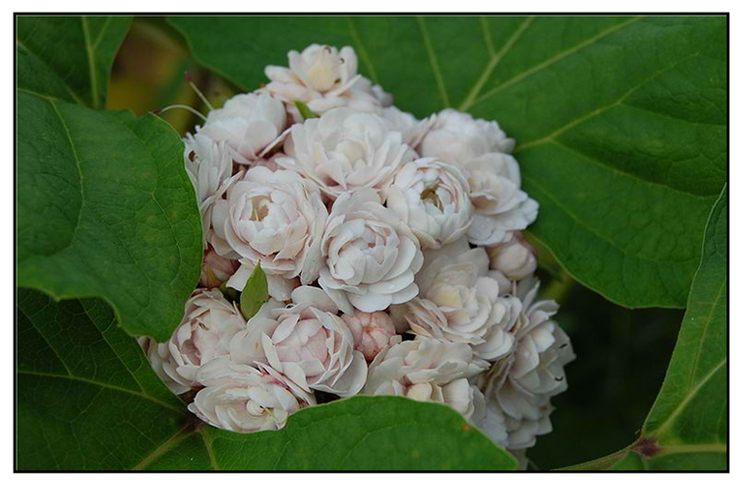
- Clerodendrum chinense, glory bower, is a species of flowering plant in the genus Clerodendrum, widely introduced to the rest of the world. It has gained the Royal Horticultural Society's Award Garden of Merit. (22)
 Botany Botany
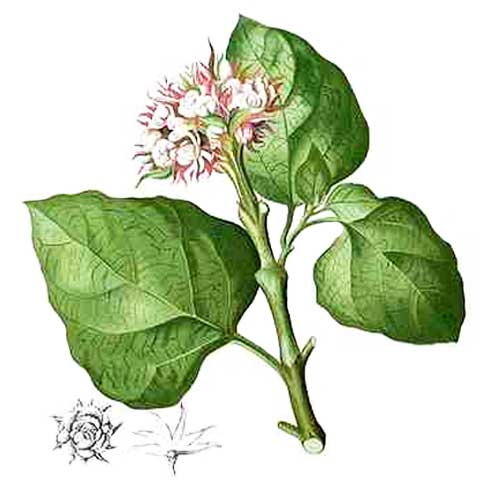
• Pelegrina is an erect, branched, somewhat hairy shrub,
1 to 2 meters in height. Leaves are broadly ovate, up to 25 centimeters long,
pointed at the tip and blunt at the base. The inflorescences (cymes)
are short-stalked and terminal, 6 to 12 centimeters in diameter, densely crowded
with flowers. Flowers are fragrant, in stalks 1 to 2 centimeters long. The
calyx-tube is rather slender below and enlarged above, with five to
six lanceolate lobes which are reddish-purple and about 1.5 centimeters long.
Corolla is white, 3 to 3.5 centimeters in diameter and 1 to 1.5 centimeters long in the
tube.
• Growth form: Perennial shrub, able to grow up to about 2.5 - 3 m tall. Foliage: Leaves simple and opposite arrangement, broadly ovate in shape, measuring about 6 - 25 cm long and 5 - 25 cm wide. Flowers: White to whitish pink fragrant flowers in a cyme inflorescence found in terminal positions, calyx usually purple or red and measures about 10 - 15 mm long. (Flora & Fauna Web)
Distribution
- Native to the Philippines. (13)
- Co's Digital Flora Database lists it as: Cultivated, not naturalized.
(27)
- Also native to Andaman Is., Assam, Bolivia, Cambodia, China, East Himalaya, Jawa, Malaya, Maluku, Myanmar, Nepal, Nicobar Is., Sulawesi, Sumatera, Thailand, Vietnam. (13)
.
- Widespread through the tropics as a widely cultivated ornamental.
- Often escapes ornamental cultivation.
- A highly invasive weed in some tropical and subtropical ecosystems.
- Rapidly invades pastures and plantations wherever planted forming dense thickets that exclude other species.
(2)
 Constituents Constituents
- Yields (24S)-ethylcholestra-5, 22,25-triene-3ß-ol.
- Petroleum ether extracts yielded steroids - clerosterol and deucosterol.
- Yields phenolic compounds acetoside, leucosceptoside A, isoacteoside, methyl and ethyl esters of caffeic acid, jinoside.
- Leaves yield flavonoids, kaempferol.
- Aerial parts yielded a new iridoid diglucoside, 5-O-ß-glycopyranosyl-harpagide with three known iridoid glucosides and six known cyclohexylethanoids.
- Study isolated two minor sterols: 24β-methylcholesta-5,22E,25-trien-3β-ol and 24α-ethyl-5α-cholest-22E-en-3β-ol. (8)
- Study of leaves for volatile oils by GC-MS analysis yielded 31 compounds. Five main compounds were 1-octen-3-ol (49.50%), (E)-3-hexen-1-ol(13.39%), linalool (9.41%), cyclohexanol (3.37%), 3-octanol (1.69%), n-valeridc acid-cis-3-hexenyl ester (1.42%), 1-hexanol (1.38%),furfural (1.37%) and α-terpineol (1.17%),accounting for 81.53% of the total volatile oils. (15)
- Fractions of a methanol extract of air-dried leaves yielded
verbascoside, isoverbascoside, decaffeoylverbascoside, hispidulin, lupeol and icariside B5, together with cornoside and rengyolne. (see study below) (16)
- Study isolated verbascoside, isoverbascoside, decaffeoylverbascoside, hispidulin, lupeol, and icarisde BS from the leaves of C. chinense for the first time, along with cornoside and rengyoloone. (see study below) (17)
- Study for secondary metabolites yielded three new compounds i.e.,
the steroid (22<i>E</i>, 24<i>S</i>)-stigmasta-4, 22, 25-trien-3-one (1), the flavone glycoside 7, 8, 4'-trihydroxyflavone-6-<i>O</i>- beta -D-glucuronopyranoside (2) and the epimeric <i>neo</i>-clerodane 14, 15-dihydro-15 xi -hydroxyclerodendrin A (3). (20)
Properties
- Butterfly attracting.
-
Flowers are very fragrant in the evening.
-
Considered diuretic, febrifuge.
- Studies have suggested anti-leukemic, anti-inflammatory, antipyretic, analgesic, antidiabetic, antitrypanosomal, antibacterial, antiplasmodial, mosquitocidal, diuretic, antihypertensive, anticancer, apoptotic, antiproliferative properties.
Parts utilized
- Leaves, flowers, roots, stems.
 Uses Uses
Edibility
- In China, young leaves used as potherb.
Folkloric
- The Malays use the plant externally as a poultice, for rheumatism and ague; or
mixed with other substances, for skin ailments.
- In the Guianas, decoction of leaves used for scabies.
- In Thailand and Malaysia, leaves used for rheumatism and ague. Root used as diuretic.
- Roots and leaves used for asthma, rheumatism, and inflammatory conditions.
- Root decoction used for jaundice.
Root decoction used externally as antiseptic. Decoction of leaves used for blenorrhea. Leaves used as diuretic and antiblenorrhagic. (16)
- In Surinam, leaf decoction used for scabies.
(11)
- In China, dried roots cooked with pork as treatment to strengthen elderly people and to relieve pain and stiffness of muscles and joints. (21)
Studies
• Phytochemicals: Study yielded beta-sitosterol, clerosterol, daucosterol, caffeic acid,
kaempferol, 5,4'-dihydroxy-kaempferol-7-O-beta-rutinoside, acteoside
and leucoseceptoside A. (1)
• Anti-Leukemic: Study showed promyelocytic cell line HL-60 could be induced to differentiate into morphologically and functionally mature monocytoid cells (up to 20%) after dose-dependent exposure to Clerodendron fragrans working in synergism with interferon-r. Results suggest a potential therapeutic value for the treatment of certain acute myelocytic leukemia. (3)
• Anti-Inflammatory / Leaves: Study evaluated an aqueous extract of leaves for anti-inflammatory activity using carrageenan, formaldehyde, histamine and egg white induced rat paw edema and cotton pellet-induced granuloma models in rats. Results showed pronounced anti-inflammatory activity at doses investigated. (4)
• Antibacterial Potential / Leaves: Study evaluating crude ethanolic leaves extracts for antibacterial activity showed effective growth inhibition of E. coli, S. aureus, and Klebsiella. (10)
• Silver Nanoparticles / Mosquitocidal / Leaves: Study reports on the eco-friendly biosynthesis of silver nanoparticles using a leaf extract of C. chinense. It showed potential against larval populations of mosquito vectors, with negligible toxicity against non-target aquatic organisms. (14)
• Analgesic / Anti-Inflammatory / Antipyretic / Leaves: Methanol extract of leaves of C. chinense and verbacoside showed significant analgesic, anti-inflammatory and antipyretic effects. (see constituents above) (15)
• Verbascoside / Analgesic, Anti-Inflammatory, Antipyretic / Leaves: A methanol extract and verbascoside isolated from the leaves showed significant analgesic, anti-inflammatory, and antipyretic effects using carrageenan induced rat paw edema, yeast induced hyperthermia and electric current anxious stimulation models. (see constituents above) (17)
• Antimicrobial / Antiplasmodial / Anti-Trypanosomal / Stems and Flowers: Study screened chloroformic and methanolic extracts of four Clerodendrum species cultivated in Egypt for antimmicrobial activities. Chloroformic extract (CE) of flowers showed activity against Plasmodium falcifarum (IC50 < 10 µg/mL); CE extracts of stems, flower, and leaves showed activity against Trypanosoma cruzi (IC50 1.21, 1.12, and 3.39 µg/mL, respectively) with marginal cytotoxicity. Verbanoside, a phenyl propanoid glycoside from leaves of C. chinense showed marginal activity against T. cruzi. (18)
• Antidiabetic / Leaves: Study evaluated the antidiabetic activity of various extracts of C. philiippinum leaves in STZ-induced diabetic rats. Results showed significant reduction of blood glucose. A methanol extract showed maximum blood glucose lowering potential compared to other extracts. (19)
• Nanoparticle / Anticancer / Stems: Study evaluated the anticancer activities of C. chinense stem ethanolic extract. High-performance liquid chromatography (HPLC) analysis identified verbacoside and isoverbacoside as major bioactive compounds in the stem extract. Total phenol and flavonoid contents in the NPs were 88.62 and 95.26%, respectively, The stem extract demonstrated dose-dependent inhibitory effect on MCF-7, HeLa, A549, and SKOV-3 cancer cell lines with IC50s of 109.2, 155.6, 206.0, and 423 µg/mL, respectively. The extract and NPs exhibited dose-dependent cytotoxicity and the highest selectivity index values against MCF-7 cells, with dose-dependent reduction in colony formation of MCF-7 cells The extract induced cytotoxicity in MCF-7 cells through apoptosis and necrosis. Extract and NPs decreased mitochondrial membrane potential (MMP) and induced G0/G1 phase arrest in MCF-7 cells. Results suggest potential therapeutic approach for breast cancer therapy. (24)
• Inhibition of A549 Cancer Migration and Apoptosis Induction / Antioxidant / Leaves: Study evaluated the antioxidant and anticancer activities of C. chinense leaf ethanolic extract. HPLC of phenylethanoid glycoside-enriched extract yielded verbascoside and isoverbascoside. Extract showed DPPH and ABTS free radical scavenging activities with IC50s of 334.2 and 1012.77 µg/mL, and FRAP of 88.73 to 2480.81 µM. The leaf extract exhibited antiproliferative activity against A549 lung cancer cells in a dose- and time-dependent manner. The antiproliferative effect against A549 lung cancer cells were attributed to hispidulin and verbascoside. Lung cancer cell colony formation was significantly inhibited by extract treatment in a dose-dependent manner. Leaf extract dose of 250 µg/mL significantly inhibited cancer cell migration. Results suggest anti-lung cancer potentials of the leaf extract. (25)
• Diuretic / Antihypertensive / Leaf, Root, Stem: Study evaluated a mixed leaf, root, and stem aqueous extract for antihypertensive and diuretic activity in Sodium Chloride diet-induced hypertensive rats. Extract doses of 100, 200, and 300 mg/kg were compared with furosemide. Results showed significant (p<0.001) effect. Dose of 100 mg/kg demonstrated best systolic and diastolic pressure lowering. The lowest dose of 100 mg showed high diuretic action, quantitatively similar to standard drug. (26)
• Rapid Antihypertensive Effects: Prevention and quick management of hypertension is essential in reducing risk of debilitating ailments and complications. Aqueous (AeC) and ethanolic (EeC) extracts of leaves of C. chinensis are used by local communities of West Africa for rapid anti-hypertensive effects. Study evaluated the anti-hypertensive effects of Aec and EeC in L-Arginine Methyl Ester Hydrochloride (L-NAME)-induced hypertensive rats. Intravenous admiinistration of the extracts at 100 mg/kg caused significant decrease in mean arterial blood pressure (MABP) in a dose-dependent manner. Both extract showed significant antihypertensive effects. Caution is advised on use of high doses, which could lead to hypotension. Further studies are need to determine safe dosage forms. (28)
• Anticancer / Antioxidant / Nanoparticles / Flowers: Study evaluated the antioxidant and anticancer activities of C. chinense flower ethanolic extract and its bioactive compounds. Nanoparticles were fabricated using a solvent displacement method. The flower extract and NPs showed significant free radical scavenging activities and ferric-reducing power. Total phenolic and total flavonooid contents of the extract and NPs significantly correlated with antioxidant activity. The flower extract exhibited antiproliferative activity against A549, MCF-7 and HeLa cells. Growth inhibition of HeLa cells mediated by extract and NPs appears associated with apoptosis, ROS formation, and cell cycle arrest. (29)
Availability
- Wildcrafted.
- Ornamental cultivation.
- Invasive. |