 Gen info Gen info
- Cycas is a genus of cycad, the single
genus of the family Cycadaceae, consists of about 100 species, chiefly
Indo-Chinese (40) and Australian (27). Cycads vary in size from trunks only a few centimeters to several meters tall. Slow in growth, cycads live long, some species known to last about 1,000 years.
- As of April 2024, the largest number of currently accepted species of cycas in Asia are found in Vietnam (27 species), China (23 species), India (14 species), Philippinees (12 species), Thailand (12 species), and Indonesia (10 species.) (12)
- The majority of Cycas species are highly endangered. Many are threatened by illegal trade of wild collected plants for plant collectors, and through conversion of land for urban development or agricultural use. (12)
- Etymology: Queen sago alludes to the name "king sago" given to the related Cycas revoluta, and to its use as source of edible starch. The specific epithet rumphii honors the German-born Dutch naturalist Georg Eberhard Rumphius (1628-1702), who served first as military officer with the Dutch East India Company in Ambon. (12)
- Sometimes called "Queen sago palm". Although palm-like in appearance, it is not a palm. (9)
Botany
• Cycas rumphii is commonly confused
with Cycas revoluta, but pitogo is a much larger plant, with larger
leaves and smooth and glabrous ovules. Trunk is stout and woody, growing to
a height of 12 meters, 20 to 50 centimeters in diameter, with a round and symmetrical
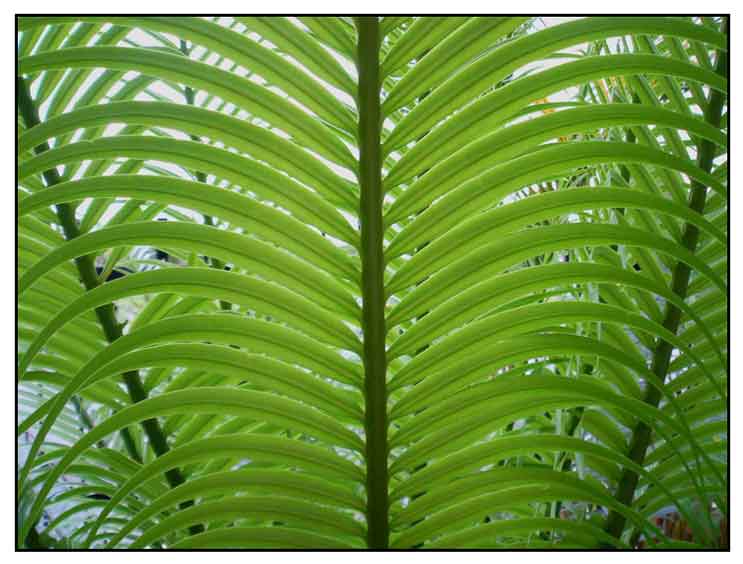
crown of large, hard, stiff, evergreen leaves. Leaves are 1.5 to 2.5 meters long, crowded at the apex of the
trunk, leaflets are 20 to 30 centimeters long, about 1 centimeter wide, smooth and shining,
falcate, 45 to 90 on each side of the midrib. Male cones are terminal,
elongated-cylindric or ovoid-cylindric. Leaves are numerous, about
30 centimeters long and densely rusty-tomentose. Fruit is smooth, ovoid to ellipsoid,
3 to 5 centimeters long.
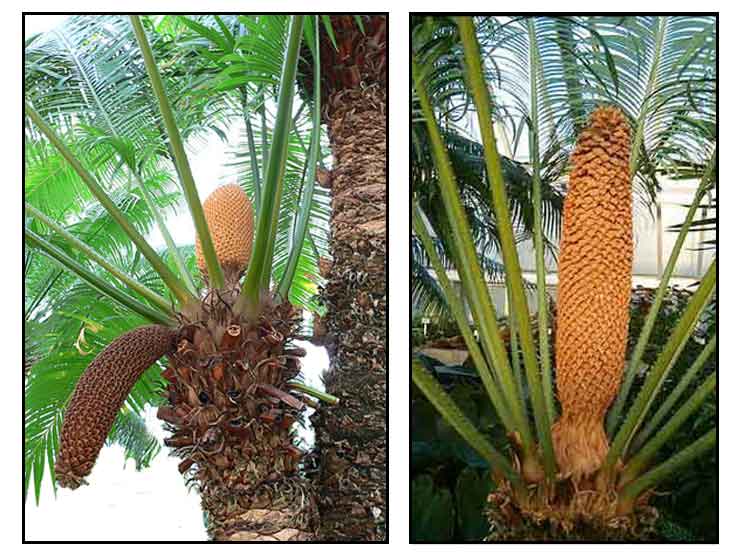
• The cycad is a small tree, growing to about 10 m (33 ft) in height, with a trunk diameter of up to 40 cm (16 in). The bark is gray and distinctively fissured into rectangular, or diamond-shaped, segments. Leaves grow from the crown – bright green, glossy, palm-like fronds, 1.5–2.5 m (4.9–8.2 ft) long, with 150–200 leaflets on each frond. Spiny petiole is 35–60 cm (14–24 in) long. The male plant's strobilus or cone, is oblong-ellipsoidal, 30–60 cm (12–24 in) long, orange in color and foetid in odor. Female's megasporophylls are about 30 cm long, fleshy, brown and densely hairy, with the fertile area about 35 mm (1.4 in) wide. The seeds are 45 mm long and 30 mm wide, ripening from green to an orange- or reddish-brown color.
Distribution
- From Batanes Islands and northern Luzon to Palawan and Mindanao, chiefly along or near the seashore.
- Occasional growths in forests.
- Commonly cultivated in the Philippines as an ornamental plant.
- Native to Borneo, Christmas I., Jawa, Lesser Sunda Is., Maluku, New Guinea, Sulawesi, Western Australia. (9)
Constituents
- Toxicity from a
glucoside in the seeds, with phytosterine.
- The plant yields a resin that is used medicinally in India.
- Yields a gum resembling tragacanth.
Properties
- Male bracts believed to be narcotic, stimulant and aphrodisiac.
- Considered vulnerary.
- Studies have shown antibacterial, aromatase inhibitory, toxoplasmocidal, anticancer properties.
Parts used
Fruit, seeds.
 Uses Uses
Edibility / Nutritional
- Ripe seeds are used
as food in times of famine, especially in the Batanes Islands. Likewise, in Guam, the cycas seeds are a staple article of food in times of scarcity.
-
The untreated seeds may be poisonous. Seed contain a toxic glucoside, pakoein, which can be treated to become edible by pounding, repeated washing, and cooking. (9)
- In Malabar, the starch from the trunk and seed is considered superior to Caryota
flour but inferior to rice flour, and eaten by the hill tribes and when rice becomes scarce.
- Seeds also reportedly eaten in India, the Andaman, in the Malay Peninsula, and the Dutch Indies.
- In India, a kind of sago is prepared from the starch stored in the trunk.
- In some parts of the Philippines, the young leaves (still rolled up)
are cooked and eaten as vegetable.
Folkloric
- In the Philippines, powdered roasted whole seed is mixed with coconut oil and applied
to wounds, boils, itchy skin lesions.
- In India, resin is used for malignant
ulcers, facilitating suppuration.
- Male bracts used are a narcotic, stimulant and aphrodisiac.
- Poultice of fruit-bearing cone is applied to loins for nephritic pains.
- Tincture from pericarp of seed and bark or poultice of bark and seeds used for sores and edematous swellings.
- Seeds are used for dizziness, headaches, and sore throats.
- Poultice of bark used for swellings.
- In Dutch East Indies, juice of young mucilaginous leaves used for flatulence and vomiting
of blood.
- In Bangladesh, used for gynecological disorders, sore throat, tuberculosis, pain.
- In India, male cones and pollen of C. rumphii are considered strongly narcotic and sold as anodyne in bazaars. Female cones are made into poultice and applied to nephritic pains. (10)
- In India, tribal people of the Nicobar Islands use the plant topically for fever. (11)
- Traditional medical practitioners of Porabari Village in Dhaka district of Bangladesh apply poultice of misture of crushed leaves of Cycas rumphii and Coccinia grandis for headache, and painful areas of body pain, twice daily for 7 days. (14)
- Nicobarese people of Andaman and Nicobar Islands used the plant to treat fever. In Bangladesh, folk medicinal practitioners use root tops used to treat debility. Bede community use leaves to treat headache and severe body pain. In India, root paste is taken orally with fruits of Capsicum frutescens by snake-bitten patients. (15)
Others
- Rituals: Leaves used in religious
ceremonies. (•) Called Namwele in the Kastom culture of Pentecost, Vanuatu, the plant is sacred, a symbol of peace and status. (9)
- Glue: Bark sap used as glue.
Studies
•
Medical Hypothesis: Cycad neurotoxins and flying foxes connect:
The high incidence of neurodegenerative diseases (ALS-PDC) among the
Chamorro people of Guam is proposed as connected to the consumption
of flying foxes high on plant neurotoxins from its foraging on neurotoxic
cycad seeds. (1)
• Cycad neurotoxins: The cycad neurotoxic amino acid, ß-N-methylamino- -alanine
(BMAA), elevates intracellular calcium levels in dissociated rat brain
cells. (2)
• Aromatase Inhibitors / Estrogen-Dependent Tumors:
In a study of tropical plants searching for inhibitors of the cytochrome P-450 aromatase which may be efficacious in treating estrogen-dependent tumors, extracts of 5 cycad folia, including Cycas rumphii, were all found to contain inhibitors of the human enzyme. (3)
• Antibacterial / Leaves: Study investigated the antibacterial potential of leaves of C. rumphii. Ethanol and methanol extracts showed maximum antibacterial activity against most of the bacteria tested. The most susceptible gram positive bacteria was S. albus while the most susceptible gram negative bacteria was S. boydii. (5)
• BMAA: (1) Cycads yields ß-methylamino-L-alanine (BMAA), which has been implicated in the in the etiology of the devastating neurodisease ALS-PDC found among the native Chamorros on Guam. (2) BMAA is potentially neurotoxic. Studies have suggested the BMAA is not produced by the cycad itself by by the cyanobacteria present in the collaroid roots. A review supports a connection between cycad exposure and the development of ALS-PDC in Guam. B-methylaminoalanine (BMAA) is found in cycad. However, analytical methods have not been adequately validated. Still, human epidemiological data suggests the amount of BMAA in processed cycad flour is not enough to be the main cause of degenerative neurological disease after consumption of cycad flour. (6)
• BMAA / ß-Carbamate / ALS-PDC: Cycad Study support the hypothesis that the neurotoxicity of BMAA is due to an excitotoxic mechanism, involving elevated intracellular calcium levels and bicarbonate. BMAA alone did not produce the increase in Ca++ levels, and results suggest an involvement of product of BMAA and CO2, namely a ß-carbamate, which may be the causative agent of ALS-PDC on Guam.
• Macrozamin / Seeds and Leaves: HPLC analysis showed macrozamin, a toxic methylazoxymethanol glycoside, to be ubiquitous in leaf and seed kernel samples of selected South African cycad species, detected at fresh levels at range of 0.026 to 0.23%. Cycas revoluta macrozamin content in this study was 0.12 ± 0.052 % for leaves and 0.11 ± 0.023 % for kernel. (also see: Oliba) (10)
• Toxoplasmocidal / Cytotoxicity Against Cancer Cell Lines / Leaves: In vitro screening evaluated various extracts Cycas rumphii leaves for toxoplasmocidal effect and cytotoxic activity against HEPG2m HGCT-116 and HeLa cancer cell lines using MTT assay. Among tested extracts the ethyl acetate fraction was most effective against T. gondii, with EC50 of 3.51 µg/ml compared to cotrimoxazole at 4.18 µg/mL, and was also most potent against tested cell lines, especially HEP^2 with IC50 of 6.98 µg/mL compared to doxorubicin at 4.50 µg/mL. Chromatographic study of the EA fraction isolated seven compounds, of which compound 7, an undescribed 4',4"biapigenin di-C-glucoside, showed strong cytotoxic activity. (13)
Availability
Wildcrafted.
|