 Gen info Gen info
- Etymology: The genus name Xylocarpus derives from Latin meaning woody, referring to the large and distinctly woody fruit and seeds of the genus.
- The common name "puzzlenut tree" derives from the irregular shape of the seeds: a puzzle can be made shuffling the seeds and attempting to reassemble them in the original spherical arrangement.
(53)
Botany
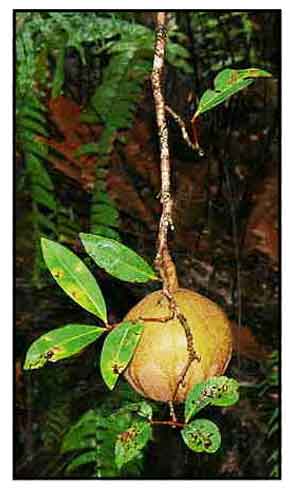
Piyagaw is a small tree growing 3 to 12
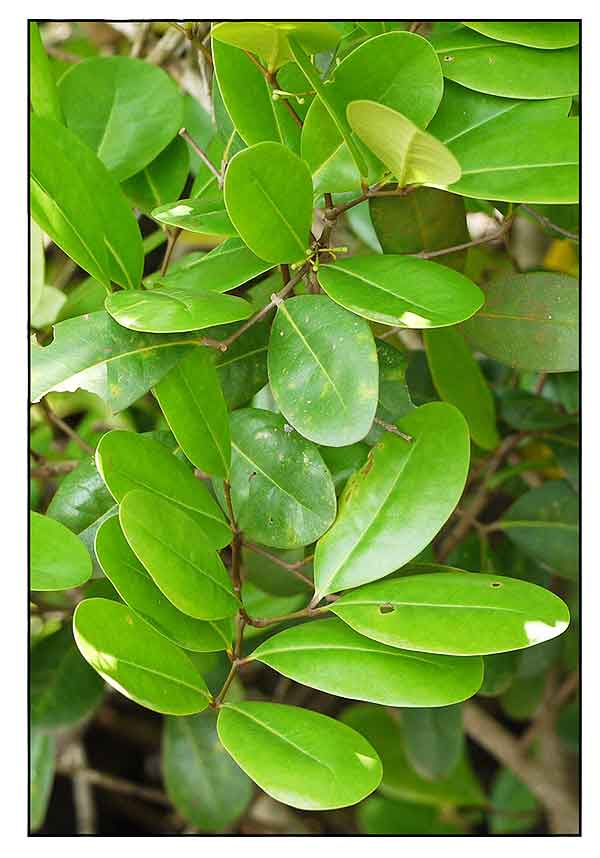
meters high. Leaves are abruptly pinnate, with pairs of leaflets which are elliptic or obovate, 8 to 18 centimeters long, 4 to 8 centimeters wide, with a pointed
base and rounded tip. Flowers are small and white, 4-parted, borne on short
terminal or axillary (upper) panicles. Fruit is spherical, 9 to 12 centimeters in
diameter, with 6 to 12 seeds. Pericarp is hard and fibrous, splitting
into 4 valves. Seeds are angled, with a spongy integument.
X. moluccensis is similar to Xylocarpus granatum (piyagaw). X. granatum has larger fruit, smooth, patchy bark, buttresses and plant-like aerial roots. X. moluccensis has a smaller fruit, with conical pneumatophores. (1)
Distribution
- Native to the Philippines.
-
Throughout the Philippines
in mangrove swamps, bordering tidal streams.
- Also native to Andaman Is., Bangladesh, Borneo, Cambodia, Caroline Is., Comoros, Fiji, Hainan, Jawa, Lesser Sunda is., Malaya, Maluku, Myanmar, New Guinea, Sri Lanka, Sulawesi, Sumatera, Thailand, Vietnam, etc.
Constituents
- Solid fat, 40-60%; tannin.
- The seeds, fruits and stems yield a large number of limonoids.
- Phytochemical exam of fruits of X. granatum isolated five new protolimonoids, protoxylocarpins A-E, and two new limonoids, xylocarpins J and K, together with xyloccensis M and Y.
(8)
- Seeds yielded 13 compounds: a new one, indiangranatumin A, together with known compounds swietemahonolide, febrifugin ,khayasin T, febrifugin A , gedunin, isolariciresinol, phaseic acid, aromadendrin, 4-hydroxy cinnamic acid, 4-hydroxybenzoic acid, 4-hydroxyphenylacetic acid,and xylogranatinin. (9)
- Methanolic extract yielded carbohydrates, saponins, tannins, and flavonoids. Alkaloids and glycosides were not found in the extract.
 - Study of seed yielded a new glyceride, 1,3-di-(16'-acetoxy-palmitoyl)-glycerol ( 1), and a known ceramide, (2 S,3 S,4 R,8 E)-2-[(2' R)-hydroxypalmitoylamino]-8-tetracosene-1,3,4-triol ( 2). (18) - Study of seed yielded a new glyceride, 1,3-di-(16'-acetoxy-palmitoyl)-glycerol ( 1), and a known ceramide, (2 S,3 S,4 R,8 E)-2-[(2' R)-hydroxypalmitoylamino]-8-tetracosene-1,3,4-triol ( 2). (18)
- Study of stem bark yielded a new flavonol derivative dihydrocaffeic acid-(3→8)-epicatechin together with two known derivatives, (+)-catechin and catechin-(4β→8)-catechin. (see study below) (19)
- Study for chemical constituents of fruit yielded ten compounds identified as: spicatin (1), xyloccensin K(2), 6-acetoxycedrodorin (3), aurantiamide acetate (4), (+)-catechin (5), alpha-tocopherol (6), abscisic acid (7), daucosterol (8), 4-hydroxybenzoic acid (9) and ethyl 3,4-dihydroxybenzoate (10). (20)
- Phytochemical screening yielded major constituents viz., alkaloids, steroids, tannins, triterpenes, limonoids, flavonoids, saponins. Various compounds isolated with known biologic activities were: 4-hydroxybenzoic acid, ethyl 3,4- dihydroxybenzoate, xylogranatinin, granatoin, N-Methyl indersine, β-Sitosterol, β -Sitosterol β -D-glucoside, Methyl angolensate, Gedunin and 1α-hydroxy-1,2-dihydrogedu., xyloccensin O, xyloccensin P , xyloccensin Q, Catechin, epicatechin, procyanidins of the B, trimer and pentamer xyloccensins O-P, xyloccensins Q-V, Xyloccensin L, xyloccensin K, xyloccensin IJ. Chelerythrine and dihydrochelerythrine. (22)
- Fruit yielded two new mexicanolides: 3-deacetyl xyloccensin M and 3-deacetyl xyloccensin N. (25)
- Study of twigs and leaves isolated eight new tetratriterpenoids viz., 9-epixylogranatin A (1), Xylogranatumin A (2), 6-O-acetyl xylocarpin D (3), 14-Hydroxy-14,15-dihydrogranatumin C (4), 30-O-tigloylhainangranatumin J (5), 9-O-methyl xylogranatin R (6), 30-O-acetylhainangranatumin E (7), 1,2-Dihydro-3α-hydroxy-turranolide (8), together with four related known compounds (9-12). (see study below)
(26)
- Study of fruits for fatty acids yielded eleven kinds of fatty acids, 5 were unsaturated, total amount was 81.97%, with the highest content composed of 9,12,15-octadecatrienoic acid. (29)
- Study isolated two new mexicanolides, grantumins H and I (1 and 2), and two phragmalins, named granatumins J and K (2 and 5) from the seeds. (33)
- Study of fruits isolated nine new limonoids, xylocarpins AI (1-5, 7-10), along with nine known limonoids.
Xylocarpins A-E were designated polyoxyphragmalins, while xylocarpins F-H represented mexicanolides. (35)
Properties
-
Bitter, astringent, anti-diarrhetic.
- Bark and root considered astringent.
- Studies have shown antimicrobial, antioxidant, cytotoxic, antimalarial, antidiarrheal, antihyperglycemic, hypolipidemic, cardiotonic, tyrosinase inhibitory, antifilarial, antitumor, neuroprotective properties.
Parts used
Fruits, bark, leaves, seeds.
Uses
Folkloric
- Fruits or seeds , powdered or decoction, are used for diarrhea.
- In Tonga, the bark is used for candidiasis, scabies, baby rash, stomach
pains, constipation.
- In Malaya, used for cholera, colic diarrhea, and other abdominal affections.
- In Fiji, bark used for headaches, fatigue, candidiasis (leaves and bark),
joint pains, chest pains and buccal pains.
- In east India and Sri Lanka, seed paste used for breast tumors. Roots used as remedy for cholera and dysentery. (15)
- Also used for replapsing
sickness.
- In Bangladesh, used for gastrointestinal disturbances such as cholera, dysentery, diarrhea; also for fever.
Others
- Wood: Used for boat building, furniture, and a fuel bark.
- Tanning: Bark used for tanning.
- Illuminant: Seed oil used for illumination
Studies
• Antimicrobial: Study of crude
extract of X. granatum showed significant antimicrobial activity against
S epidermis, S aureus, Shigella boydii and Proteus spp and moderate
activity against E coli and S pyogenes. (1)
• Antioxidant / Flavonols: Methanol extract showed to be rich in flavan-3-ols and procyanidins. It exhibited excellent DPPH radical scavenging and 15-lipoxygenase inhibiting activities attributed to the high content of catechins and procyanidins.
• Phragmalins: Study isolated three new polyhydroxylated phragmalins, named xyloccensins Y, Z1 and Z2 from the fruit of Xylocarpus granatum, with eight known compounds. (5)
• Antidiarrheal / Bark: Study of methanol extract of XG bark for in experimental diarrhea induced by castor oil and magnesium sulfate in mice showed significant dose-dependent antidiarrheal activity and supports its use in traditional herbal medicine. (6)
• Antibacterial: Study of methanol extract demonstrated antibacterial activity against gram positive bacteria Staphylococcus aureus and Bacillus subtilis and gram negative bacteria Proteus vulgaris. (12)
• Antibacterial / Bark: Antimicrobial screening showed the crude ethanol extract and partial fraction of barks showed significant antimicrobial activity against Staphylococcus epidermis, S. aureus, Shigella boydii and Proteus spp. and moderate activity against E. coli, Streptococcus pyogenes. (13) A methanol extract of Xylocarpus granatum stem bark showed potent wheat rootlet and shoot growth inhibitory activity in a concentration related manner. The methanol extract showed antibacterial activity (MIC > 3 mg/ml) against Bacillus subtilis, Staphylococcus aureus and Proteus vulgaris. Results suggest the bioactive principle(s) of X. granatum may be relatively non polar compound(s). (31)
• Antimalarial / Gedunin and Xyloccensin-I / Fruits: Study evaluated the antimalarial activity of Xylocarpus granatum fruits and their active constituents. A chloroform fraction showed promising anti-malarial activity in an in vitro model of Plasmodium falcifarum. Gedunin and xyloccensin-I, pure compounds isolated from the active fraction, showed activity equivalent to the parent active fraction in vitro model. (14) Study evaluated the antimalarial activity of X. granatum fruits and their active constituents gedunin and xyloccensin-I using an in vitro model. The chloroform fraction of X. granatum fruits showed promising antimalarial activity using an in vitro model of Plasmodium falcifarum. Four pure compounds were isolated, namely, gedunin, photogedunin, xyloccensin-I and palmitic acid. Only gedunin and xyloccensin-I showed activity equivalent to the parent active fraction in vitro model. (34)
• Antidiarrheal / Antimicrobial / Bark and Leaves: An ethanolic extract of bark and leaf showed antidiarrheal activity in castor oil induced diarrheal rats in a dose-dependent manner. The bark extract showed gram positive antibacterial activity and anti-yeast activity. (15)
• Cardiotonic / Bark: Study evaluated the cardiotonic activity of an alcoholic bark extract of Xylocarpus granatum. Extract showed dose dependent positive ionotropic effect on normal and hypodynamic frog heart. There was also dose dependent inhibition of Na, K ATPase activity. The cardiotonic activity is similar to the mechanism of digoxin (inhibition of Na, K ATPase enzyme activity). (16)
• Antihyperglycemic/ Antidyslipidemic / Fruits: Study of ethyl acetate fraction of fruits of X. granatum and X. moluccensis showed both are effective in improving glucose tolerance, decreasing blood glucose, serum cholesterol and triglycerides in STZ-induced diabetic rats and dyslipidemic hamsters. There was also increase glucose uptake by L6 skeletal muscle cells. (17) A 50% aqueous extract of epicarp of fruits of X. granatum given orally at dose of 500 mg/kg showed significant antidyslipidemic activity in a hamster model. Among four fractions tested, the chloroform soluble fraction showed highly significant lipid lowering at 50 mg/kg. Purification yielded four compounds and gedunin alone showed promising activity even at 25 mg/kg dose. (41)
• Antioxidant / Flavanol / Stem Bark: Study of stem bark yielded a new flavanol derivative dihydrocaffeic acid-(3→8)-epicatechin together with two known derivatives, (+)-catechin and catechin-(4β→8)-catechin were isolated from the stem bark. Catechin-(4β→8)-catechin showed the highest DPPH radical scavenging activity with IC50 of 4.5 µg/mL. (19)
• Tyrosinase Inhibitory and Antioxidant Activity / Seed Kernel: Study evaluated various extracts of seed kernel for tyrosinase inhibitory activity. A methanol extract showed best activity on inhibition of monophenolase and diphenolase activity. The extract also showed antioxidant activity with IC50 of 10.61 ± 2.1µg/mL. Results showed the seed kernel has potential as tyrosinase inhibitor and antioxidant agent. (21)
• Antifilarial / Genudin and Photogedunin: Study in experimental rodent host evaluating the antifilarial activity of X. granatum showed the fruit extract contains promising in vitro and in vivo antifilarial activity against human lymphatic filarial parasite B. malayi. Results showed antifilarial activity primarily localized in the ethyl acetate soluble fraction with IC50 of 8.5 and 6.9 µg/ml in adult worms and microfilaria, respectively. The activity was attributed to two pure compounds gedunin and photogedunin. (23)
• Xylocarpin H / Limonoid / Antidepressant: Study of Xylocarpin H, a limonoids from X. granatum, showed antidepressant-like effects in mouse forced swimming and tail suspension tests. The antidepressant activity in mouse behavioral models of depression was likely through inhibition of HPA axis systems. Results suggest a potential as novel antidepressant candidate for treatment of depression and related disorders. (24)
• Tetratriterpenoids / Neuroprotective: Study of twigs and leaves isolated eight new tetratriterpenoids (1-8), together with four related known compounds (9-12). Compounds 11 and 12 displayed moderate effects against h2o2-induced neurotoxicity in PC12 cells. (see constituents above) (26)
• Xylogranatins / Antifeedants / Seeds: Study of seeds yielded 13 limonoids, xylogranatins F-R (1-13). The structure of the compounds suggest a new biogenetic pathway to tetranortriterpenoids. Xylogranatins F, G, and R exhibited marked antifeedant activity against the third larvae of Mythimma separata. The most potent was xylogranatin G. (27)
• Xylogranin B / Wnt Signal Inhibitory Limonoid / Cytotoxicity / Seeds: Study isolated xylogranin B (compound 2) from X. granatum leaves. Compound 2 inhibited TCF/ß-catenin transcriptional activity (IC50 48.9 nM) and exhibited strong cytotoxicity against colon cancer cell lines. Compound 2 significantly decreased ß-catenin levels in nuclei which in Wnt signal inhibitory effects. (28)
• Anti-Nutritional Properties / Fruits: Study evaluated the anti-nutritional properties of four edible mangrove fruits. The fruit of X. granatum exhibited the highest level of oxalate content (1.68 ± 0.25 mg/g dry wt.) and highest tannin content (0.89 ± 0.01 TAE g/g dry wt.). Phytate content was 0.054 ± 0.002 mg/g dry wt. while saponin content was 0.022 ± 0.01 g/g dry wt. (30)
• Amelioration of Hyperglycemia and Oxidative Stress Associated Diabetic Complications / Bark: Study evaluated the in vitro antidiabetic (α-glucosidase inhibition assay) and antioxidant (ABTS scavenging and metal chelating assay) activities of various extracts of leaves and bark extracts in STZ induced diabetic mice. Ethanol bark extracts (XGEB) showed higher in vitro a-amylase inhibition and ABTS scavenging activities. The XGEB treatment also resulted in significant decrease (p<0.05) in blood glucose, triglycerides, total cholesterol, SGOT, SGPT and urea levels. HPLC analysis revealed the presence of simple polyphenols, isoflavone, and flavonol-like compounds. Results demonstrated the beneficial effect of XGEB in controlling hyperglycemia and ameliorating oxidative stress associated diabetic complications. (32)
• Hept Hormone /
Treatment of Tumors / Invention: The invention relates to a newly isolated triterpene xylocarpus granatum heptyl hormone from X. granatum, its use in the preparation of a medicament for the treatment of tumors. Repeated experiments have indicated the compound has significant inhibition of tumor cell activity. (36)
• Antioxidant / Stem Bark: Study evaluated X. granatum stem bark for secondary metabolite content and antioxidant activity. Secondary metabolite analysis yielded alkaloid, flavonoid, steroids, polyphenols, and tannin. Antioxidant activity by DPPH radical scavenging showed IC50 value of 31 µg/mL methanol extract, 44.35 µg/mL ethyl acetate extract, 159.82 µg/mL n-hexane extract, n-hexane fraction 87.6 µg/mL, ethyl acetate fraction 49.31 µg/mL, and water fraction 41.1 µg/mL, and ascorbic acid as standard 8.13 µg/mL. (37)
• Stigmasterol / Anticancer /
Hela and MCF-7 Cells / Fruit: Study reports on the anticancer screening of stigmasterol isolated from the fruit of X. granatum using Hela and MCF-7 cells. The compound showed good activity against Hela cells compared to MCF-7 cells. (38)
• Biological Activities of Limonoids, Catechins, Procyanidins / Bark:Procyanidins and catechins were found in high amounts in a methanol bark extract of X. granatum. Catechins, procyanidins, limonoids, and plant extracts were evaluated for DPPH radical scavenging activity and 15-lipoxygenase (15-LO) inhibiting effects. Catechins and procyanidins exhibited high activity. Procyanidin of the pentamer type was most potent (DPPH IC50 3.3 ± 0.3 µM, 15-LO 0 ± 1 µM). Extracts were found to have antibacterial activity. (39)
• Silver Nanoparticles / Polysaccharide / Antimicrobial / Leaves: Study reports on the green synthesis of silver nanoparticles using polysaccharide extracted from leaves of X. granatum. Polysaccharide-based metallic NPs have increasing commercial demand because of wide applicability such as electronics, chemistry, energy, cosmetics, and medicine. The polysaccharide acts as reducing and stabilizing agent. The synthesized NPs were very effective as antimicrobial agent against come important human pathogens such as E. coli, S. typhimurium, S. typhi. The NPs also showed sporicidal activity. The NPs can also reduce microbial load by decreasing microorganisms in sewage water. Effectiveness was compared with Cipran-500. (40)
• Gedunin
/ Limonoid / Inhibition of CaCo-2 Colon Cancer Cell Line / Bark: Study yielded two limonoids from the bark of X. granatum, gedunin and 1a-hydroxy-1,2-dihydrogedunin. Traditionally, gedunin has been used as an astringent and febrifuge, and for treatment of fever, malaria, thrush, cholera, dysentery, and diarrhea. Study evaluated the cytotoxic potential of gedunin using CaCo-2 colon cancer cell line (IC50 = 16.83 µM). (43)
• Gastroprotective / Antiulcer / Gedunin and Photogedunin / Anti-Secretory / Fruit: Study evaluated the gastroprotective mechanism of X. granatum fruit. A chloroform fraction (FrCHCl3) was evaluated against cold-restraint (CRU), aspirin (AS) alcohol (AL) and pyloric ligation (PL) induced gastric ulcer models in rats and histamine (HA) induced duodenal ulcer model in guinea pigs. Results showed potential anti-ulcer activity against CRU (58.28%), AS (67.81%), AL (84.38%), PL (65.66%) and HA (61.93%) induced ulcer models. Activity was compared to Omeprazole and Sucralfate. Phytochemical study of FrCHCl3 yielded gedunin (36%) and photogedunin (2%). FrCHCl3, gedunin, and photogedunin significantly inhibited H+K+-ATPase activity in vitro with IC50s of 89.37, 56.86, and 66.54 µg/mL respectively, compared to omeprazole (30.24 µg/ml) confirming their antisecretory activity. (46)
• Anticancer / Antioxidant / Leaves: Study of ethyl acetate extract of leaves yielded phenolic compounds and several organic and amino acids as byproducts, such as succinic acid and acetic acid. Traces of flavonoids and non-categorized phenolic compounds exhibited intermediate antioxidant activity (IC50 84.93 ppm) and anticancer activity against HeLa, T47D, and HT-29 cell lines. Fraction 5 showed strongest anticancer activity (IC50 23.12 ppm). (47)
• Cipadesin A / Antidepressant: Study evaluated the potential antidepressant-like effects of cipadesin A, a limonoids extracted from X. granatum, in acute stress-induced depression mouse models using forced-swimming test (FST), tail suspension test (TST), and open-field test (OFT). Results showed cipadesin A significantly reduced floating time in the FST and immobility time in TST. It dose-dependently increased the time in central zone in the OFT without alt3ring locomotor activity. Treatment significantly increased the levels of serum corticosterone and ACTH. The antidepressant-like effects occurred likely via inhibition of the HPA (hypothalamus-pituitary-adrenal) axis activity in response to stress. (48)
• Burn Wound Healing / Antioxidant / Seeds: Study evaluated the effect of XG extract seed creams (10 and 15% concentration) on burn wound grade IIA in mice. Treatment with 15% cream promoted significant burn wound healing by increasing wound contraction rate, proliferation of fibroblasts, and re-epithelization. The XG extract also showed very strong antioxidant activity (IC50 7.939 ppm). (49)
• Burn Wound Healing / Antioxidant / Fruit: Study evaluated lotions made of mangrove fruit extract (XG) and a mixture of fruit extract and sodium alginate extract lotion as topical on incision cut wound on mice abdominal area. Results showed the XG extract lotion displayed significant antimicrobial activity against both pathogenic microbe species (Pseudomonas aeruginosa and Staphylococcus epidermis) and did not conflict with the antimicrobial activity found in the sodium alginate lotion. The mix of XG mangrove fruit and sodium alginate showed most potency in wound treatment. (50)
• Gedunin / Antiproliferative in Ovarian Cancer Cells: Gedunin is a natural tetranoterpenoid secondary metabolite found in plants of the Meliaceae family, which has been reported for its anticancer activities. Study reported on the molecular mechanisms underlying the in vitro anti-proliferative activity of gedunin isolated from XG in human ovarian cancer cells. The gedunin triggered severe ROS generation leading to DNA damage and cell cycle arrest in G2/M phase thus inhibiting cell proliferation. ROS upregulation led to mitochondrial stress and membrane depolarization, which eventually resulted in mitochondria-mediated apoptosis. Gedunin is also an inhibitor of the evolutionarily conserved molecular chaperone Heat Shock Protein 90 (hsp90) responsible for maintaining cellular homeostasis, and targeting this chaperone can be an attractive strategy for developing cancer therapeutics. The study provides insights into the molecular mechanism of action of gedunin, which may aid drug development efforts against ovarian cancer. (52)
Availability
Wild-crafted. |




.jpg)

