|
Gen info
- Poinsettia is a member of the Euphorbiaceae family. The genus Euphorbia is the third largest genus of flowering plants, with almost 2000 species.
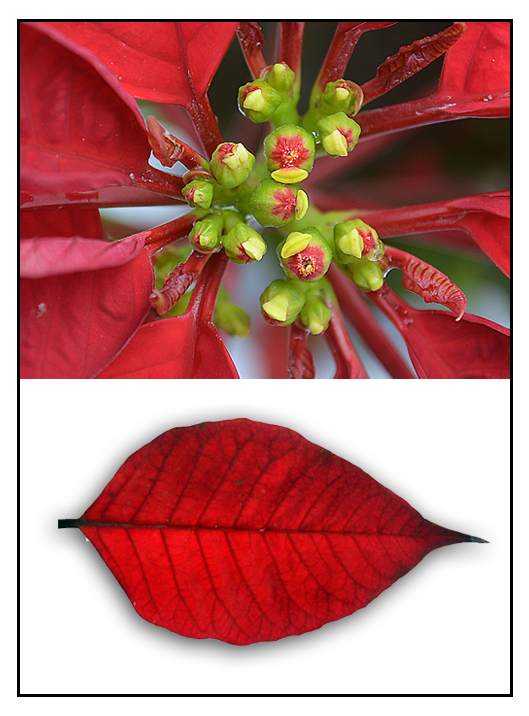
- The showy red, pink, white, or bicolored part of the plant, usually referred to as the flower, actually are modified leaves or bracts.
- In Aztecs of central Mexico once called the plant Cuetlaxochitl. Because of its brilliant color, the poinsettia was a symbol of purity to the Indians. (21)
- Etymology: Poinsettia was first introduced in the United States in 1825 by Joel Roberts Poinsett, a botanist and at that time, the first U.S. ambassador to Mexico. The genus name Euphorbia derived from the Greek physician Euphorbus, of king Juba II on Numidia. The specific epithet pulcherrima means 'very beautiful".
- The modern era of poinsettia culture began with the seedling cultivar Oak Leaf, originally grown in Jersey City, New Jersey.
(21) T
- The introduction of the Paul Mikkelsen cultivar in 1963 heralded a new era of
varied cultivars. Today there are over 100 poinsettia cultivars grown commercially, with the Eckespoint® Freedom™ representing over 50% of the red market worldwide and 70-75% of the market of poinsettias with red bracts. (21)
 Botany Botany
• Poinsettia is an erect, sparingly, and laxly branched shrub, 2
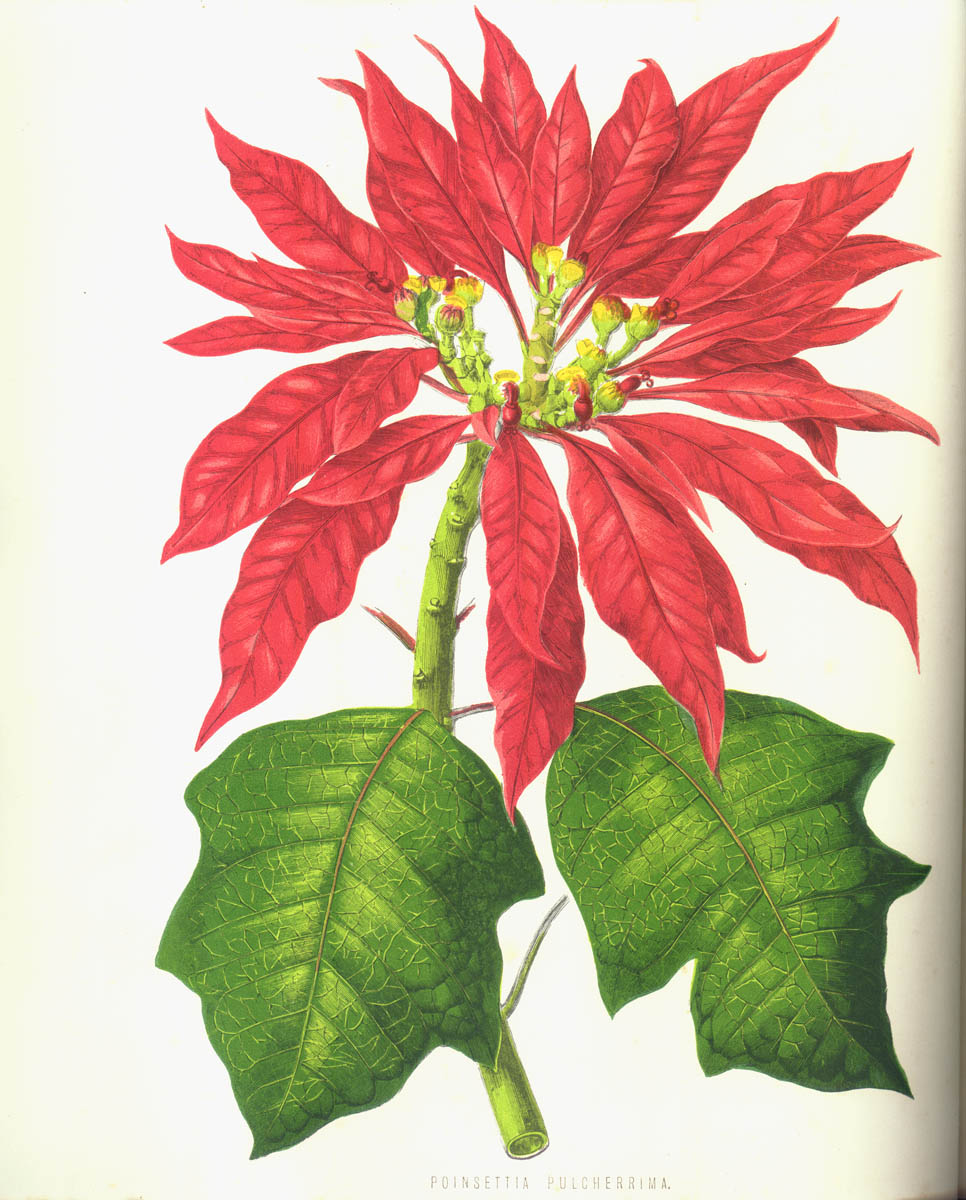
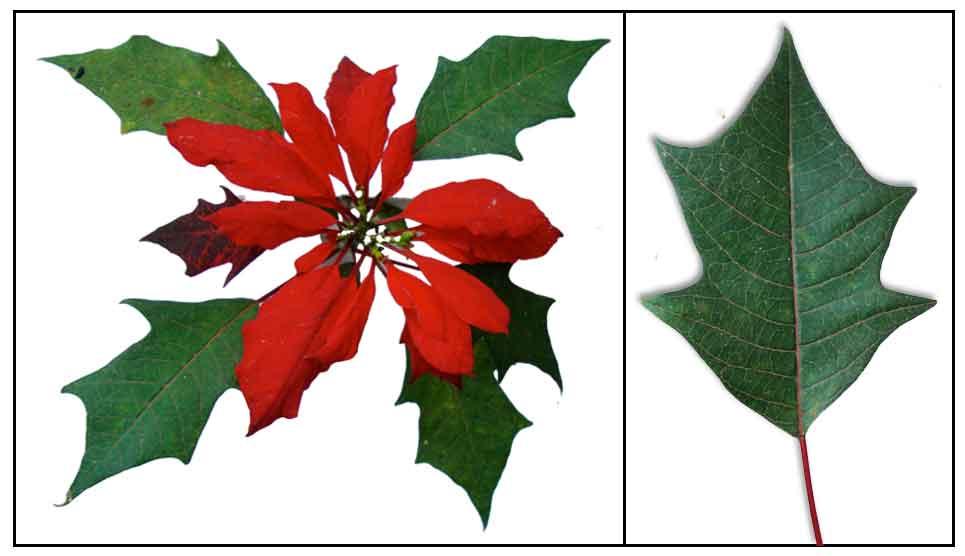
to 4 meters high. Leaves are elliptic to oblong-elliptic or the upper ones lanceolate, 10 to 18 centimeters, the lower ones entirely green, obscurely repand or slightly lobed, long-petioled, slightly hairy beneath, the upper ones, at the time of flowering, uniformly bright-red.
Inflorescence is terminal. Involucres are ovoid, about 1 centimeter long, the margins toothed, each with one or two large, yellow glands. Flowers are crowded.
• Perennial shrub that grows up to 3.3 m tall in the wild. Foliage: Dark green, thin leaves are broadly ovate with smooth edges (entire leaf margin) or pointed lobes and a long, thin tip. Flowers: The colorful, petal-like structures are bracts (modified leaves). Poinsettias typically have bright red bracts, but there are also cultivars with pink or white bracts. The true flowers are small, egg-shaped and occur at the base of the bracts. The flowers initially have red or green tips, but later releases yellow pollen. (
Distribution
- Introduced, probably around 1870.
-
Cultivated as ornamental garden
plant.
- A traditional Christmas plant.
- Probably introduced about 1870.
- Native to Guatemala and Mexico. (15)
 Constituents Constituents
- Triterpenes in the latex of E pulcherrima.
- Bracts yield a resin, a yellow and red coloring-matter, essential oil, tartaric acid, gallic acid, gum, glucose, sucrose, starch, and salts.
- Bark yields a red coloring principle; bracts yield a scarlet dye.
- Leaf yields alkaloids, saponins, sulfur, fat, amilodextrin, and formic acid.
- Aerial parts yielded alkaloids, steroids, terpenoids, saponins, glycosides, reducing sugar, and amino acid. (6)
- Analysis of various fractions of whole plant yielded terpenoids, flavonoids, alkaloids, saponin, and steroids.
(12)
- Study of solvent fraction of aerial parts yielded alkaloids, steroids, terpenoids, saponins, glycosides, reducing sugar, and amino acids. (see study below) (9)
- Study of aerial parts isolated eight compounds and identified as 5,7- dimethoxycoumarin (1), ß-sitosterol (2), 1,2-benzenedicarboxylic acid bis (2-ethylhexyl) ester (3), octadecylic acid (4), syringic acid (5), ferulic acid (6), daucosterol (7), and rutin (8).
(24)
- Study of aerial parts isolated three new compounds, euphorimaoid A (1), euphorimaoid B (2), 1α-hydroxy-3ß-acetoxy-olean-9,12-diene (3), two firstly isolated natural products 3β-acetyloxy-olean-13(18)-en-12-one (4) and 18,19-epoxyolean-3β-ol acetate (5), together with 13 known compounds (6–18). (see study below) (30)
- Study of bark isolated two flavonoids isolated from the bark of E. pucherrima: 3,5,7-trihydroxy-2-(4-hydroxy-3-methoxyphenyl)-6-methoxy-4H-chromen-4-one (1) and 2-(3,4-dihydroxyphenyl)-3,5,7-trihydroxy-6-methoxy-4H-chromen-4-one (2). (see study below) (32)
Properties
- Emetic, galactagogue, and cathartic.
- Latex considered caustic and poisonous.
- Studies have shown cytotoxic, antibacterial, anticonvulsant, antinociceptive, antioxidant, anti-inflammatory, sedative, muscle relaxant, urease and tyrosinase inhibitory, antiglycation, phosphodiesterase inhibitory properties.
Parts
utilized
Leaves and flowers.
Uses
Folkloric
- Leaves applied as poultice for erysipelas and a variety of
cutaneous problems.
- Latex is poisonous and causes irritation in wounds.
- Latex is very caustic and dangerous to the eyes.
- Infusion of flowers used as galactagogue.
- Plants used as emetic and cathartic.
- In Mexico, decoction of bracts taken by nursing women to increase the flow of milk, although the practice is considered dangerous by some. (see concerns) Plant latex provided a source of medicine for fever. (21)
- Infusion of flowers prescribed as galactagogue.
- Plant used as emeto-cathartic.
- In Indonesia, the racunan plant (E. pulcherrima) is used as emetic, emmenagogue, and galactagogue, for treating tuberculosis, skin infections, and fractures.
Others
- Dye: Mexican Indians used to make a reddish-purple dye from the bracts. (21) (see study below: 31)
 Concerns & Myths Concerns & Myths
• The common myth of the Christmas flower poisoning originated in 1919 when authorities mistakenly claimed that ingestion of poinsettia leaves caused an American child's death. (16)
• Accidental ingestion of the the plant can cause stomach irritation, discomfort, nausea and vomiting. The latex can cause skin irritation.
• Although the plant is less toxic than once believed, pregnant and breast-feeding persons are advised against its use. Also, because of gastric side effects reported on accidental ingestion, patients with stomach ulcers, IBS, Crohn's disease are advised not to use it. (20)
• These two studies report on 2 cases of contact dermatitis: (1) Contact Dermatitis 1985 May;12(5):285-6 [Contact dermatitis due to Euphorbia pulcherrima Willd, simulating a phototoxic reaction / Massmanian A1.], and (2) Contact Dermatitis 1985 May;12(5):285 [Contact dermatitis from Euphorbia pulcherrima / Santucci B, Picardo M, Cristaudo A.]
* Other than occasional cases of vomiting, the ingestion of poinsettia plant is not associated with serious effects. The United States Consumer Product Safety Commission denied a petition in 1975 to require warning labels on poinsettia plants. In a study of 22,793 cases of poinsettia exposure, 98.9% were accidental exposures in children and 96.1% required no treatment in a health care facility, and 92.4% did not require any type of therapy. (16) (17)
• A study reports a 50-pound child would have to eat more than 1-1/4 pounds of poinsettia leaves (500-600 leaves) to have any side effects. (18)
• Is it poisonous? The Myth of the Poisonous Poinsettia—The weblog is a counterpoint that the deadly poison of the poinsettia is entirely a myth. It could be guilt by association with two other popular Christmas plants—holly and mistletoe—which are genuinely poisonous. While the genus (Euphorbia) to which poinsettia belongs contain some poisonous plants, poinsettia itself is not toxic. (13) (14) (15)
• Holiday Plant with Toxic Misconceptions: Commonly used as a Christmas decoration, the majority (74.9%) of exposures occur in the months of December, January and February. In 2010, the American Association of Poison Control Center (NPDS) reported Euphorbia as the 6th highest rate of genus-specific human plant exposure calls - 750, likely an underestimation of the actual amount of exposures. Despite its legend of toxicity. there is little data to support it. While pulcherrima species contain complex terpenes (diterpenes) that are local irritants that can cause gastrointestinal upset, it does not contain toxin. (26)
• Poinsettia shares two common allergen proteins with natural rubber latex' - 40% of individuals with latex allergy has cross-sensitivity with the poinsettia plant. Reactions vary from rare type I immediate hypersensitivity, type IV allergic contact dermatitis, or irritant contact dermatitis. Anaphylactic shock in infants with atopic eczema and latex allergies have been published with probably causality, although a rarity. Clearly, families with members with atopic eczema or generalized atopia should avoid the use of poinsettia as a Christmastime decoration. (26)
Studies
• Cytotoxicity: Two cytotoxic terpenoids isolated
from E pulcherrima. Cytotoxicity evaluation was performed using Ehrlich
ascites tumor cells. Although no cytotoxic activity was observed, both
isolated triterpenes exhibited cell inactivating effects. (1) Crude alcoholic extracts and isolated fractions of E. milli and E. pulcherrima exhibited promising cytotoxic activity against Artemis salina shrimp larvae attributed to the presence of polar compounds. (10)
• Antibacterial:
In a study of fruits, leaves, stems and flowers that included E. pulcherrima,
the extracts exhibited moderate antibacterial effects on Micrococcus
pyogenes, E coli and P aeruginosa. (•)
• Phytochemicals:
A study of the petroleum ether extract of the latex, bracts and flowers of E pulcherrima yielded germanical, ß-amyrin and pseudotaraxasterol; from the latex, a new sterol, pulcherrol; from the stems, an octaeicosanol and ß-sitosterol. (3)
• Bactericide / Chitosan :
A chitosan solution markedly inhibited the growth of Xanthomonas sp. pathogenic to E. pulcherrima from different origins. Results showed potential bactericide against plant pathogenic bacteria.
• Anticonvulsant / Antinociceptive:
Study evaluated the central nervous system effects of Euphorbia pulcherrima in mice and rats. Results showed the crude dried extracts showed anticonvulsant and antinociceptive properties with no effect on motor coordination and anxiety. (7)
• Antibacterial / Antinociceptive:
Study of racunan leaf extract showed it can be used as an antibacterial against Escherichia coli. (8)
• Antibacterial / Free Radical Scavenging / Analgesic:
Study of solvent fractions yielded alkaloids, terpenoids, saponins, glycosides, reducing sugar, and amino acid. An EA fraction and methanol extract exhibited significant free radical scavenging activity and moderate antibacterial activity against K. pneumonia, S. epidermis, B stearothermophilus and S typhimurium. A crude extract exhibited significant phytotoxic effect and a crude methanolic extract showed significant analgesic effect. (9)
• Anticonvulsant :
Study evaluated the anticonvulsive effects of E. pulcherrima of various extracts using various convulsive experimental models in mice. Results showed EP crude dried extract showed anticonvulsant properties in Maximal Electroshock Seizure test model and Pentylenetetrazole induced seizure models. (11)
• Antibacterial / Bioactive Compounds:
Study showed an ethyl acetate fraction of methanol extract of whole plant yielded phytochemicals (terpenoids, flavonoids, alkaloids, saponin, and steroids) which showed remarkable activities against E. coli, S. aureus, S. typhi and P. aeruginosa. (12)
• Acute and Subchronic Toxicity Studies:
Study evaluated the acute and subchronic toxicity of Euphorbia pulcherrima methanol extract. Results showed no changes in liver and kidney function parameters. Authors suggest further studies to evaluate the mild hepatic histological changes among a few members treated with 100 and 1000 mg/k/d and for any hepatoprotective or nephroprotective potential the extract may possess. (19)
• Christmas Flower 101: This concise and very informative review presents the many facets of poinsettia viz., its history, the many cultivars, various foliar diseases, root rot, flower blights, among others, including recommendations on propagation, control of root rot, management of diseases and nutrient deficiencies. (21)
• Antibacterial / Anti-Staphylococcus / Leaves, Flowers and Stems: Study analyzed crude extract of leaves, flower and stem of E. pulcherrima for antibacterial activity on Staphylococcus aureus. Results showed zone of inhibition was moderately higher in an isolated treated with leaves/flowers extract than stem. ! 100% concentration plant extract showed higher inhibition than 50% concentration. (22)
• Eupulcherol A / Anti-Alzheimer's Bioactivity: Study isolated eupulcherol A (1), a novel triterpenoid, from E. pulcherrima. Biological studies showed that eupulcherol A possessed anti-Alzheimer's disease bioactivity, which could delay paralysis of transgenic AD Caenorhabditis elegans. A biogenetic pathways for the compound was also proposed. (23)
• Efficacy Against Aflatoxin Producing Fungi: Study evaluated various concentrations of dry flower powder of Euphorbia pulcherrima and E. milli on growth of aflatoxin producing toxigenic strains of fungi Aspergillus flavus (AF) and A. parasiticus (AP). Total inhibition (100%) of growth of AF and AP were seen at concentrations of 30 mg/ml and 35 mg/ml, respectively. Bioassay with goundnut seeds soaked with different concentration 5-35 mg/ml) of flower extract showed both fungi were incapable of infecting the seeds of both Euphorbia species. (25)
• Antifungal Effect / Aspergillus fumigatus / Leaf and Inflorescence:
Study evaluated different concentrations of acetone fraction of leaves and alcohol fraction of inflorescence on various cytomorphological parameters i.e. cell number, myceium width, conidial size, conidiophore size, etc. of Aspergillus fumigatus. Results showed concentration dependent inhibition of fungal growth. (27)
• Anti-Inflammatory / Analgesic / Sedative:
Study isolated two flavonoids, spinacetin (1) and patuletin (2) from a chloroform fractions of E. pulcherrima, and were screened for invivo anti-inflammatory, analgesic, sedative, and muscle relaxant effects. Compounds 1 and 2 tested against hot plate-induced noxious stimuli showed excelled (p<0.05) dose-dependent analgesic effect. Both compounds showed significant muscle relaxant activity with time by traction and inclined screening model. On open field method, both compounds showed good sedation (p<K0.05) at 20 mg/kg. Both compounds showed anti-inflammatory potential on histamiine-induced paw edema and carrageenan edema model at 20 mg/kg. The compounds showed good to excellent inhibition potential against µ-opioid receptors and COX-2. (29)
• Inhibitory Effect on Osteoclastogenesis / Aerial Parts:
Study of aerial parts isolated three new compounds, euphorimaoid A (1), euphorimaoid B (2), 1α-hydroxy-3ß-acetoxy-olean-9,12-diene (3), two firstly isolated natural products 3β-acetyloxy-olean-13(18)-en-12-one (4) and 18,19-epoxyolean-3β-ol acetate (5), together with 13 known compounds (6–18). All compounds were evaluated for inhibition of osteoclastogenesis in BMMs (bone marrow-derived macrophages). Compounds 7 to 10 showed significant concentration-dependent inhibition. (30)
• Anthocyanin Metabolic Engineering:
Previous research has demonstrated the possibility of manipulating flower color through metabolic engineering of anthocyanin biosynthesis pathway and plant tissue culture in different ornamental plant species. In poinsettia, the red color is provided by the bracts, modified leaves whose axillary buds have differentiated to form the inflorescence, in response to photoperiod. Study discusses the possibilities of genetic engineering of the anthocyanin synthetic pathway in E. pucherrima through introduction of one or more foreign delphinidin biosynthetic genes under transcriptional control of a pathway-specific promoter, and genome editing possibilities as an alternative tool to modify color of the bracts. (31)
• Enzyme Inhibitory Activities / Flavonoids / Bark:
Study evaluated the enzyme inhibitory activities of two flavonoids isolated from the bark of E. pucherrima: 3,5,7-trihydroxy-2-(4-hydroxy-3-methoxyphenyl)-6-methoxy-4H-chromen-4-one (1) and 2-(3,4-dihydroxyphenyl)-3,5,7-trihydroxy-6-methoxy-4H-chromen-4-one (2). Compound 1 and 2 showed promising urease inhibitory potential with IC50s of 15.3 and 19.0 µM, respectively, compared to positive control thiourea with 21.00 µM. Compound 1 showed significant tyrosinase inhibitory activity with IC50 of 48.7 µM; compound 2 a moderate effect with IC50 74.8 µM, compared to standard alpha kojic acid IC50 47.6 µM. Compounds 1 and 2 also exhibited anti-glaciation and phosphodiesterase inhibitory activities. (32)
Availability
Ornamental cultivation.
|