Gen info
- There are two varieties of the santol fruit, which was previously considered two different species: the yellow variety and the red -- the difference is in the color that older leaves turn to before falling; and the red more common, with the mix of red and green leaves adding to its distinction and attraction. (48)
Botany
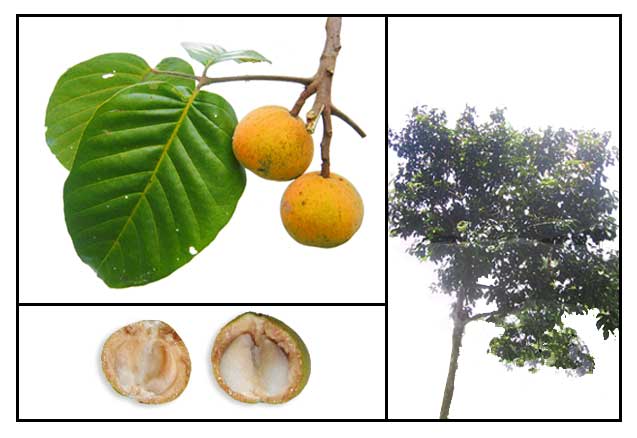
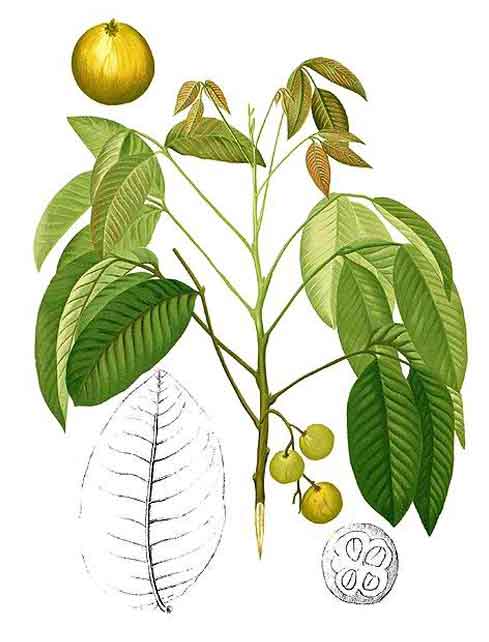
Sandlot is a tree growing up to
20 meters high, with softly hairy young branches and leaves. Leaves are groups of 3 leaflets, elliptic to oblong-ovate, 10 to 25 centimeter long, with pointed
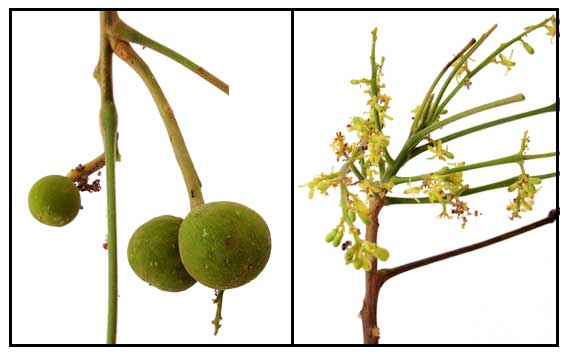
tips and round bases. Flowers are numerous, somewhat fascicled, about 1 centimeter long, in greenish or yellowish clusters.
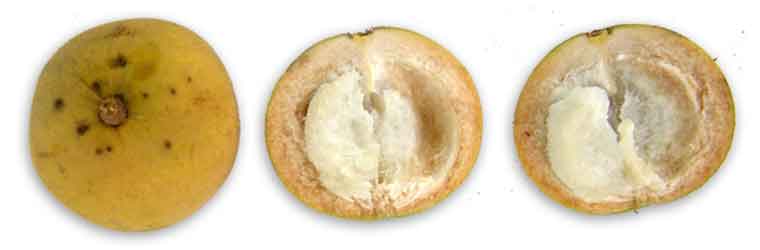
Fruits are rounded and somewhat flattened, 4 to 6 centimeters, yellowish-orange when ripe with a thick pericarp. Seeds are large, surrounded by a translucent or pale, sweet tasting edible pulp.
Distribution
- Native to the Philippines.
(21)
- Throughout settled areas in the Philippines, planted or semi-cultivated, and abundant in secondary
forests.
- Also native to Borneo, Jawa, Lesser Sunda Is., Malaya, New Guinea, Sulawesi, Sumatera. (21)
 Constituents Constituents
- Bark contains traces of a bitter principle, a toxic alkaloid.
- Seed contains an amorphous bitter principle.
- Bark also contains a bitter substance, sandoricum acid, similar to
acids found in Chisocheton, dysoxylum, heynea and carapa.
- Thai study yielded two new limonoids from the leaves: sandoripin A and
sandoripin B.
- Study on leaves have yielded trijugin-type limonoids, sandrapins A, B, C, D and E and sandoripin A and B.
- Studies have yielded more than 10 terpenoids. Terpenoids represent the largest class of secondary metabolites from natural source.
- Seeds have yielded andirobin-type limonoids - sandoricin and 6-hydroxysandoricin.
- Fruit hulls have yielded bryononic acid and bryonolic acid terpenoids, meso-inositol and dimethyl mucate polyalcohol.
- Stem bark studies have yielded triterpenoids such as, katonic acid, indicic acid, koetjapic acid, 3-oxo-12-oleanen-29-oic acid, alloaromadendrene, caryophyllene oxide, spathulenol], bryononic acid, secobryononic acid, secoisobryononic acid, 20-epikoetjapic acid, 3-epikatonic acid and sandorinic acid A, B and C.
- Ethyl acetate extract of leaves yielded two new limonoids: 2α-(2-methylbutanoyl)oxy]sandoricin (1) and 2α-(2-methylpropanoyl)oxy]sandoricin (2). (18)
- Hexane extract of stem bark yielded an oleane-type triterpenoid, briononic acid. (see study below) (19)
- Ethyl acetate extract of leaves yielded
two new limonoids identified as acetate derivatives 1 and 2, suggested to be added to the class of highly oxidized ring fissioned limonoids. (26)
- Study of stem bark yielded secomultiflorane-type triterpenoid acids: bryononic acid and two new ring=A secotriterpenoids. (30)
- Study yielded two new additional trijugin-type limonoids, sandrapins D (4) and E (5), which are analogues of previously reported sandrapins A-C (1-3).
(34)
- Study of seeds isolated three andirobin- and one trijugin-class limonoids, named koetjapins A-D (1-4). (see study below)
(37)
- Study of leaves extract isolated three new pentacyclic triterpenes, named sandkoetjapic acids A-C (1-3), along with known triterpenes 3-oxo-olean-12-en-29-oic (4), bryonolic (5), and bryononic (6) acids. (None of them showed activity as inhibitors of RTKs and ß-lactamase)
(43)
Properties
- Roots is aromatic,
carminative, antispasmodic, astringent, stomachic, and tonic.
- Fruit considered astringent.
- Studies have suggested ichthyotoxic, anticarcinogenic, antibacterial, antioxidant,
anticancer, anti-inflammatory, termite repellent, insecticidal, antiangiogenic, antifungal, xanthine oxidase inhibitory properties.
Medical emergencies associated with seed swallowing: Obstruction, perforation and peritonitis
- Thai and Philippine physicians have reported and warned on the risk of swallowing whole seeds of Sandoricum koetjape and the possible complications of intestinal obstruction, perforation, and peritonitis, and the emergency surgery required. In a retrospective study, 6 of 30 patients with seed-induced perforation died within 28 days of surgery, the mortality often in the picture of septic shock. The 'bangkok santol", a larger variety, may be responsible for more severe cases that require surgery. (48) (see study below: 23)
Parts
used
Roots, bark, and
leaves.
Uses
Nutrition / Edibility
- Fruit is eaten raw or spiced.
-
High in carbohydrates,
fair in iron, but low in calcium.
- Fair source of vitamin B.
- Santol makes a delicious preserve - peeled, quartered, and cooked in syrup.
- Unripe, sour fruits used as souring agent in sinigang.
- In Thai cuisine, not fully ripe fruit is used in making som tam. It is also one of the main ingredients in santol/pork and santol/prawn Thai curries. (48)
Folkloric
- Fresh leaves applied to the skin are sudorific.
- Used by the Ifugaos for diarrhea.
- Ayta people of Porac, Pampanga, apply mashed fresh leaves throughout the body as repellent against hematophagous insects. (35)
- Indigenous people of Santol, La Union, use the lolly fruit for fever and diarrhea. Bark
used in embalming, placed inside the casket. (36)
-
Decoction or infusion
of leaves used for baths to reduce fever.
- Also, used for diarrhea and as a tonic after childbirth.
- Bark poultice used for ringworm.
- Bitter roots, bruised with vinegar and water, is a carminative; used
for diarrhea and dysentery.
- Pounded barks applied to ringworm.
- Leaves used for skin infections and rashes.
- Roots used as tonic.
- Roots used in Malay medicine as preventive after childbirth and as a general tonic.
- In Malaysia, aqueous extract of the bark is consumed as a tonic after childbirth. (8)
- In Indonesia, bark decoction used to treat leucorrhea and colic. (8) Used for treatment of stomachache, diarrhea, vaginal discharge, and as postpartum tonic. (45)
Others
- Wood: Yields a lightweight to medium-weight hardwood. Used for light construction, joinery, domestic woodware, tool handles, and wood carvings.
- Fragrance: Fragrant wood used in perfumery. (27)
- Dye: Bark used for tanning fishing nets. (27)
- Poison: Seeds contain limonoids (antifeedant compounds). (27)
- Insect repellent: Leaves used as insect repellent. (35)
 Studies Studies
• Ichthyotoxic and
Anticarcinogenic Effects: Two ichthyotoxic triterpenoids
were isolated with non-toxic katonic acid which showed remarkable inhibitory
effect on Epstein-Barr virus early antigen activation. The triterpenoid
koetjapic acid showed promising chemopreventive possibility. (1)
• Anti-cancer: Study
isolated a new ring-A secotriterpene, koetjapic acid, and five known compounds. Two compounds
exhibited significant cytotoxic activity against cultured human cancer
cells. (2)
• Anti-inflammatory / Stems:
Stem extract study yielded 3-oxo-12-oleanen-29-oic acid and katonic
acid which showed anti-inflammatory activity equivalent to indomethacin. (3)
• DNA Polymerase B Inhibition:
Bioassay-guided fractionation of S. koetjape using assay sensitive to DNA polymerase ß inhibition isolated three compounds (1-3) having IC50 values from 20 to 36 µM. Derivatives 11, 12, and 13 from compounds 1 and 2 showed activity against DNA polymerase ß with IC50 values from 16 to 36 µM. (4)
• Termite Repellent:
Although the research product was not quick in killing termites. it was as good as the commercial product in repelling them. It also showed to be environmentally friendly, organic, lacking unpleasant odors and containing no dangerous chemicals. (6)
• Antiangiogenic / Koetjapic Acid:
Antiangiogenesis is the formation of new blood vessels and plays an important role in tumor growth and metastasis. It is an important target in cancer therapy. Study isolated koetjapic acid, a seco-A-ring oleanene triterpene. Results suggest the non-cytotoxic compound, KA, may be a potent antiangiogenic agent; its activity may be attributed to inhibition of endothelial cells migration and differentiation as well as VEGF suppression. (9)
• Breast Cancer / Cytotoxic / Apoptotic:
A n-hexane extract showed dose-dependent cytotoxic and apoptotic activities on all breast cancer cell lines. Study provides evidence for the presence of an effective anticancer agent in the stem bark of S. koetjape. (10)
• Topical Anti-Inflammatory Effect / Stem Extracts:
Anti-inflammatory effect of stem extracts was investigated on topical administration in a TPA-induced mouse ear inflammation model. Fractionation of active fractions isolated 3-oxo-12-oleanen-29-oic acid and katonic acid as the biotic principles responsible for the anti-inflammatory activity. The inhibition effect was almost equivalent to indomethacin. (13)
• Cytotoxic / Anti-Angiogenic / Stem Bark:
An n-hexane extract of stem bark of S. koetjape was investigated for cytotoxic and anti-angiogenic properties in an invitro cell proliferation assay. In a rat aorta ring assay, study showed inhibition of outgrowth of blood vessels from rat aorta rings. Extract also showed dose-dependent growth inhibition of all tested cell lines. At 50 µg mL, there was potent induction of apoptotic cell death of HCT-116 colon cancer cell line by inducing caspases activity. Results showed anti-angiogenic and apoptotic properties on colon cancer cell line. (14)
• Breast Cancer / Cytotoxic / Apoptotic / Stem Bark:
Study evaluated cytotoxic and apoptotic properties of stem bark in an invitro cell proliferation assay on three breast cancer cell lines and one normal cell line. The n-hexane extract exhibited dose-dependent growth inhibition of all tested cell lines. At 100 µg m, there was induced apoptotic cell death by inducing activity of effector caspases. Results suggest S. koetjape is a good candidate for further research targeting cancer treatment. (15)
• Sentulic Acid / Cytotoxic Tritpenoids / Human Promyelocytic Leukemia HL-60 Cells: Study isolated a new ring A-seco triterpenoid, sentulic acid, along with a known oleanane-type triterpenoid, 3-oxoolean-12-en-27-oic acid. Cytotoxic activity was studied on human promyelocytic leukemia HL-60 cells. Results showed the compound were able to induce cytotoxicity through apoptosis. (16)
• Biosorption / Lead and Cadmium / Peel Wastes:
In a study comparing biosorbent capacity of peel wastes of S. koetjape, A. comosus and C. nobilis for removal of lead and cadmium in contaminated tap water from Manila, S. koetjape showed the highest biosorption efficiency for lead and cadmium at 64.02% and 78.94% respectively. (17)
• Briononic Acid:
A hexane extract of stem bark yielded an oleane-type triterpenoid, briononic acid. Study suggests it originated from β-amyrin undergoing enzymatic hydrogenation reaction at C-12 followed by rearrangement process. (See constituents above) (19)
• Bioinsecticide Effect:
Study evaluated stem bark extracts of five Meliaceous plants in Indonesia against 3rd instar larvae of armyworm, Spodoptera litura. The maximum bioinsecticide effect was seen with Sandoricum koetjape and suggests promise as a botanical insecticide. (20)
• Retrospective Study / Peritonitis due to Seed Ingestion:
Study evaluated the factor associated with mortality of patients with peritonitis due to S. koetjape seed ingestion. All patients were diagnosed with seed-induced colon perforation intraoperatively. Six of 30 patients died. The factor-associated mortality was consistent with a picture of septic shock. Early recognition and treatment of hypotension with surgery and control of infection is key to the improvement of mortality outcome. (23)
• Limonoid Antifeedant / Seeds:
Two new limonoids, sandoricin (1) and 6-hydroxysandoricin (2) from a seed extract f S. koetjape showed effective antifeedant activity when incorporated into artificial diets and fed to fa army worm (Spodoptera frugiperda) or European corn borer (Ostrina nubilalis) larvae. (24)
• Antifungal / Candida albicans / Stem:
Study evaluated S. koetjape methanol bark extracts and fractions for antifungal activity against C. albicans. GC-MS analysis showed fraction III to have greatest antifungal activity with potential antifungal compounds identified as α-gurjunene, trans-caryophyllene, aromadendrene, α-humulene, β-caryophyllene, δ-Cadinene, alloaromadendrene, octadecanoic acid, hexadecanoic acid methyl ester, hexadecanoic acid, 9-octadecenoic acid metil ester, 9-octadecenoic acid. (25)
•
Risk-Associated Mortality / Peritonitis from Sandorica Koetjape Seed Ingestion: Retrospective study reports on the mortality of patients who presented with peritonitis due to S. koetjape seed ingestion. All patients received preoperative diagnosis of Sandorica seed-induced colon perforation. Six of 30 patients died during a 28-day hospitalization. The clinical picture was consistent with septic shock. (28)
• Potential Antioxidant
Source / Agricultural Peel Waste: The peel, the outer skin covering the fruit, is often discarded as agricultural waste. Studies have shown the peel to be an abundant source of natural antioxidant compounds, such as tannins and polyphenols. In this study, freeze-dried aqueous extract of fruit peel was evaluated for antioxidant properties at concentrations of 200 ppm. Extract exhibited greater than 90% free radical scavenging by DPPH and superoxide radical scavenging assays. Extract exhibited good antioxidant capacity with ORAC f 139,000 µmol TE/1000 g and highest total phenolic content at 1,734 mg GAE/100g. Results suggest the agricultural fruit peel waste has potential for commercial development as a natural antioxidant dietary supplement. (29)
• Antimicrobial / Seeds: Study evaluated various extracts of seeds for phytochemical constituents and antimicrobial activity against three bacteria viz., P. aeruginosa, B. subtilis, and S. aureus. Phytochemical screening yielded high amounts of alkaloid and flavonoid. A crude methanol extract showed inhibition zones towards the three test bacteria with minimal IZ of 0.25 mg/L for B. subtilis and 0.50 mg/L for both P. aeruginosa and S. aureus. (31)
• Inhibition of Blood Type O Fibrin Formation / Leaves: Study evaluated the inhibitory activity of S. koetjape leaf extract to blood type O fibrin formation. Warfarin was used as positive control. Results showed the 100% concentration has the highest time of coagulation but replication was almost the same. (32)
• Invention / Anticancer / Human Colorectal Cell Line: Invention relates to extracts from S. koetjape plant, their usages and functions in the treatment of cancer. The invention provides a compound purified and crystallized from an n-hexane extract of stem bark. Compound shows inhibitory activity towards human cancer cell with higher potency towards human colorectal (HCT 116) cell lines. (33)
• Limonoids / Antileukemic / Inhibitory Effect on P-388 Cells / Seeds: Study of seeds isolated three andirobin- and one trijugin-class limonoids, named koetjapins A-D (1-4). Preliminary biological activity showed only compound 4 has significant inhibitory activity against P-388 cells, while antibacterial tests showed none of the compounds were active. (37)
• Sandoripins / Anti-Inflammatory / Leaves: Study of Sandoricum koetjape leaves isolated two new limonoids, sanjecumins A and B (1,2), together with sandoripins A and B (3,4). Sandoripins A and B showed moderate inhibition of nitric oxide production in mouse macrophage-like cell line J774.1 stimulated by lipopolysaccharide. (38)
• Inhibition of Growth and Transcription of E. coli Colibactin Genes: In a study of 16 medicinal plants, aqueous extracts of Terminalia catappa, Psidium guajava and Sandoricum koetjape showed growth inhibition against E. coli ATCC25922, which is known to produce colibactin toxin. The plant extracts contain tannin and quercetin, known to inhibit the growth of E. coli ATCC 25922. The extracts showed efficacy in down-regulating the expression of five genes required for colibactin biosynthesis. Results suggest the plant extracts and compounds have potential to prevent the transient infection and DNA damage of the eukaryotic epithelial cells. (39)
• Cytotoxic / Anti-Angiogenic / Apoptotic / Stem Bark: Study evaluated the cytotoxic and anti-angiogenic properties of n-hexane extract of S. koetjape stem bark in vitro. The extract showed dose dependent growth inhibition of all tested cell lines with IC50s against HCT-116, HUVEC, CCD-18CO, and HT-29 of 14, 23, 50, and 52 µg/mL, respectively. At 50 µg/mL, the extract potently induced apoptotic cell death of HCT-116 colon cancer cell line by inducing caspases 3 and 7 activity. Results suggest the extract possess both anti-angiogenic and apoptotic properties on colon cancer cell lines. (40)
• Xanthine Oxidase Inhibitory / Antioxidant / Leaves: Study evaluated the antioxidant and xanthine oxidase inhibitory effect of S. koetjape methanol leaves extract. The ME contained high amounts of phenolic and flavonoid compounds. For antioxidant and XO inhibition, the ethyl acetate fraction revealed strong activity with IC50s of 3.70 and 50.18 µg/mL, respectively. XO inhibition by the EA extract was competitive inhibition that mimics the inhibition mechanism of allopurinol. LC-MS/MS chromatogram yielded dehydrotumulosic acid, methyl ophiopogonanone A, quercetin-4'-glucoside, luteolin-7-ß-D-glucopyranoside and neokurarinol. (41)
• Sentulic acid / Anti-Inflammatory: Study isolated a seco-terpenoid, sentulic acid (SA) from Sandoricum koetjape, which attenuated nitric oxide (NO) production following co-stimulation with lipopolysaccharide (LPS) and interferon-gamma (IFN-γ) in RAW264.7 macrophage cells. Both mRNA and protein expression levels of inducible NO synthase were suppressed by SA. Sentulic acid treatment inhibited the binding of LPS to TLR4 in macrophages. Results suggest SA is beneficial for the treatment of inflammatory diseases. (42)
• Antioxidant / Juice: The juice of S. koetjape yields high total phenolic content (617.04 µg GAE/g sample. Higher phenolic content was detected in crude methanolic extract (241.01 GAE/100 g FW). The antioxidant activities could be associated with high TPC. The juice exhibited great DPPH scavenging activity (418.22 µg VCEA/g sample). Extract also elicited antioxidant activity in HEK-293 cells by attenuating H2O2-induced ROS production. Results attribute the antioxidant activity from induction of mRNA and protein expression of GPx-1 in HEK-293 cells. (44)
• Bryononic Acid / Antibacterial / Fruit Hulls: Study isolated triterpenoid Bryononic Acid from S. koetjape. Antibacterial activity was evaluated using microdilution method. Extracts and fractions showed activity against Salmonella enterica with MICs of 6.0 µg/mL. (45)
• Anti-Inflammatory in Post Scaling Gingivitis / Peel: Study evaluated the effects various solvent fractions on the phytochemical compounds of Sentul fruit peel and its potential as anti-inflammatory in post-scaling gingivitis. Flavonoids, saponins, and tannins are aromatic hydroxyl groups that act as antibacterial. The aqua fraction of Sentul ethanol extract yielded the highest levels of flavonoids, saponins, and tannins, and was considered the best treatment with flavonoid level of 11476.16 mg/100g QE,, tannins 88.605 mg/g and saponins 6.862 mg/g. (46)
• Anti-Inflammatory in Post Scaling Gingivitis / Peel: Streptococcus mutans is one of the microorganisms known to cause dental caries. Kecapi sentul leaves extract contain alkaloid, flavonoid, steroid, phenol, and triterpenoid which has antibacterial properties for inhibition of S. mutans. Study evaluated various concentrations of leaves extracts and chlorhexidine gluconate 0.2% as positive control. Results showed the leaves extracts with concentration groups of 30, 40, 50, 60 and 70% (mean diameter of inhibition zones were 9.1 mm, 13.3 mm. 17.13 mm, 18.65 mm and 21.05 mm, respectively) have antibacterial potential against Streptococcus mutans. (47)
Availability
Wild-crafted.
Cultivated for its fruit.
|