Gen info Gen info
- Rubus is a large and diverse genus of flowering plants in the rose family, Rosaceae, subfamily Rosoideae, with other 1,350 species.
Botany
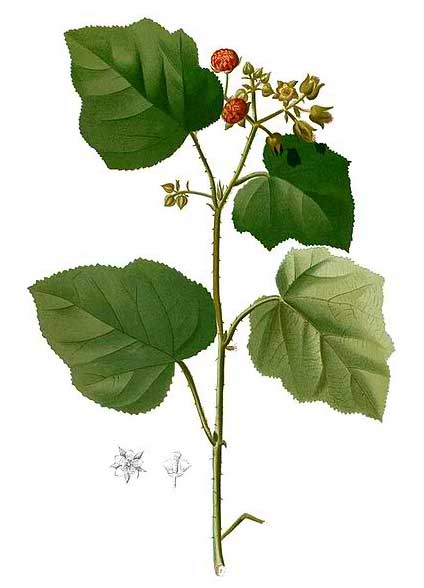
Sapinit is a climbing, straggling, prickly shrub, reaching a height of 2 to 3 meters, with branches covered by wooly hairs. Stems, buds, petioles, and lower surfaces of the leaves are velvety. Leaves are thin, flat, usually 3- to 5-lobed, deeply cordate at the base, broadly ovate, and 5 to 15 centimeters wide. Upper surface is hairy and prominently reticulate when dry. Flowers are about 2 centimeters across, usually in small clusters, and borne in racemes at the axils of leaves and at the ends of branches. Calyx lobes are ovate to lanceolate, entire or pectinate. Petals are obovate, white, and shorter than the calyx segments. Berries are bright red, about 1 centimeter in diameter, succulent, slightly acid, with numerous carpels, and hairy receptacle.
 Distribution Distribution
- Native to the Philippines.
-
In forests at medium and higher altitudes, and in very wet regions at low altitudes, from northern Luzon to Mindanao and Palawan.
- Also native to Assam, Bismarck Archipelago, Borneo, Caroline Is. India, Jawa, Laos, Lesser Sunda Is. Malaya, Maluku, Myanmar, New Caledonia, New Guinea, New South Wales, Queensland, Solomon Is., Sri Lanka, Sulawesi, Sumatera, Thailand, Vanuatu, Victoria, Vietnam. (12)
Constituents
- Bark contains 10 percent tannin and considered astringent.
- Fruit contains malic and citric acids, pectin and albumin.
- In a study of three wild
Rubus species, R. moluccanus yielded the highest total flavonoid content [18.17 ± 0.20 mg catechin equivalents (CE)/g] and anthocyanin content [36.96 ± 0.39 mg cyanidine-3-glucosiide equivalents (c-3-gE)/g]. (see study below) (7)
- Phytochemical screening yielded
26 compounds. Major constituents were hydroxy methyl furfural (21.642) and 1,1,2,-triacetoxyethane (17.908), and 2,4-dihydroxy-2,5-dimethyl-3(2H)-furan-3-one (10.345) and 2-hydroxy-3-methyl1-4-pyrone. (see study below) (7)
- Phytochemical screening of various extracts (ethanol formaldehyde, acetic acid, chloroform) of leaves yielded alkaloids (E), proteins and amino acids (E, C), phenolic compounds (F, E), tannins (F,E), glycosides (E, AA, C) and saponins (E).
(see study blow) (8)
- Study of ethanolic extract of defatted whole plant isolated a pentacyclic triterpene, rubonic acid. (9)
- In a study of three wild Rubus species, R. moluccanus showed highest total flavonoid (18.17 mg CE/g) and anthocyanin content [36.96 mg cyanidin-3-glucoside equivalents (c-3-gE)/g]. Total carotenoid content was 9.69 mg BC/g dried sample, and total phenolic content was 20.76 mg GAE/g. (see study below) (13)
 Properties Properties
- Leaves considered emmenagogue and abortifacient.
- Root is astringent.
- Studies have suggested antioxidant, anti-inflammatory, antibacterial, anthelmintic, anticholinesterase properties.
Parts used
Roots, leaves, and fruit.
Uses
Edibility
 - Fruit is edible with sour flavor; used in jams and sauces. - Fruit is edible with sour flavor; used in jams and sauces.
Folkloric
- Root, leaves, and fruit used for diarrhea.
- Malays use the fruit as remedy for nocturnal micturition in children.
- Leaves considered a powerful emmenagogue and abortifacient.
- A single dose of sap from young shoots drunk to induce labor. (6)
- Root decoction used for dysentery.
- In India, decoction of tender leaves of R. moluccanus, together with Psidium guajava, Perilla ocimoides and Vernonia volkameriaefolia and Urena lobota root prepared in water administered in an empty stomach once daily for 2-3 days for abdominal pain.
- In Assam, India, fruit and young shoots (leaves and stems) are taken to provide energy, and enhance fertility in female. (10) Leaves part of a herbal leaf concoction used for abdominal pain. Decoction of tender shoots with leaves, fruit, seed kernel, aerial parts of other plants used for peptic ulcer disease. (11)
- Leaf used as antihypertensive.
- In Papua, New Guinea, heated leaves are applied to the abdomen for abdominal pain. (11)
- Leaves chewed with salt and spat onto sores to promote healing. Sap from leaves or stems used to treat eye diseases. (6)
- Fruit considered a remedy for nocturnal bedwetting of children. (6)
Others
- Dyes: Fruit yields a purple dye.
Studies
• Antioxidant / Antibacterial: Study evaluated 80% methanol extracts of three wild Rubus species viz., R. moluccanus, R. fraxinifolius, and R. alpestris. R. moluccanus and R. alpestris extracts showed mild inhibition towards Bacillus subtilis, Staphylococcus aureus, Escherichia coli, and Salmonella enteritidis. R. moluccanus showed a total phenolic content of 20.76, total flavonoid 18.17, total anthocyanin 36.96 and total carotenoid 9.69. Antioxidant assays yielded 38.00 ± 1.63 (DPPH assay), 50.37 ± 5.28 (FRAP), and 0..73 ± 0.03 (ABTS) assays. (see constituents above) (7)
• Antimicrobial / Anthelmintic / Leaves:Study evaluated various extracts of shade dried and pulverized leaves of Rubus moluccanus for antimicrobial and anthelmintic activities. Results showed febrifugal and febricidal activity against adult Indian earthworm, Pheretima posthuma. The ethanol extract showed significant antibacterial and antfungal activity against test pathogenic organisms i.e., E. coli, B. subtilis, and S. aureus. (8)
• Rubonic Acid / New Triterpene: Rubonic acid, a new pentacyclic triterpene acid from the defatted whole plant of Rubus moluccanus formulated as 3,7-diket-olean-12-ene-28-oic acid on the basis of spectral {IR, UV, PMR and mass) and chemical evidences. (9)
• Anticholinesterase Inhibition Activity / Fruit: Study evaluated three wild Rubus species (Rubus moluccanus, R. fraxinifolius, R. alpestris) for phytochemical content, antioxidant, antibacterial, and antiacetylcholinesterase activities. It showed mild inhibition towards Bacillus subtilis, Staphylococcus aureus, Escherichia coli, and Salmonella enteritidis. Rubus moluccanus showed highest anticholinesterase activity (26.42%). (13)
Availability
- Wild-crafted.
-
Seeds, teas, powders, plants in the cybermarket.
|