Gen info
- The genus Jatropha (Euphorbiaceae) comprises about 170 species of woody trees, shrubs, sub-shrubs, and herbs in the seasonably dry tropics of the Old and New World. (18)
-
Jatropha integerrima, commonly known as peregrina or spicy jatropha, is a species of flowering plant in the spurge family, Euphorbiaceae.
- The genus name Jatropha derives from Greek words iatros, meaning "physician", and trophe, meaning "nutrition".
Botany
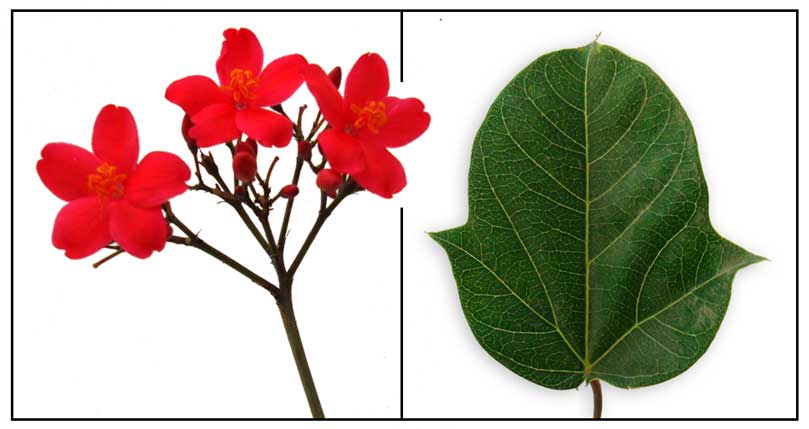
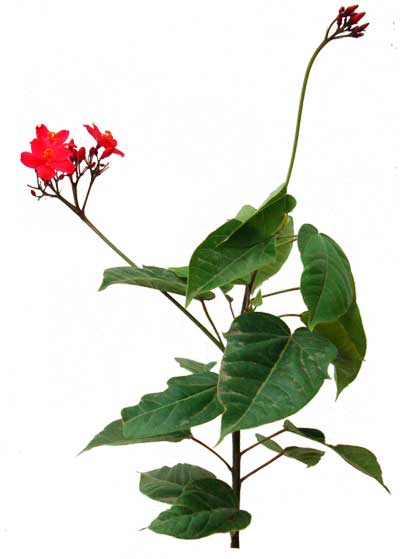
• Jatropha integerrima is a medium-sized branching shrub, growing up to 3 meters high. Leaves are ovate to oblong, up to 10 centimeters long and 7 centimeters wide, fiddle-shaped or with 3 sharply pointed lobes. Blade is dark green above and light green below, with petioles up to 5 centimeters long, with entire margins. Flowers are red, showy, emerging as clusters on terminal cymes and borne by a peduncle up to 12 centimeters long. Fruit is an oval 60loobed capsule containing 3 smooth and spotted seeds.
Distribution
- Introduced to the Philippines in the 50s, now widely spread.
- Native to Cuba.
 Constituents Constituents
- Diterpene constituents consist of macrocyclic diterpenes jatrophone, jatrophatrione, jatropholone A-B, riolozatrione, curcusones A-D, rhamnofolane, lathyrane.
- Extracts of leaves and stems yielded tannin, terpenoids, steroids, flavonoids and saponins.
- Seed oil of J. pandurifolia yielded 38.40% oil content. Methyl ester analysis showed saturated and unsaturated fatty acids in varying proportions along with hydroxy fatty acid up to 8.6%.
(11)
- Methanolic extract of stem bark of J. pandurifolia isolated seven compounds viz. 3-O-acetylaleuritolic acid (1), jatropholone A (2), jatropholone B (3), 2α-hydroxyjatropholone (4), 2β-hydroxyljatropholone (5), scopoletin (6) and aleuritolic acid 3-p-hydroxycinnamate (7).
(12)
- Phytochemical screening using two solvent crude extracts (ethyl acetate and methanol) yielded alkaloids (EA,M),
flavanoids (EA,M), steroids (EA,M), tannins (EA), and phenols (EA). Total phenol content was 408.00±34.00 µg GAE/g. Total flavanoid content for ethyl extract of leaves was 10.14±0.59 µg QE/g. (14)
- Study of essential oil of
leaves yielded pentadecanal (32.4%), 1,8-cineole (11.2%) and ß-ionone (10.8%) as major components. Seeds oil yielded mainly alipathic hydrocarbons viz. pentacosane (13.6%), hexacosane (13.3%), octacosane (12.3%) and heptacosane (10.1%). (see study below) (15)
- Study to J. integerrima trunks yielded nine new diterpenoids, jatrointelones A-I (1-9), along with seven lathyranes (1-7) and two jatropholanes (8 and 9), together with 12 known analogues (10-21). (see study below) (16)
- Study of roots yielded five new compounds, 2a-hydroxyjatropholone (1), 2ß-hydroxyjatropholone (2), 1,5-dioxo-2,3-dihydroxyrhamnofola=4)10),6,11(18),15-tetraene (3), 2-keto-5-hydroxyguai-3,11-diene (4), and a sesquiterpene-coumarin conjugate, jatrophadioxan (5), along with nine known compounds. The six diterpenes were evaluated for antiplasmodial, antituberculosis, and cytotoxic activities. (19)
- Study of ethyl acetate extract of latex of J. integerrima yielded a new cycloheptapeptide, integerrimide C (1). (see study below) (20)
- GC-MS analysis of leaves and seeds for essential oil showed significant variation. Leaf EO yielded pentadecanal (32.4%^), 1,8-cineole (11.2%), and ß-ionone (10.8%) as major components. Seed oil comprised mainly of alipathic hydrocarbons, pentacosane (13.6%), hexacosane (13.3%), octacosane (12.3%), and heptacosane (10.1%). Defatted seed oil was predominantly made up of monoterpenes 1,8-cineole (35.5%), p-cymene (20.5%) and
α-pinene (16.5%). (see study below) (25)
Properties
- Drought tolerant.
-
Considered purgative, styptic, emetic.
- Latex considered toxic.
- Leaves, when accidentally chewed. can cause stomachalgia and can be purgative.
- Studies have shown antimicrobial, cytotoxic, antioxidant, antiproliferative, wound healing, larvicidal, anti-inflammatory, anti-neurodegenerative, hepatoprotective, nephroprotective, acetylcholine esterase inhibitory, tyrosinase inhibitory properties.
Toxicity concerns
- Caution: Seed capsules which follow the flowers hold several smooth, speckled and toxic seeds, a fact that advises the plant should be place out of the reach of children. (17)
- Plant sap can cause contact dermatitis with skin irritation, itching, and rashes.
- Monkolvisut et al (2006) reported the latex to be toxic and the leaves can cause stomachache and purgative effects.
Levine et al (2000) reports of toxicity on two boys who developed who developed intractable vomiting, colicky abdominal pains and water diarrhea one hour after ingestion of ten seeds each. (18)
Uses
Folkloric
- No known folkloric medicinal use in the Philippines.
- Elsewhere, used in the treatment of warts, tumors, rheumatism, herpes, pruritus, toothaches, scabies, eczema and ringworm.
- Various parts have been used as purgative, styptic, emetic; used for treatment of tumors, herpes, warts, pruritus, toothaches, scabies, rheumatism, ringworm and eczema.
(28)
Others
- Dye: Flowers yield a natural dye. (21)
- Biodiesal: Potential for biodiesel production.
Studies
• Antimicrobial / Cytotoxic: Study on the n-hexane extract of the plant showed significant inhibitory activity against tested microorganisms. It also showed significant cytotoxicity when subjected to brine shrimp lethality assay. (1)
• Free Radical Scavenging / Antioxidant: Five indigenous plants, including J pandurifolia, were investigated for their antioxidant activity. All the extractives were shown to possess significant DPPH radical scavenging activity. Significant antioxidant activity was noticed by the chloroform soluble fraction of the methanolic extract of J pandurifolia, and moderate antioxidant activity from the methanolic extract of the leaves of JP. (2)
• Integerrimene / Roots: Study isolated integerrimene, a possible biogenetic precursor of the rhamnofolane diterpenes and a new rhamnofolane endoperoxide 2-epicaniojane from the roots of J. integerrima. (3)
• Cyclic Peptides / Cytotoxic Activity / Latex: Study isolated two new cyclopeptides: integerrima cyclopeptide 4 and integerrima cyclopeptide B from fractionation of ethyl acetate extract of latex. The two cyclopeptides showed significant cytotoxic activity in vitro against KB tumor cells with IC values of 0.46 ±0.04 and 0.66 ±0.08, respectively. (6)
• Cyclic Heptapeptides / Antiproliferative / Melanoma Cells / Latex: Study isolated two new cyclic heptapeptides, integerrimides A and B, from the latex of Jatropha integerrima. Both peptides significantly inhibited neurite outgrowth in neuronal cell culture. They also partially inhibited proliferation of human IPC-298 melanoma cells as well as migration of human Capan II pancreatic carcinoma cells. (7)
• Enantiomeric Neolignans and Sesquineolignans / Inhibition of NO Production: Study of trunk of JI isolated two pairs of new sesquineolignan enantiomers, (±)-jatrointelignans A and B (1a/1b and 2a/2b), one pair of new neolignan enantiomers, (±)-jatrointelignan D (4a/4b), and two new neolignans, (+)-jatrointelignan C (3a), and (+)-schisphenlignan I (5a) together with seven known analogues. Compounds 5a, 6a, and 4b exhibited pronounced inhibition on NO production. (8)
• Antimicrobial / Roots: In a study of successive extracts of roots of three jatropha species viz. J. curcas, J. gossypifolia, and J. integerrima for antibacterial activity against S. aureus, P. aeruginosa, M. luteus, E. coli and antifungal activity against A. niger and C. albicans, all the extracts showed significant antimicrobial activity with MIC range of 0.78 to 12.5 mg/ml extract. (9)
• Catalase Activity / Monitoring of Environmental Pollution: Study assessed the activity of detoxifying peroxide enzymes as indicators of local air pollution. Results showed that catalase activity is more effective in stress conditions in J. integerrima and C. surattensis and could be a way to estimate atmospheric pollution in tropical countries. (10)
• Anthocyanins / Antioxidant / Flowers: Study evaluated the anthocyanin content, antioxidant and toxicity activity of four red flowers (Bougainvillea glabra, Jatropha integerrima, Melastoma malabathricum and Mussaenda philippica) by DPPH and Brine Shrimp Lethality method. Jatropha integerrima showed the strongest antioxidant activity (11.67 ppm), the richest anthocyanin content (15.83 mg CGE/100 g DW) and was not toxic. Results suggest a potential pigment source for food and natural product applications. (13)
•
Antimicrobial / Essential Oil / Leaves and Seeds: Study evaluated the chemical composition of essential oils of leaves and seeds by GC and GC-MS. The oils showed weak antimicrobial activity against Bacillus cereus and Staphylococcus aureus. (see constituents above) (15)
• Natural Thioredoxin Reductase Inhibitors / Trunks: Thioredoxin reductase (TrxR) is a potential target for cancer chemotherapy with redox balance and antioxidant functions. Study to J. integerrima trunks yielded nine new diterpenoids, jatrointelones A-I (1-9), along with seven lathyranes (1-7) and two jatropholanes (8 and 9), together with 12 known analogues (10-21). Compounds 1,3,6,7 and 15-21 showed stronger activity than positive control curcumin (IC50 25.0 µM). Compounds 17 and 19 showed highest activity with IC50 of 9.4 and 6.8 µM, respectively. (16)
• Cytotoxicity / Cycloheptapeptide / Latex: Study of ethyl acetate extract of latex isolated a new cycloheptapeptide, integerride C, which exhibited significant cytotoxic activity against tumor kB cells with IC50 1.7µM.(20)
• Larvicidal / Antifeedant / Leaves: Study evaluated the larvicidal and antifeedant activities of ethyl acetate crude extracts of Jatropha integerrima leaves against fourth instar larvae of Spodoptera litura and Helicoverpa armigera. Maximum antifeedant activity was74.33% and 70.11% at 5% concentration and maximum larvicidal activity of chloroform extracts of 76.84% and 73.12% at 5% concentration against S. litura and H. armigera, respectively. Results indicate J. integerrima has potential as alternative botanical pesticide against S. litura and H. armigera. (22)
• Wound Healing / Roots: Invention reports on the use of J. integerrima root extracts for wound healing, using an ointment formulation of methanolic and/or aqueous extracts of roots. The ointments containing the extracts were evaluated for wound healing activity using three in vivo models viz. excision model in mice, incision model in rats and excision model in diabetic rats. Results showed the J. integerrima root extracts, particularly methanol and aqueous extracts have significant wound healing property as evidenced by significant reduction of epithelization and elevation of hydroxyproline content. (23)
• Anti-Inflammatory / Oral and Topical Formulation / Leaves: Study evaluated the anti-inflammatory activity of J. integerrima leaves extract (JILE) using rat paw edema model. Extract was applied orally in doses of 200 and 400 mg/kg or topically as cream at 2.5, 5, and 10% strength. Results showed maximum reduction of edema volume by 63.09% compared to indomethacin at 6o.43%. The anti-inflammatory effect was accompanied by decrease in NO, PGE2, TNFα, and PKC by 19, 29.35, 16.9, 47.83%, respectively. Topical application showed dose-dependent reduction in paw edema and normalized levels of PGE2m TNFα, and PKC with the 10% cream. Signs of inflammation were reduced or absent from the paw tissue of tested animals. LC/MS analysis of JILE yielded 133 metabolites, including 24 diterpenoids, 19 flavonoids, 10 phenolic acid conjugates, 8 cyclic peptides, 6 phytosterols, 4 sesquiterpenes, and 4 coumarins. Several of the annotated metabolites, such as vitexin, isovitexin, fraxitin, scopoletin, stigmasterol, among others. (24)
• Essential Oil / Weak Antimicrobial Activity / Seeds and Leaves: GC-MS study evaluated seeds and leaves for essential oil. The oils displayed weak antimicrobial activity against Bacillus cereus and Staphylococcus aureus. (see constituents above) (25)
• Silver Nanoparticles / Antibacterial / Cytotoxicity / Leaves: Study reports on a safe method of synthesis of J-AgNPs using Jatropha integerrima leaves extract as reducing agent. The J-AgNPs and ampicillin-nanocomposite conjugate were investigated for potential antibacterial effects against four clinical isolates and cytotoxic effects against cancer and normal cell lines. The J-AgNPs showed strong antibacterial effect, although the ampicillin conjugate from showed very weak antibacterial effect. The NPs caused reduction in cell viability of all treated cells by initiating ultrastructural changes and apoptosis, identified by TEM and LSM analysis. (26)
• Silver Nanoparticles / Antibacterial / Antioxidant / Flowers: Study reports on the synthesis of silver nanoparticles. Antibacterial efficacy of JIF-NPs was evaluated by well diffusion and microdilution techniques. The JIF-NPs showed highest and lowest growth inhibitory activity towards E. coli and B. subtilis. MICs against E. coli, K. pneumoniae, S. aureus, and B. subtilis were 2.5, 5.0, 5.0, and 7.5 µg/mL, respectively. The JIF-NPs exhibited significant radical scavenging activities against DPPH, hydroxyl, Superoxide, and ABTS with IC50s of 32.5, 25, 42.5, and 33.5 µg/mL, respectively. Results suggest potential for the NPs as alternative antibacterial and antioxidant. (27)
• Anti-Neurodegenerative / Antioxidant / Anti-Inflammatory / Flowers: Study evaluated the methanolic extract of J. integerrima flowers yielded saponins, flavonoids, phenols, quinone and proteins. The extract showed promising concentration-dependent antioxidant activities using DPPH, FRAP, and H2O2 scavenging assays. Anti-inflammatory property was evidenced by potentials against albumin denaturation and heat induced hemolysis. The extract also effectively inhibited acetylcholine esterase and tyrosinase in invitro assays to suggest anti-neurodegenerative capabilities. (28)
• Hepatoprotective / Carbon Tetrachloride Induced Toxicity / Leaves: Study evaluated the hepatoprotective properties of ethanolic extract of J. integerrima leaves in a rat model of liver injury produced by carbon tetrachloride (CCl4). Results showed significant dose-dependent decrease in blood levels of liver enzymes and bilirubin. There was also statistically significant reduction in overall oxidative stress levels. The hepatoprotective activity was supported by histopathological evidence of hepatocyte protection against CCl2 damage. Results suggest a potential hepatoprotective agent. (29)
• Nephroprotective / Chromium Exposure: Study evaluated the effect of J. integerrima on renal functions of male Albino rats exposed to chromium. Study was done in three phases: Acute, sub-chronic, and Chronic. Mean CRP. KIM, urea, and creatinine levels were significantly lower in the treatment group. compared to controls. Results showed J. integerrima may have potential to heal reverse the injurious effects if given as therapy for up to 30 to 60 days. (30)
Availability
- Wild-crafted.
- Ornamental cultivation.
|