|
Botany
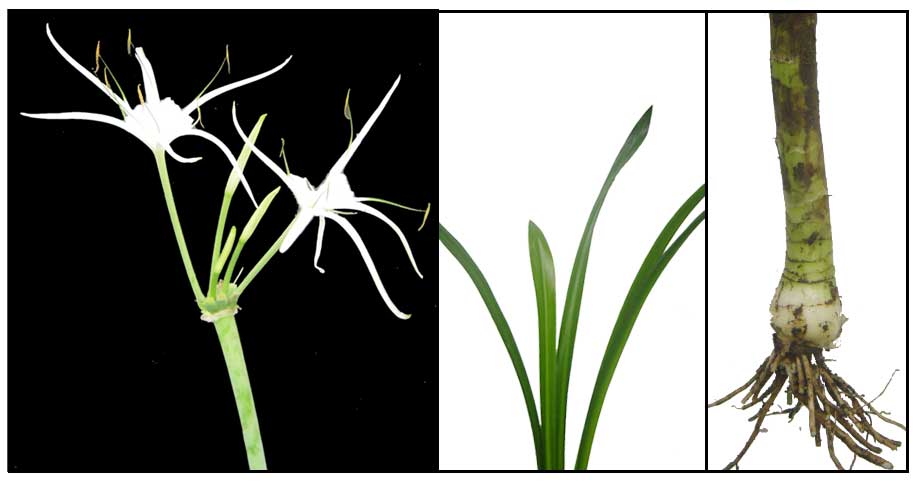
Spider lily is a bulbous, herbaceous plant. Leaves are fleshy, crowded, dark green and
glossy, narrowly lanceolate, 0.5 to 1 meter long, 6 to 7 centimeters wide. Scape
is erect, solid, somewhat compressed, about 0.5 meter tall, bearing at its
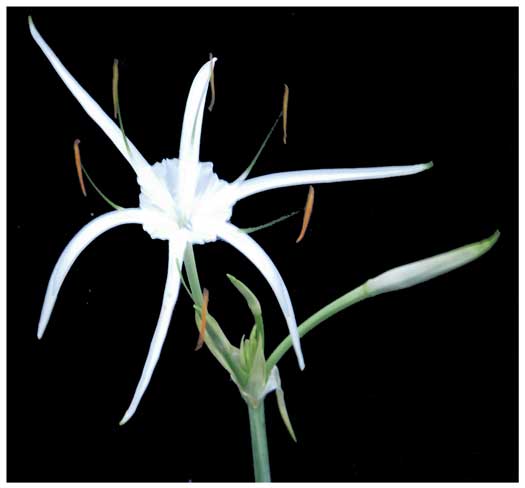
apex few to many, sessile, umbellate flowers. The flowers are fragrant
with the perianth-tube greenish below and whitish above, about 12 centimeters
long, the lobes linear, white, and spreading, 10 centimeters long and 5 to 7
millimeters wide. The membraneous cup connecting the filaments is white, funnel-shaped,
4 to 5 centimeters diameter. The anthers are green and erect.
 Distribution Distribution
- Cultivated as ornamental hedge in Manila and
other large towns.
- Grows wild in waste places, through bulb reproduction.
- Found in a broad range of growing conditions, from wet and boggy to
dry areas.
- Native of tropical America.
 Constituents Constituents
- Yields a toxic alkaloid, lycorine, which is responsible
for its emetic property. The roots contain 0.015 per cent of the alkaloid.
- Phytochemical screening yielded the presence of alkaloids, volatile constituents, tannins, flavonoids, flavonols, saponins, steroids, cardiac glycosides, and terpenoids.
- Pancratistatin isolated from the bulbs.
- Phytochemical screening of bulb and flowers isolated four alkaloids, lycorine (1), hippeastrine (2), 11‐hydroxyvittatine (3), and (+)‐8‐O‐demethylmaritidine (4), and of two flavonoids, quercetin 3′‐O‐glucoside (5), and rutin (6).
GC-MS study of flowers for volatile compounds yielded 26 known compounds
. (8)
Properties
- Emetic.
- Studies on lycorine has shown antineoplastic cytotoxic, and antiviral properties.
Parts
utilized
Bulb, roots.
Uses
Folkloric
- In the Philippines, the bulb is the
only part of the plant used for wound healing.
- In Lao, roots boiled in water, used for testicles too low because of excessive running.
- Mixture of oil and crushed bulbs applied on face to treat freckles and blemishes.
Studies
• Methylflavan / Antioxidant: Study
isolated 7,4'-dihydroxy-8-methylflavan from the extract of P littorale
stem and assessed for its radical scavenging properties. (1)
• Cytotoxicity / Pancrastistatin: A
1993 study isolated pancratistatin (PST) from H littoralis which displayed
potent cytotoxicity against a human tumor cell line. A recent study showed
selectivity of PST to cancer cells and sparing of normal cells.
This study investigated the anti-cancer efficacy and specificity of
two PST-related natural compounds, AMD4 and AMD5. Results showed AMD5
had efficacy and selectivity similar to PST and AMD4 lacked apoptotic
activity. The phenanthridone skeleton in natural Amaryllidaceae alkaloids
may be a common element for selectivity against cancer cells. (2)
• Anti-tumor / Alkaloids: The
biologic activities of isocarbostyril alkaloids showed excellent in
vitro and in vivo cytotoxicity against many tumor cell lines and high
selectivity for cancer cells versus normal cells. (3)
• Lycorine Alkaloids / Littoraline / HI Reverse Transcriptase Inhibition / Cytotoxicity: Study
isolated a new alkaloid, littoraline, with 13 other known lycorine alkaloids
and one lignan. Littoraline showed inhibitory activity of HIV reverse
transcriptase and lycorine and haemanthamine showed potent in vitro
cytotoxicity. (4)
• Pancratistatin / Anticancer / Large Scale Production: Study reports on a method for large scale production of H. littoralis by tissue culture. The species serves as an effective source of pancratistatin, a powerful anticancer agent. Pancratistatin is primarily produced in the bulbs, to a lesser extent, in the roots, and not in the seeds and leaves. Bulbs cultivated in Arizona yielded ca. 9-24 mg/kg f.w. (5) Narciclasine was employed as precursor for synthetic conversion to natural (+) pancratistatin. (•)
• Alkaloids: Phytochemical screening of bulbs and flowers yielded four alkaloids: lycorine, hippeastrine, 11-hydroxyvittatine, and (+)-8-O-demethylmaritidine, plus two flavonoids, quercetin 3-O-glucoside and rutin. Study investigated the antimicrobial activity of a petroleum ether extract of the flowers.
• Narcistatin / Antineoplastic: Human cancer cell line inhibitory isocarbostyril precursors were isolated from the bulbs of Hymenocallis littoralis from the horticultural production or reduction of narciclasine 1a-4 from the same source. (9)
• Anti-Candida Activity: Study evaluated the inhibitory activity of a methanol extract of various plant parts against Candia albicans. The flower and anther were effect at 6.25 mg/ml. (10)
• Antimicrobial: Study evaluated an aqueous extract against three organisms: E. coli, S. aureus, and Candida albicans. Varied concentrations showed inhibitory activity against all the tested organisms.
• Antibacterial: Ethyl acetate and methanol extracts of leaves, flowers, and stem barks showed antibacterial activity against B. subtilis.
• Anti-Inflammatory / Flowers: Study evaluated the anti-inflammatory potential of crude extract of flowers using inhibition of protein denaturation method. Successive ethanol extract have shown potent anti-inflammatory activity by HRBC membrane stabilization method with 83.46% and 84.72% for 100 and 500 µg/ml, respectively. (12)
• Wound Healing / Bulb, Roots, Stem, Anther: Study evaluated the wound healing activity of various methanol extracts of H. littoralis. Bulbs, roots, and anther extracts exhibited wound healing activity at 1 µg/ml at 16 h of treatment. (13)
• Biofilm Inhibition / Leaves: Study evaluated antimicrobial, antioxidant, and antibiofilm potentials of H. littoralis against pathogenic microorganisms using experiment and computtional biology methods. Promising antibiofilm and antimicrobial activities were confirmed against S. aureus NCIM 2654 and C. albicans NCIM 3466. Leaf extract showed good antioxidant activity attributed to phenols and flavonoids. The in vitro and in silico results suggest potential for design of new lead compounds against biofilm producing pathogenic microorganisms. (14)
• Lycorine Quantification in Different Plant Parts: Study developed an analytical method using HPLC for quantification of lycorine in various plant extracts and tissue culture of H. littoralis. The bulb extract yielded hihest lycorine content with 2.54 ± 0.02 µg/mg; the root extract yielding least with 0.71 ± 0.02 µg/mg. The analytical method has potential for quantification of lycorine in tissue culture production and standardization. (15)
• Brine Shrimp Cytotoxicity of Various Plant Parts: Study evaluated the correlation between brine shrimp lethality test (BSL( abd anticancer activity in various methanolic extracts of H. littoralis root, bulb, anther, and leaves. A methanol leaf extrct showed highest cytotoxic effect to the nauplii followed by bulb, root, anther, stem, and flower. Results indicate the extracts are toxic at low concentrations. Studies were suggested to evaluated in vivo toxicity and cytotoxicity assay in mammalian cell lines for safe application to humans. (16)
• Anti-Arthritic / Flowers: Study evaluated the anti-arthritic potntial of a crude extract of flowers using inhibition of protein denaturation method. Results showed potentdose-dependent anti-arthritic activity by inhibition of protein denaturation method. (17)
Availability
Cultivated.
|