|
 Gen info Gen info
- Canthium is a genus of flowering plants in the family Rubiaceae. They are shrubs and small trees, with deciduous leaves and usually thorny stems.
- Etymology: The genus Canthium
was named by Jean-Baptiste Lamarck in 1785 in Encyclopédie Méthodique. The name is a latinisation of "kantankara". a Malayalam name from Kerala for Canthium coromandelicum. Kantan means "shining" and kara means "spiny shrub". (11)
-
The Canthium taxonomy has been problematic; its final circumscription remains in doubt until phylogenetic studies achieve greater resolution for the clade containing Canthium coromandelicum and its closest relatives. (11)
Botany
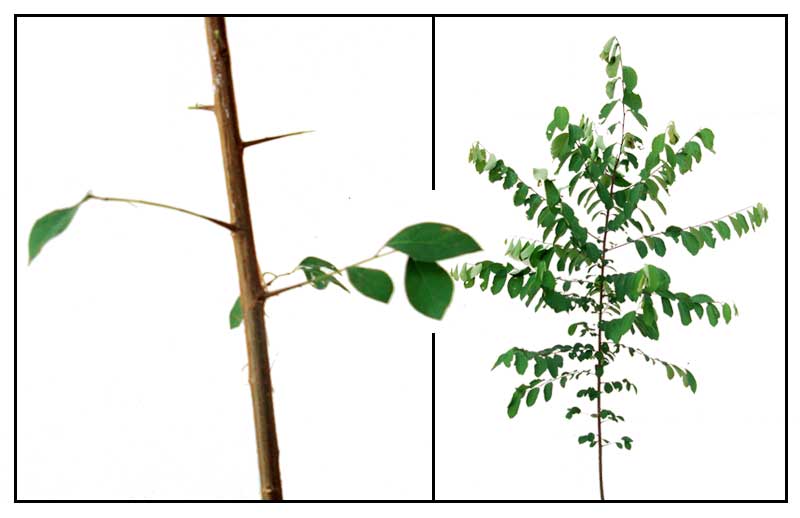
• Kuliak-daga is a shrub or a small tree growing up to 2 to 5 meters. Branches are somewhat hairy and armed with sharp, slender axillary spines 5 to 10 millimeters in length. Leaves are ovate to elliptic-ovate, 1 to 2.5 centimeters long, short-petioled, and pointed at both ends. Flowers are greenish-yellow or nearly white, about 6 millimeters long, borne singly in the axils of the leaves. Fruit is red, fleshy, ovoid, about 7 millimeters long.
 • Shrubs, 2-3 m tall; branches flattened to subterete, often rather slender, strigillose to strigose or pilosulous, sometimes with lateral short shoots to 0.5 cm; thorns slender to stout, 3-30 mm, straight, or sometimes absent. Leaves paired along developed stems or sometimes clustered on lateral short shoots; petiole 2-3 mm, strigillose to pilosulous; blade drying papery, ovate to lanceolate or elliptic, 2-6 × 1-3.5 cm, adaxially glabrous or strigillose to hispidulous along principal veins or throughout, abaxially puberulent to strigillose or hispidulous, base rounded or obtuse, apex obtuse, acute, or weakly acuminate; secondary veins 2 or 3 pairs, in abaxial axils with pilosulous and/or foveolate domatia; stipules deciduous after distalmost several nodes, triangular to ovate, 2-3 mm, densely strigillose to strigose, acute. Inflorescences fasciculate, 0.5-1 cm, few flowered, strigillose to glabrescent; peduncles 1-3 mm, each with a pair of triangular bracteoles ca. 1 mm and fused in pairs. Calyx puberulent to glabrous; ovary portion obconic, ca. 0.8 mm; limb 0.5-0.8 mm, truncate to undulate. Corolla white, funnelform, outside glabrous; tube suburceolate, ca. 2 mm; lobes 5, triangular-oblong, ca. 3 mm, acuminate. Ovary 2-locular; stigma ca. 0.5 mm. Drupes yellow, ovoid to subglobose, obovoid, or somewhat dicoccous, laterally somewhat flattened, 15-25 × 10-20 mm, smooth, glabrous, with calyx limb persistent; pyrenes 2, weakly tuberculate. (Flora of China) • Shrubs, 2-3 m tall; branches flattened to subterete, often rather slender, strigillose to strigose or pilosulous, sometimes with lateral short shoots to 0.5 cm; thorns slender to stout, 3-30 mm, straight, or sometimes absent. Leaves paired along developed stems or sometimes clustered on lateral short shoots; petiole 2-3 mm, strigillose to pilosulous; blade drying papery, ovate to lanceolate or elliptic, 2-6 × 1-3.5 cm, adaxially glabrous or strigillose to hispidulous along principal veins or throughout, abaxially puberulent to strigillose or hispidulous, base rounded or obtuse, apex obtuse, acute, or weakly acuminate; secondary veins 2 or 3 pairs, in abaxial axils with pilosulous and/or foveolate domatia; stipules deciduous after distalmost several nodes, triangular to ovate, 2-3 mm, densely strigillose to strigose, acute. Inflorescences fasciculate, 0.5-1 cm, few flowered, strigillose to glabrescent; peduncles 1-3 mm, each with a pair of triangular bracteoles ca. 1 mm and fused in pairs. Calyx puberulent to glabrous; ovary portion obconic, ca. 0.8 mm; limb 0.5-0.8 mm, truncate to undulate. Corolla white, funnelform, outside glabrous; tube suburceolate, ca. 2 mm; lobes 5, triangular-oblong, ca. 3 mm, acuminate. Ovary 2-locular; stigma ca. 0.5 mm. Drupes yellow, ovoid to subglobose, obovoid, or somewhat dicoccous, laterally somewhat flattened, 15-25 × 10-20 mm, smooth, glabrous, with calyx limb persistent; pyrenes 2, weakly tuberculate. (Flora of China)
 Distribution Distribution
- Native to the Philippines.
-
Found in dry thickets
at low altitudes in Pangasinan, Zambales, Bulacan, Rizal, Camarines, and Sorsogon Provinces in Luzon.
- Also native to Bangladesh, Borneo, Cambodia, China South-Central, China Southeast, Hainan, Jawa, Lesser Sunda Is., Malaya, Philippines, Sumatera, Vietnam. (6)
Constituents
• Phytochemical study showed
the roots to predominantly consist of triterpenes, alkaloids, anthraquinones,
steroids, organic acid, phenols and carbohydrates.
 • Study of essential oils from C. horridum yielded 27 peaks and identified 26 compounds. The main components were 1,2-benzenedicarboxylic acid bis(2-methylpropyl) ester (36.08%), bis(2-ethylhexyl) phthalate (13.82%), n-hexadecanoic acid (8.32%), (Z,Z,Z)-9,12,15octadecatrien-1-ol (9.61%) among others. (1) • Study of essential oils from C. horridum yielded 27 peaks and identified 26 compounds. The main components were 1,2-benzenedicarboxylic acid bis(2-methylpropyl) ester (36.08%), bis(2-ethylhexyl) phthalate (13.82%), n-hexadecanoic acid (8.32%), (Z,Z,Z)-9,12,15octadecatrien-1-ol (9.61%) among others. (1)
• Study of CH stems yielded ten compounds: (+)-syringaresinol (1), scoparone (2), scopoletin (3), 3'-methoxy-4'-hydroxy-trans-cinnamaldehyde (4), sinapic aldehyde (5), syringic acid (6), mannitol (7), vanillic acid 4-O-beta-D-glucopyranoside (8), beta-daucosterol (9) and beta-sitosterol (10). (see study below) (3)
• Study of stem extract isolated 20 compounds:
syringaresinol (1), quercetin(2), scoparone(3), scopoletin(4), fraxidin(5), sinapic aldehyde(6), 3-methoxy-4-hydroxy-trans-cinnamaldehyde (7), coniferyl alcohol (8), p-hydroxybenzoic acid (9), vanillic acid (10), syringic acid (11), syringaldehyde (12), di-isobutyl phthalate (13), vanillic acid 4-O-β-D-glucopyranoside(14), 3-(1-C-β-D-glucopyranosyl)-2,6-dihydroxy-5-methoxybenzoic acid (15), mannitol (16), β-daucosterol (17), β-sitosterol (18), nonadecanoic acid (19), dibutyl phthalate (20). (see study below) (8)
• Bioassay-guided study of stem extract of C. horridum yielded ten compounds: (+)-syringaresinol (1), scoparone (2), scopoletin (3), 3'-methoxy-4'-hydroxy-trans-cinnamaldehyde (4), sinapic aldehyde (5), syringic acid (6), mannitol (7), vanillic acid 4-O-beta-D-glucopyranoside (8), beta-daucosterol (9), and beta-sitosterol (10). (see study below) (10)
• Optimized ultrasound-assisted extraction of CH leaves using polyols yielded major antioxidant bioactive compounds, including: 4-(Butoxymethyl) phenol, 3-O-Caffeoyl-4-O-methylquinic acid, Quercetin 3-(2G-glucosylrutinoside), 2,4-Dihydroxybenzoic acid and other bioactive compounds. (see study below) (12)
Properties
- Studies have suggested antimicrobial, antioxidant, cytotoxicity properties.
Parts used
Leaves and bark.
 Uses Uses
Edibility
· In Java, confections are made from the acid fruit. Leaves are pounded in water to prepare a sweet cincau jelly.
Folkloric
• In the Philippines, boiled leaves and bark used to hasten menstruation.
• In Malaya, plant is used for wounds and fevers.
• In Indo-China, bark and young twigs used for dysentery.
• Decoction also used after childbirth.
• In Indonesia, used to soothe inflamed eyes. In Malaysia, used to heal wounds and promote recovery from childbirth. (7)
• In
Vietnam bark and young stems used to treat dysentery. (7)
• In China, folk healers of the Lahu people apply mashed leaves on snake bites. Plaster from mashed leaves used for
foot pains.
• In China, used for cough, diabetes and hypertension. (11)
• Boiled fruits used to treat foot wounds.
Studies
• Anti-Bacterial: Study
isolated compounds found for the first time, Carulignan, lupeol, b-sitosterol,
among many others. The chloroform fraction showed anti-bacterial activities.
• Phytochemicals / Antibacterial: Study
of the chemical composition of the roots of C horridum yielded triterpene, alkaloid, anthraquinone, steroid, organic acid, phenol, carbohydrates among others. The chloroform fraction was shown to have antibacterial properties. (2)
• Constituents / Antimicrobial: Study of CH stems yielded ten compounds. Syringic acid (compound 6) had the highest activity against Bacillus subtilis; syringaresinol (Compound 1) showed good activity against E coli, B subtilis and S aureus. None of the compounds showed inhibitory activity against Aspergillus niger. (see constituents above) (3)
• Phenolics / Antioxidant: Study
of leaves showed the polyphenol content of 0.4879%. Results show the leaves had strong antioxidant activity, with an IC50 value of 0.35mg/mL. (5)
• Antibacterial / Stems: Bioassay-guided isolated studies of stem extract isolated 20 compounds. Compound 1 showed high inhibitory activity against Escherichia coli, Bacillus subtilis and Staphylococcus aureus. Compounds 3 and 7 had medium activity against these bacteria. No compounds showed activity against Aspergillus niger. (8)
• Antimicrobial / Stem: Bioassay-guided study of C. horridum stem extract yielded ten compounds. Compound 6 showed highest activity against Bacillus subtilis, while compound 1 should good activity against E. coli, B. subtilis and S. aureus. No compound showed activity against Aspergillus niger. (see constituents above) (10)
• Ultrasound-Assisted Extraction of Compounds Using Polyols / Leaves: Study evaluated phenolic compounds in C. horridum leaves using UHPLC-ESI-QTOF-MS/MS. Polyols-based ultrasound-assisted extraction resulted in higher amount of bioactive substances and improved in vitro antioxidant properties compared to use of single polyols. The aqueous-polyols extract from CH leaves exhibited low toxicity. The extract also showed cellular antioxidant properties on NIH/3T3 fibroblasts and reduced melanogenesis in B16F10 melanoma. Study identified potential application of leaves in cosmetic and pharmaceutical applications. (see constituents above) (12)
Availability
Wild-crafted.
|