 Gen info Gen info
- Baccaurea is a genus of flowering plant belonging to the family Phyllanthaceae, comprising over 100 species, distributed from Malesia to the West Pacific. (3)
-
Etymology: The genus name Baccaurea derived from Latin bacca, "berry" and aurea, "golden", referring to the golden color of the berries. The specific epithet macrocarpa derived from Latin, "large-fruited", referring to the plant's large fruits. (2)
Botany
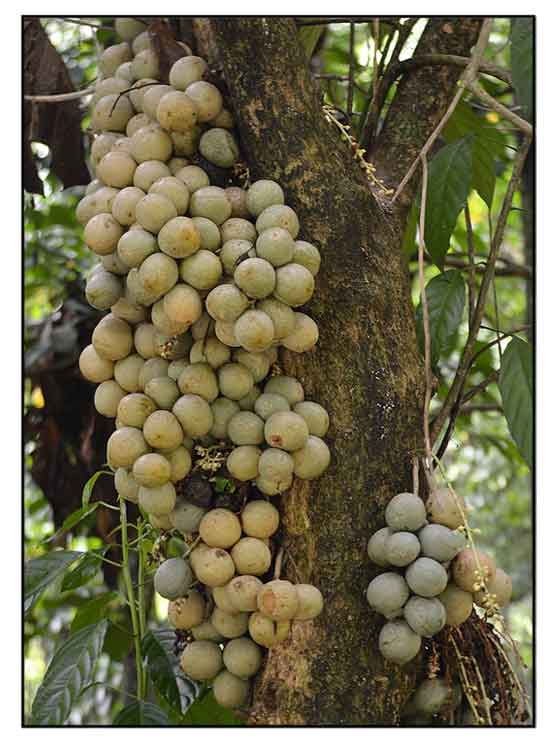
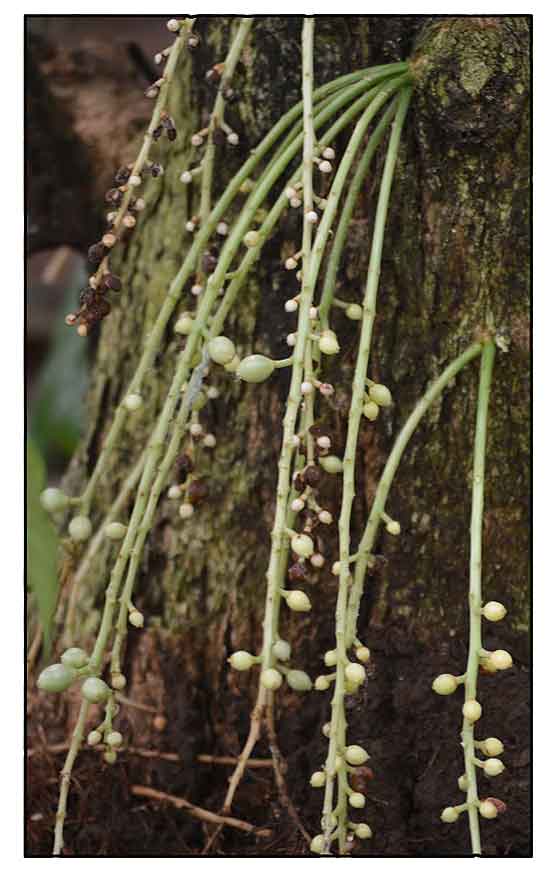
• Baccaurea macrocarpa is a tree up to 15 m tall, with a round crown. Foliage: Leaves are alternate, long-stalked; leaf blades that are 18–36 cm long, with narrowed bases. New leaf blades are pale-green with a slight purple tinge. Flowers: Flowers are yellowish-green, found in clusters that are 7.5–20 cm long on branches and sometimes the trunk. Female flowers are shorter than the male ones. Fruits: Fruits are faintly 3-grooved, and 25–64 mm-wide berries; either oblong with 1–2 seeds, or round and somewhat apple-shaped with 3–6 seeds; found singly or in bunches of 2–4 at the end of strings up to 20 cm long. Outer fruit coverings are dull brownish-gray or reddish-brown gray. Seeds are embedded in sour-sweet pulp that changes from cream-white and opaque to translucent when the fruit ripens. (2)
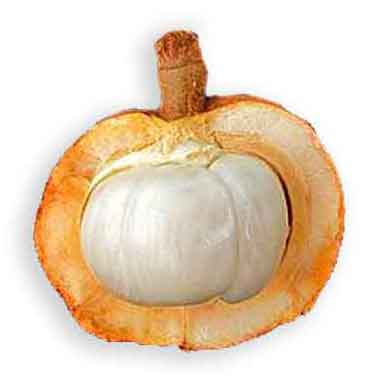
• It is dioecious, and the female tree bear fruit directly on the trunk and large branches. Fruit is large, orange-skinned, white-fleshed, with a delicious tangy flavor akin to mandarin (tangerine) (3)
 • Trees up to 27 m high, candelabriform branching pattern weak, branchlets glabrous. Indumentum of small stellate and simple hairs. Stipules 2-9 by 1-5 mm. Leaves: petiole (10-)22-145 mm long; blade (ovate to) elliptic (to obovate), (7.2-)9-37 by 3.1-17.5 cm, length/width ratio (1.1-)1.6-2.8(-3.5), leathery to papery, base attenuate to cuneate (to round), lower surface mostly scarcely hairy on midrib and nerves, disc-like glands present, nerves 6-10(-13) per side. Staminate inflorescences (axillary to) ramiflorous to cauliflorous, 1 to few together, up to13 cm long; bracts 1-3 mm long, bracteoles usually present. Staminate flowers 0.7-2 mm in diameter, green to yellow to white; pedicel 1-2 mm; sepals 5, elliptic, 0.7-1.5 by 0.4-0.7 mm; stamens 5(6), 0.1-0.25 mm long, filaments 0.1-0.2 mm long, straight, anthers c. 0.1 by 0.15 mm. Pistillate inflorescences ramiflorous to cauliflorous, 1-3 together, up to 18 cm long. Pistillate flowers 2-4.5 mm in diameter; pedicel 3-7.5 mm long; sepals 4-6, ovate, 1.5-2.8 by 1-1.3 mm; ovary 3- or 4-locular; style 0.5-1.5 by c. 1 mm wide; stigmas 0.5-1 mm long, cleft. Fruits (sub)globose, fleshy capsules, up to 80 mm in diameter when fresh, 30-65 by 34-75 by 34-75 mm when dry, brown to yellow to orange to dull red to dark green, loculicidally (and septicidally) dehiscent, (sub)glabrous outside, subglabrous to densely hairy inside. Seeds 13-23 by 11-18.5 by 4-7 mm; arillode white to yellow (to orange). (Flora of Thailand) • Trees up to 27 m high, candelabriform branching pattern weak, branchlets glabrous. Indumentum of small stellate and simple hairs. Stipules 2-9 by 1-5 mm. Leaves: petiole (10-)22-145 mm long; blade (ovate to) elliptic (to obovate), (7.2-)9-37 by 3.1-17.5 cm, length/width ratio (1.1-)1.6-2.8(-3.5), leathery to papery, base attenuate to cuneate (to round), lower surface mostly scarcely hairy on midrib and nerves, disc-like glands present, nerves 6-10(-13) per side. Staminate inflorescences (axillary to) ramiflorous to cauliflorous, 1 to few together, up to13 cm long; bracts 1-3 mm long, bracteoles usually present. Staminate flowers 0.7-2 mm in diameter, green to yellow to white; pedicel 1-2 mm; sepals 5, elliptic, 0.7-1.5 by 0.4-0.7 mm; stamens 5(6), 0.1-0.25 mm long, filaments 0.1-0.2 mm long, straight, anthers c. 0.1 by 0.15 mm. Pistillate inflorescences ramiflorous to cauliflorous, 1-3 together, up to 18 cm long. Pistillate flowers 2-4.5 mm in diameter; pedicel 3-7.5 mm long; sepals 4-6, ovate, 1.5-2.8 by 1-1.3 mm; ovary 3- or 4-locular; style 0.5-1.5 by c. 1 mm wide; stigmas 0.5-1 mm long, cleft. Fruits (sub)globose, fleshy capsules, up to 80 mm in diameter when fresh, 30-65 by 34-75 by 34-75 mm when dry, brown to yellow to orange to dull red to dark green, loculicidally (and septicidally) dehiscent, (sub)glabrous outside, subglabrous to densely hairy inside. Seeds 13-23 by 11-18.5 by 4-7 mm; arillode white to yellow (to orange). (Flora of Thailand)
Distribution
- Native to the Philippines.
-
Some compilations list it as introduced.
- Also native to Borneo, Malaya, Sumatera, Thailand. (1)
 Constituents Constituents
- Methanolic extract of bark yielded secondary metabolites including alkaloids, flavonoids, phenolics, steroids, and triterpenoids. (see study below) (5)
- Nutrient analysis of fruit (per 100 g) revealed low level of ash (0.32-1.64%), fat
(0.24-5.98%), protein (0.44-2.73%), water 61.99-84-84%), fiver (7.91-18.83%), and carbohydrates (13.40-27.66%). Estimation of energy content (kcal/100 g) is about 2.9% to 8.8% of 2000 kcal daily requirement. Macro minerals yield were P (60.88±5.71 - 720.95±54.67 μg/g), Ca (149.94±13.73 - 515.32±23.33 μg/g), and Mg (137.98±14.76 - 315.18±24.51 μg/g), and a sufficient amount of micro mineral Zn (6.68±1.32 - 15.29±3.10 μg/g), Fe (0.02±0.00 - 20.97±17.32 μg/g), Cu (0.75±0.00 - 4.94±0.11 μg/g), and Mn (0.22±0.00 - 2.42±0.01 μg/g). Phenylalanine was the most significant essential amino acid in the fruit, followed by leucine, isoleucine, valine, threonine, histidine, lysine, and methionine. Highest level of essential amino acids was in the seeds (1085.72 mg/g), followed by flesh (315.47 mg/g) and skin (233.58 mg/g). Seeds also contained the most nonessential amino acids i.e., tyrosine, alanine, aspartate, glutamate, asparagine, serine, glycine, arginine (1074.39 mg/g), while the flesh yielded 312.24 mg/g, and the skin 229.74 mg/g. (8)
- GC-MS analysis of methanolic bark extract revealed 37 compounds. Main components were fatty acids and fatty acid esters. Total content of unsaturated fatty acids and esters with a peak area of 19.88% including 9,12-octadecadienoic acid (Z,Z)-, methyl ester, 9-octadecenoic acid, methyl ester, undec-10-ynoic acid, undecyl ester, undec-10-ynoic acid, undecyl ester, cis-vaccenic acid, and oleic acid. (5)
Properties
Studies have suggested antioxidant, antibacterial, antileukemic, antiaging properties.
Parts used
Bark, fruits, leaves, stem.
Uses
Edibility
- Fruits are edible with a sour-sweet pulp.
Folkloric
- No report found on usage as folk medicine.
Others
- Wood: Timber is durable and strong, suitable for construction.
Studies
• Antioxidant / Bark: Study evaluated the phytoconstituents, toxicity, and antioxidant activity of bark of Tampoi. Toxicity test using brine shrimp lethality test showed no toxicity with LC50 >1000 ppm. On antioxidant activity testing by DPPH assay, the methanol bark extract showed significant activity with IC50 of 11.15 ppm. GC-MS analysis isolated 37 compounds, including methylparaben, a phenolic predicted to act as antioxidant. (see constituents above) (5)
• Antioxidant / Fruits: Study evaluated different parts of fruits (pericarp, flesh, and seed) of B. macrocarpa for antioxidant activity, TPC, TFC, TAC, and carotenoid contents. Results showed the pericarp contained highest amount of total phenols, total flavonoid, total anthocyanin, and total carotenoid with values of 60.04 GAE/g, 44.68 mg CE/g, 1.23 mg c-3-gE/100 g, and 0.81 mg BCE/g. The pericarp showed highest antioxidant activity by DPPH. ABTS, and FRAP assays. Antioxidant activity significantly correlated with total phenol and flavonoid contents. (6)
• Antibacterial / Leaves: Study evaluated the antibacterial activity of extract and fraction of Baccaurea macrocarpa leaves. Ethyl acetate fraction yielded secondary metabolites such as alkaloid, anthraquinone, flavonoid, and tannin. Disc diffusion method showed zones of inhibition of 8.33 mm and 31.67 for E. coli / ciprofloxacin and 7.33 mm and 17 mm for B. cereus / clindamycin. (7)
• Antileukemic Activity / Stem: Study evaluated methanol stem extracts of Baccaurea macrocarpa, Syzygium jambos, Bouea macrophylla, and Diospyros discolor. B. macrocarpa showed antileukemic activity with 22.6% survived HL-60 percentage, second to S. jambos at 12.7%. (9)
• Gel Mask Preparation to Prevent Skin Aging / Fruit: Antioxidants may help prevent skin damage due to the aging process. Study evaluated a gel mask preparation from tampoi fruit as antioxidant to treat skin problems. Mask was prepared by mixing a base mask of PVA (Polyvinyl alcohol), propyline glycol, Carbomer 940 to which tampoi fruit extract is added, making 4 formulas F1, F2, F3, and F4 at 3, 6, 12, and 18% respectively. Results showed a significant effect on the viscosity test and adhesion test of each formula. The pH test and spreadability test did not have a significant effect on each formula. The optimal formula was F1 with PVA concentration of 3%. (10)
• Toxicity Testing: Toxicity testing on methanolic bark extract of B. macrocarpa using BSLT (brine shrimp lethality test) method showed the extract was not toxic with LC50 above 1000 ppm. (5)
• Antioxidant / Cosmetic Potential / Peels: Study evaluated phytochemicals, bioactive compounds, and antioxidant activity of Langkhae peel extract. A 95% ethanol crude extract yielded highest flavonoid content 0.14 mg GAE/g. Condensed tannins of 50% ethanol crude extract was highest at 0.54 mg GAE/g. Hydrolysable tannins was highest in the 95% methanol crude extract at 0.60 mg GAE/g. The 95% methanol crude extract showed highest phenolic compound content at 2.13 mg GAE/sample. On antioxidant testing by DPPH, ABTS, and FRAP assay, the 95% methanol crude extract was highest. Results suggest the peel extracts has potential as medicine or cosmetic agent free radical. (11)
Availability
- Wild-crafted.
- Seeds in the cybermarket.
|