|
 Taxon confusion Taxon confusion
Physalis, a genus of the family Solanaceae consists of about 100 species. Among these, Physalis minima has been confused with P. angulata (putokan). Some compilations list them as synonyms, others list them as separate species. In Bangladesh, the two have long been misidentified. A critical examination separates them as species. (See below: sources)
Botany
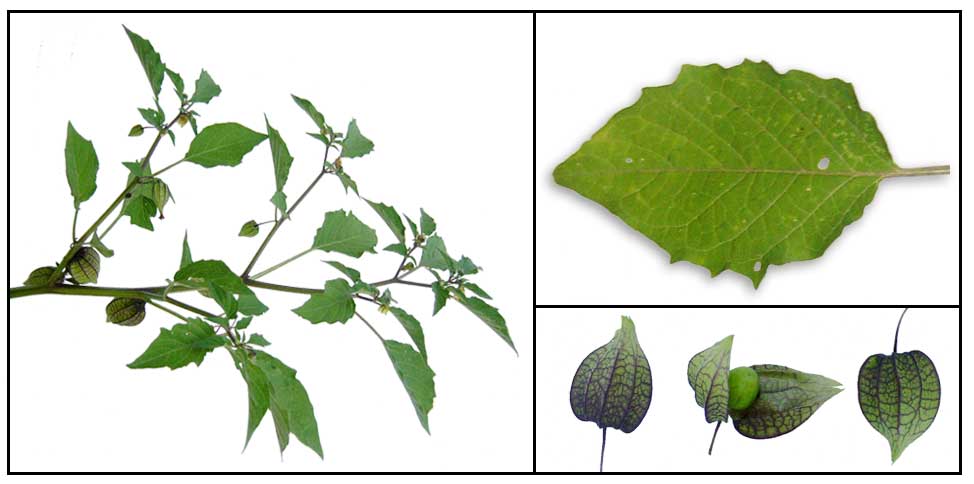
Pantug-pantugan is an erect, branched, hairy
annual herb, growing 0.5 to 0.8 meter high. The branches are terete
and often tinged with purple, the ultimate ones slightly angular. Leaves
are ovate, 6 to 12 centimeters long, 4.5 to 7 centimeters wide, with pointed tip, rounded
or slightly heart-shaped base, nearly entire or with faintly undulately lobed
margins. Flowers are solitary, axillary, about 8 millimeters long. Corolla is
pale yellow, with 5 large, purple spots at the base inside. Fruit
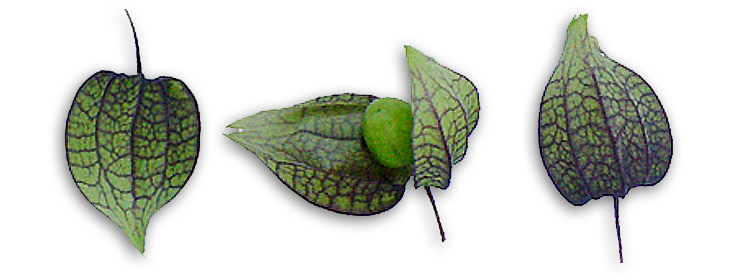
is round, fleshy and edible, about 1 centimeter in diameter. Calyx is inflated,
accrescent, and ovoid, about 3 centimeters long, 2 centimeters in diameter, green,
with 5 prominent and alternating slender and purplish ribs.
Distribution
- Found from the Babuyan Islands and northern Luzon to Mindanao and Palawan.
- Often
common in open, waste
places at low altitudes, ascending up to 1,600 meters.
- Pantropic weed.
Constituents
- Phytochemical studies yield alkaloids, anthraquinones, flavonoids, cardiac glycosides, phenols, quinones, reducing sugars, saponins, steroids, starch, tannin and terpenoids from the stem, leaf, and unripe fruit.
- Ethanolic extract of leaves yielded major
compounds, viz. acetamide, 2,2,2- trifluoro-N-methyl- (7.2%), 2-cyclopenten-1-one, 2- methyl- (3.83%), phytol (17.88%), n-Hexadecanoic acid (29.81%), octadecanoic acid (5.04%), oleic acid (3.55%), 9,12-octadecadienoic acid (Z,Z)- (12.47%), hexaethylene glycol monododecyl ether (5.6%) and 9,12,15-octadecatrienoic acid, (Z,Z,Z) (14.63%). Ethanolic extract of roots yielded n- Hexadecanoic acid (4.06%), 2-[2-[2-[2-[2-[2-[2-(2- Hydroxyethoxy)ethoxy]ethoxy]ethoxy] ethoxy]ethoxy]eth oxy]ethanol (1.43%), O-Methyl-DL-serine,N- dimethylaminomethylene-,ethyl ester (63.20%) and Ethyl dl-(1-naphthyl)glycolate (4.94%). (18)
- Fruits yielded major compounds, viz. acetamide, 2,2,2-trifluoro-N-methyl- (3.90%), 4H-pyran-4-one, 2,3-dihydro-3,5-dihydroxy-6- methyl-(8.40%), 5-hydroxymethylfurfural (14.07%), (Z)- 3-phenyl-2-propenoic acid (3.33%), n-hexadecanoic acid (28.98%), octadecanoic acid (3.35%), octadec-9-enoic acid (9.15%), 9,12-octadecadienoic acid (Z,Z)- (16.09%), 2-Isopropoxyethyl propionate (9.28%) and 9,12,15- octadecatrienoic acid, (Z,Z,Z)- (3.47%).
(18)
- Study for bioactive compounds in leaves yielded heneicosanoic acid (25.22), bicyclo [4.1.0] hepta-2, 4-dien (27.41), octadecanoic acid (CAS), stearic acid (31.19) and octadeca-9, 12-dienoic acid (32.02). Phenolic compounds profile yielded ellagic acid (4.13 min), catechol (3.59 min), gallic acid (4.12 min) and catechin (7.41 min).
(19)
- A solvent fraction of chloroform extract of cultured tissues yielded alkaloids, fixed oils, resins, steroids, tannins, xanthoproteins and glycosides. (see study below) (25)
- GC-MS analysis of ethanolic extract of leaf, root, and fruit
yielded important compounds like phytol, vitamin E, oleic acid, and n-hexadecanoic acid. (28)
- Phytochemical screening of leaves yielded flavonoids, alkaloids, tannins, saponins, steroids, cardiac glycosides, reducing sugars and terpenoids. Methanol extract yielded a t of 78.3 mg/g of phenolic compounds. Total flavonoid content was 61.3 mg/g of flavonoid. (see study below) (29)
- GC-MS study for methyl esters if fatty acids in oil
yielded a total of nine fatty acids in quantifiable amount. Both saturated and unsaturated FAs were identified. Among the unsaturated fatty acids, palmitic acid was found in highest concentration (46.83%), with linoleic acid (w-6) and linolenic adie (w-3) in appreciable amounts (16.98 and 14.80%, respectively). (30)
-
Bioactivity-guided phytochemical study yielded eight compounds, elucidated as 3-isopropyl-5-acetoxycyclohexene-2-one-1 (1), isophysalin B (2), physalin G (3), physalin D (4), physalin I (5), physordinose B (6), stigmasterol-3-O-β-D-glucopyranoside (7) and 5α-6β-dihydroxyphysalin R (8) (see study below) (32):
 Properties Properties
- Bitter tasting, cooling
in effect.
- Fruit is alterative, diuretic,
aperient.
- Plant is considered appetizer, antipyretic, anti-inflammatory, antitussive, diuretic, laxative, expectorant, purgative, and tonic._
- Studies have suggested anti-fertility, antimicrobial, anti-inflammatory, analgesic, hypoglycemic, anticancer, antimicrobial, antioxidant, diuretic properties.
Parts utilized
Roots, leaves, fruits.
Uses
Nutritional
- Fruit is edible, with a taste of a sweet cherry tomato.
Folkloric
- In Java, root is used as vermifuge.
- Root extract used for fever.
- Poultice of leaves, smeared with oiled and heated, applied to ulcers.
- Decoction of leaves with Plantago major used for gonorrhea; also, diuretic.
- Fruit used as alterative, diuretic and aperient; used in dropsy, urinary diseases, and gout.
Used for colds and fever, swelling pain of the throat, bronchitis.
- Fruit used for gout; also used to infuse vigor and offset premature decay.
- In Konkan, plant paste made with rice water used to restore flaccid breasts.
- Poultice of fruits used for headaches and intestinal pains.
- In the Punjab, used for gonorrhea.
- Malays used a poultice for headaches and intestinal pains
- Pounded
fresh material may be used as poultice or decoction of the same may
be used as wash for eczema infection.
- Juice of leaves, mixed with mustard oil and water, used for
earaches.
- In India, used for dysuria,
ascites, ulcers, cough, bronchitis, pruritus and erysipelas. Used as a tonic, diuretic and purgative; as a remedy for spleen disorders. Also used for diabetes.
- In Uganda, infusion of leaves used for treatment of cough. (38)
Studies
• Antifertility:
Study of extract of P minima on female albino rats exhibited variations
in ovarian and uterine weights and significant histopathologic changes
in the histoarchitecture of the female reproductive system. (1)
• Antimicrobial:
Antimicrobial activity of Rauvolfia tetraphylla and Physalis minima
leaf and callus extracts: Leaf and callus extracts of R. tetraphylla
and P. minima inhibited bacterial and fungal growth. (2)
• Phytochemicals / Withaphysalin D:
Study yielded Withaphysalin D, a new withphysalin. (3)
• Anti-Inflammatory / Analgesic:
Study of the whole plant of Physalis minima on rats showed marked anti-inflammatory and analgesic activities. The antipyretic activity was insignificant. Results showed PM as a potential candidate as an anti-inflammatory and analgesic agent. (4)
• Cytotoxic / Anti-Cancer / Human Lung Adenocarcinoma Cell Line:
In the study, the chloroform extract of Physalis minima exhibited remarkable cytotoxic activities on human lung adenocarcinoma cell line in time- and dose-dependent manners. Its apoptotic effect suggests potential for development as an anticancer drug. (5)
• Cytotoxic / Anti-Cancer / Withaphysalin: Study yielded a novel withanolide, withaphysalin P (1) with six other new withaphysalins (2-7), together with three known withaphysalins (8-10). Compounds 1-3, 7-10, 7a and 7b showed moderate cytotoxic activity against two human cancer cell lines – colorectal-carcinoma HCT-116 cells and non-small cell lung cancer. NCl-H460 cells. (6)
• Hypoglycemic / Alpha-Glucosidase Inhibition:
Physalis minima extract showed in-vitro inhibitory activity of intestinal alpha glucosidase enzyme maltase with decrease intestinal absorption of monosaccharides through inhibition of disaccharide hydrolysis. (7)
• Apoptotic Effects / Anti-Breast Cancer:
A chloroform extract of Physalis minima produced significant inhibition against human T-47D breast carcinoma cells. It induced apoptotic cell death via p53-, caspase-3-, and c-myc-dependent pathways. (8)
• Antibacterial Potential:
Study showed a methanol and chloroform extracts of P. minima exhibited potent inhibitory activity against all the bacterial strains tested. Polar compounds in the crude extract were responsible for the antimicrobial action. (10)
• Antibacterial / Leaves and Stems: Study showed leaf and stem extracts to have moderate antibacterial activity when evaluated against Bacillus cereus, B. subtilis, Citrobacter sp., Enterobacter aerogenes, E. coli, K. pneumonia, P. aeruginosa, P. fluorescens and S. aureus. Overall antibacterial assay showed the ethanolic extract to be more effective than other solvents. (12)
• Anti-Lipid Peroxidation:
Study evaluated the free radical scavenging activity of ethanolic extracts of Piper trioicum and Physalis minima, with goat liver as the lipid source. Results showed suppression of lipid peroxidation. In the study, P. trioicum extract showed more activity than Physalis minima. (11)
• Diuretic Activity / Leaves:
Study evaluated the diuretic effect of petroleum ether extract of P. minima in albino rats. Results showed significant increase in urine volume, with increased excretion of potassium and sodium. The effect was similar to furosemide. (15)
• Antioxidant / Stems and Leaves:
Study evaluated the in vitro antioxidant activity of crude extracts of stems and leaves of P. minima by DPPH and reducing power assay. The methanolic extract of leaf showed higher activity to others extracts of stem and leaves. The entire tested sample showed lower scavenging activity than standard ascorbic acid. (16)
• Free Radical Scavenging Activity / Leaves :
Study screened an ethanolic extract for in vitro antioxidant activity by various radical scavenging assays. Results showed marked concentration dependent antioxidant activity and may be attributed to the presence of bioflavonoids in the leaf. (17)
• Antidiabetic / Toxicity Study: Study evaluated the hypoglycemic effects of P. minima extracts in alloxan-induced diabetic rats.
Chronic administration of flower and leaf extract showed a fall in fasting blood sugar of rats. Toxicity study showed the medium lethal dose (LD50) f the extract is higher than 1 g/kg body weight. (20)
• Hypoglycemic Effect: Study evaluated the effect of methanolic extract of Physalis minima on blood glucose level and sperm quality in normoglycemic mice. Results showed a significant dose dependent decrease (p<0.05) in blood glucose of treatment groups, without affecting sperm quality in male mice. (21)
• Anti-Inflammatory Effect on Gastric Tissue: Study investigated the effect of a methanolic extract of P. minima in gastric inflammation and gastric ulcer formation in rats. The methanol extract of Pm exhibited anti-inflammatory action due to its effect in inhibiting phospholipase A2 expression in gastric tissue. The gastric ulcer formation as side effect of the MEMP was lower compared to aspirin. (22)
• Antidiabetic / Toxicity Study /Leaves: Study evaluated Physalis minima leaves for in vitro a-amylase, a-glucosidase inhibitory activities and glucose uptake by yeast cells in alloxan-induced diabetic rats. Results showed a dose-dependent percent inhibition by the extract against α-amylase (16%-84%), α-glucosidase (18%-76%), and glucose uptake by yeast cells (16%-78%). Toxicity study showed a medium lethal dose (LD50) of the extracts is higher than 1 g/kg body weight. (23)
• Anti-Ulcer Activity: Study evaluated the anti-ulcer effect of different extracts of Physalis minima in NSAIDs induced ulcer model in albino rats. Extract dose at 200 and 400 mg/kg produced significant inhibition of gastric ulcers induced by NSAIDs. (24)
• Antimicrobial / Cultured Tissues: Study evaluated chloroform extracts of cultured tissues of Physalis minima for in vitro antibacterial studies and phytochemical analysis. The chloroform extract exhibited activity against all tested organisms: seven bacterial species (Bacillus megaterium, B. subtilis, E. coli, E. faecalis, P. vulgaris, P. aeruginosa, S. aureus) and three fungal species (A. niger, A. fumigatus, and C. albicans). E. coli was found highly sensitive. (see constituents above) (25)
• Influence of Growth and Ripening on Antibacterial Potential / Fruit: Methanol and ethyl acetate extracts of mature and ripened fruit showed significant activity against Micrococcus luteus and Bacillus subtilis. Study demonstrated the influence of maturity indices of P. minima fruit on its antibacterial potential. (26)
• Hepatoprotective Against Paracetamol Toxicity / Leaves: Study evaluated the hepatoprotective activity of P. minima against paracetamol-induced hepatic injury in rats. Results showed hepatoprotective activity in comparison with standard hepatoprotective drug silymarin. Phytochemical screening yielded flavonoids, glycosides, saponins, tannins, amino acids, and terpenoids. (27)
• Anticancer / Leaves: Study evaluated P. minima for anticancer activity. The % viability of HeLa cell line and Hep2 cell line were 80% and 71.8%, respectively. Percentage of growth inhibition of methanolic extract in SRB assay increased with increasing concentration against both HeLa and Hep2 cell lines (68 and 58% respectively). The methanolic extract showed strongest growth inhibitory activity of both HeLa and Hep2 cell lines (85 and 73%, respectively) in MTT assay. (see constituents above) (29)
• Analgesic Activity: Ethanol and ethyl acetate extracts of P. minima were screened for phytochemicals and analgesic activity using hot plate method in albino wistar rats. Results showed significant and nearly equal analgesic activity in both extracts. The analgesic activity may be due to the presence of flavones, which re known to target prostaglandins involved in late phase of acute inflammation and pain perception. (31)
• Chemopreventive / Michael Reaction Acceptors: Bioactivity-guided phytochemical analysis and chemopreventive effects of P. minima constituents. Results demonstrated the ethyl acetate extract had potential quinone reductase (QR) inducing activity with induction ration (IR, QR induction activity) value of 1.47 ± 0.24 and glutathione binding property as potential Michael reaction acceptors. Bioactivity-guided phytochemical study yielded eight compounds. Compounds 2 (isophysalin B) and compound 6 (physordinose B) showed significant QR inducing activity with IR values of 2.80 ± 0.19 and 2.38 ± 0.46, respectively. (see constituents above) (32)
• Acute Oral Toxicity Study / Leaves: Study evaluated the acute oral toxicity of water extract of Physalis minima leaves on female Sprague-Dawley rats at dosage of 2000 mg/kg for a period of 14 days using OECD guidelines. Results no significant toxic effects as evidenced by absence of mortality and no change in behavioral pattern. Histopathological architecture was normal. (33)
ª Immunomodulatory / Fruits: Study evaluated P. minima unripe fruits for immunomodulatory activity. HPLC and LC-MS of methanolic crude extract of unripe fruits showed presence of active constituents i.e., steroidal alkaloids, which may be responsible for stimulant properties. Results suggest potential for fruits to b used as drug to strengthen immunity against various infections. (34)
• Subchronic Toxicity / Leaves: Study evaluated the subchronic toxicity of aqueous extract of P. minima leaves in female Wistar rats at doses of 90, 270, and 450 mg/kbw for 90 days. Results showed the aqueous extract of leaves do not induce hematologic toxicity, hepatotoxicity, and renal toxicity in subacute toxicity study. (35)
• Wound Healing / Fruits: Study evaluated the wound healing efficacy of hydroalcoholic extract of Physalis minima in excision wound model in male Wistar albino rats. Results showed promotion of wound healing via bactericidal activity. (36)
•
Anticancer / Apoptotic and Non-Apoptotic Cell Death in Human Ovarian Carcinoma Caov-3 Cells: Study evaluated a chloroform extract for cytotoxicity and possible cell death mechanism in human ovarian Caov-3 carcinoma. Results showed the chloroform extract exerted anticancer effect due to a combination of apoptotic and autophagic cell death mechanisms on Caov-3 cells. Induction of programmed cell death was mediated via c-myo, p53, and caspase-3 dependent pathway. (37)
Availability
Wild-crafted.
|