|
 Gen info Gen info
- Apocynaceae is a family of flowering plants that includes trees, shrubs, herbs, stem succulents, and vines, commonly known as the dogbane family (some taxa used as dog poison). Most exude a milky latex when cut.
- Taxonomy: As of 2012; the family was reported to contain some 5,100 species, in five subfamilies: Apocynoideae, Ascelpiadoideae , Periplocoideae, Rauvolfioideae, and Secamonoideae. 375 genera are currently accepted. (34)
- Cascabella thevetia is a poisonous plant native throughout Mexico and
Central America. It is widely cultured as an ornamental.
(35)
Etymology: The genus name Cascabela (cascabel or cascavel) is Spanish for small bell, a snake's rattle, or a rattlesnake itself, alluding to the plant's toxicity comparable to the venom of a rattlesnake. The latin specific epithet thevetia commemorates Andre de Thevet (1516-1590) a French Franciscan priest and explorer, who explored Brazil and Guiana, where the plant is known as chapéu-denapoleão, i.e., Napoleon's hat. (35)
 Botany Botany
• Campanero is an erect, branched, smooth shrub or small tree growing
to a height of 2 to 5 meters, with a copious milky sap. Leaves are linear, glossy and green, 10 to 15
centimeters long, 7 to 10 centimeters wide, stalkless and shining. Calyx teeth are pointed, 7 to 9 millimeters long and green. Corolla is
funnel- or bell-shaped, about 7 centimeters long, about 5 centimeters wide, and yellow. The
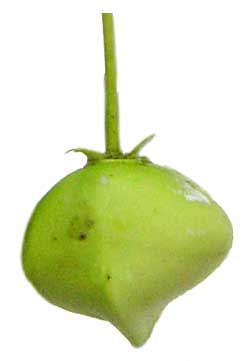
fruit is a drupe, smooth, green, shining, somewhat hard, rounded and angled, 3 to 4 centimeters in diameter.
• Cascabela thevetia is an evergreen tropical shrub or small tree. Its leaves are willow-like, linear-lanceolate, and glossy green in color. They are covered in waxy coating to reduce water loss (typical of oleanders). Its stem is green turning silver/gray as it ages. Flowers bloom from summer to fall. The long funnel-shaped sometimes-fragrant yellow (less commonly apricot, sometimes white) flowers are in few-flowered terminal clusters. Fruit is deep red-black in color encasing a large seed that bears some resemblance to a 'Chinese lucky nut.' (35)
Distribution
- Cultivated and naturalized.
-
Widely scattered cultivation as an
ornamental plant in Manila and larger towns in the Archipelago.
- Native to South America.
- Now pantropic.
 Constituents Constituents
- Seeds yield a toxic compounds, mostly cardiac glycosides and their free aglycones such as thevetin, theveridoside, theveside, cerberine, peruvoside, perusitin, and digitoxigenin.
-
Study showed that on hydrolysis the glucoside breaks up into glucose and an amorphous product, thevetidine.
- Seeds yield a fixed oil containing triloein 63%, tripalmitin and stearin,
37%. Also yields equally high protein content of the defatted meal (30-37% protein).
- Thevetin has been classified with the digitaline group so activity on
the heart muscle, blood pressure elevation, heart irregularities. It
also causes increased intestinal peristalsis, increased salivation,
and pupil contraction. Experiments have showed thevetin produces death by asphyxiation and cardiac paralysis. Applied to the skin, it produces convulsions of cerebral origin, and paralysis of spinal origin.
- Flowers yielded quercetin, kaempferol and quercetin-7-o-galactoside.
- Phytochemical evaluation showed the plant to be rich in active constituent, i.e., α-amyrin acetate, lupeol acetate, α-amyrin, ß-amyrin, lupeol, and thevetigenin.
- Phytochemical screening of leaf extracts yielded bioactive compounds, viz. alkaloids, phenols, flavonoids, steroids, tannins, coumarins, and reducing sugars. (21)
- Fruits yielded alkaloids, steroids, flavonoids and tannins, with the absence of phenolics, saponins, and anthroquinone. (23)
 Properties Properties
- Drought resistant and tolerant to high temperatures.
-
Bark is emetic, febrifuge, and antiperiodic.
- Leaves are cathartic.
- Seeds are purgative.
- Toxicity: Toxic to most vertebrates. See Toxicity Concerns below.
- Milky juice is poisonous and vesicant.
- Studies have shown
antimicrobial, anti-termite, anti-inflammatory, anti-spermatogenic, anti-diarrheal, cytotoxic, antioxidant, immunomodulatory, hemolytic, piscicidal properties.
Parts utilized
Leaves, seeds, bark.
Uses
Edibility
-
All parts of the plant are toxic if eaten, especially the fruit and seeds. (see toxicity below)
Folkloric
- In the Philippines, bark decoction, in regulated doses, used as an emetic and febrifuge, especially for intermittent fevers.
- The bitter bark is considered a powerful febrifuge, only grains equal a dose of cinchona. In excess, it is emetic and poisonous.
 - Bark is antiperiodic in small doses. - Bark is antiperiodic in small doses.
- Leaves used as cathartic.
-
In some countries, seeds are chewed
for a drastic emetic effect.
- In Bengal and neighboring provinces, seeds also used as abortifacient.
- In Puerto Rico, seeds are used as drastic emetic.
- One kernel of seed produces acro-narcotic symptoms similar to aconite.
-
Seeds are bitter and chewed for purgative effect.
- Milky juice considered highly poisonous and used as vesicant.
- Oil is used externally for skin ailments.
- In the Mishing community of northeast India, fresh milky latex is taken orally to induce abortion. (31)
- In India, leaves are ground and paste applied to bone fractures. (32)
Others
- Fish poison: Used for poisoning fish.
- Suicide:
In India, highly poisonous seeds used for homicidal and suicidal purposes. (•) In South India and in Sri Lanka, swallowing seeds is one of the preferred methods of suicides in villages where the plant grows in abundance. (35)
- Ritual: In India, bright yellow flowers are used for religious purposes and worshiping by Hindu devotees. (35)
Studies
• Antimicrobial: Study of an ethanol extract showed antimicrobial activity which
may be attributed to various phytochemicals – flavanoids, phenolics,
polyphenols, tannins, terpenoids, sesquiterpenes – effective antimicrobial
substances against a wide range of microorganisms. (2) Study of hexane, chloroform, methanol, and ethyl acetate leaf extracts of Cascabela thevetia showed significant antimicrobial activity against tested human pathogens. Chloroform and methanol extracts showing highest activity. (see constituents above) (21) Study showed the extract of T peruviana proved to be effective against E coli, Klebsiella pneumonia, P aeruginosa. It also showed moderate activity against S aureus, C albicans, Aspergillus niger, Mucor, Rhizopus and Penicillium species. (3)
• Flavanone and Flavanol Glycosides
/ Reverse Transcriptase Inhibition: Flavanone
and flavonol glycosides from the leaves of Thevetia peruviana and their
HIV-1 reverse transcriptase and HIV-1 integrase inhibitory activities:
Two new flavanone glucosides and a new flavonol glycoside were isolated
from the leaves of T. peruviana and were investigated for their inhibitory
effects against HIV-1 reverse transciptase and HIV-1 integrase.
• Toxicity
Studies / Processing: Study showed
that raw Thevetia seed cake, even at a low 5% replacement of soybean
meal in the diet, is very toxic and lethal to rabbits. Death may have
occurred because of thevetins A and B (cardiac glycosides) and other
multisystem effect of toxins. Tp seed cakes need adequate processing
to remove toxic agents and anti-nutritive factors. Processing may allow
it to be used as a protein supplement in rabbits and other livestock
feeds.
•
Cardenolide Glycosides: Study isolated
four cardenolide glycosides and four triterpenoid saponins. Cardenolide
glycosides 1 and 2 showed significant reversal effect on TRAIL resistance
in human gastric adenocarcinoma cells. (6)
• Anti-Termite / Antimicrobial: Thevetia peruviana seed oil was used to make a surface coating with antifungal, antibacterial and anti-termite properties. Results showed T. peruviana-based oil paint was self-preserving against microbes and substantially protected wood from subterranean termites. (9)
• High Protein Content / Toxicity Reduction / Seed: Tp seeds have a high oil content and equally high protein content. Seed detoxication is required before the seed can find application as a possible protein source. Previous studies have shown the oilseed protein content can be improved by alcoholic extraction of toxic components to leave a protein concentrate. Study results show the toxic cardiac glycosides of the seed meal can be significantly reduced while increasing the protein content of the residual meal, with a potential of serving as a protein source for animal feed formulations.
• Biodiesel-Termite: Emulsified fuels have more priority in reducing nitrogen oxide and smoke simultaneously than other fuels. Tp biodiesel emulsified with water in various ratios (5, 10, 15, and 20%) tested for engine performance and emission characteristics showed improvement in brake thermal efficiency with a drastic reduction in NO. The 15% water emulsified fuel showed the best results. (12)
• Anti-Inflammatory / Flowers: In an in vitro evaluation of fresh flowers, an isolated compound showed anti-inflammatory activity with a biphasic property.
• Antidiarrheal / Cytotoxic / Leaves: Study of ethanol-extracted leaves of yellow oleander tested against castor oil-induced diarrhea in a model of albino rats showed significant antidiarrheal activity. Study also showed Tp also possess moderate cytotoxic activity. Antimicrobial ability was poor. (13)
• Antispermatogenic / Male Contraceptive / Bark: Study of Tp bark methanol extract in male rats showed a decline in spermatogenic elements, with reduction in sperm density and motility, with an 18% residual fertility. Results show an inhibition of spermatogenesis in rats, with a potential for developing a male contraceptive. (14)
• Toxicological Studies / Stem Bark, Leaf and Seed Kernel: Comparative study evaluated the toxic effects of extracts of stem bark, leaf, and seed kernel of yellow oleander in albino rats. Rats injected with an aqueous kernel extract died faster than those with the aqueous leaf or stem bark extracts. (16)
• Activated Carbon from TP Leaves and Seed Skin: Activated carbon was prepared from Thevetia peruviana leaves (TPLC) and seed skin (TPSC) by chemical activation with phosphoric acid. Both TPLC and TPSC showed ability to remove methylene blue from aqueous system and TPSC showed better absorption capacity. Both showed comparable characteristic with commercial activated carbon. (17)
• Piscicidal / Bark and Leaves: Sublethal doses of acetone leaf and bark extract caused significant alterations in total protein, free amino acids, DNA and RNA protease and acid and alkaline phosphatase activity in muscle, liver, and gonadal tissues of fish Catla catla in laboratory conditions. (18)
• Biologic Activities / Immunomodulation / Cytotoxicity / Twigs: Study of twigs of Thevetia peruviana yielded 17 bioactive compounds. Biological assays on a hydroalcoholic extract demonstrated a broad spectrum of bioactivity such as a four-fold increase in ß-cell proliferation in immunomodulation experiments, strong cytotoxicity in pancreas, lung, prostate, breast, and colon cancer cells and anti-inflammatory activity. (22)
• Antifertility / Fruit: Study evaluated the antifertility effect of aqueous, alcoholic, and petroleum ether extracts of Cascabella thevetia fruit in female albino rats. Results showed significant post coital antifertility activity, with reduced number of live fetuses, and increased resorption index and post implantation losses, with prolonged estrous cycle and diestrus phase in experimental animals. (23)
• Antidiabetic / Acute Toxicity Study / Bark: Acute oral toxicity study of bark extract in female Wistar albino rats using OECD guidelines showed an LD50 of more than 2000 mg/kg body weight. In vivo antidiabetic study of the bark showed it is helpful in controlling blood sugar. (24)
• Anticancer /
Antiproliferative / Apoptotic / Fruits: Study evaluated the cytotoxic, antiproliferative, and apoptotic activity of methanolic extract of T. peruviana fruits on human cancer cell lines using MTT assay. The T. peruviana extract exhibited cytotoxic activity on four human cancer cell lines: prostate, breast, colorectal and lung, with IC50 of 1.91 ± 0.76, 5.78 ± 2.12, 6.30 ± 4.45, and 12.04 ± 3.43 µg/mL, respectively. The extract induced apoptotic cell death. MS analysis yielded secondary metabolites: thevetiaflavone and cardiac glycosides. Results suggest a natural anti-cancer product with effects on proliferation, motility, and adhesion of human breast and colorectal cancer cells, and apoptosis induction in human prostate and lung cancer cell lines, with minimal effects on non-tumorigenic cell lines. (26)
• Interactions: Major: (Antibiotics) Oleander can affect the heart and some antibiotics (macrolides--erythromycin, azithromycin and clarithromycin) may increase its absorption. Other antibiotics might increase its side effects. (Digoxin) Oleander can increase the effects of digoxin and risk of side effects. (Quinine) Quinine interacts with oleander and diuretics. Moderate: There is concern that taking oleander with calcium supplements might cause overstimulation of the heart. (27)
• Antioxidant / Anti-Inflammatory / Flowers: Study evaluated the anti-inflammatory and antioxidant activities of an ethyl acetate fraction of flowers. Results showed antioxidant activity by DPPH assay and ABTS method and anti-inflammatory activity by HRBC membrane stabilization and Albumin denaturation methods. (28)
• Silver Nanoparticles / Antimicrobial / Leaves: Study reports on the biosynthesis, characterisation, and antimicrobial activity of leaf extract mediated silver nanoparticles (AgNPs). The AgNPs showed significant activity against both Gram-positive and Gram-negative bacteria as well as pathogenic fungi. Results suggest a potential for leaf mediated AgNPs to be used in antifungal and antibacterial creams and ointments, except for oral administration since all parts are highly toxic from cardiac glycosides. (29)
• Antioxidant / Hemolytic / Flowers: Study evaluated the antioxidant and hemolytic activity of various extracts of Cascabela flowers. Ethyl acetate and acetone flower extract showed strong antioxidant activity and low hemolytic potential. IC50 value for hemolytic activity was 78.31 µg/mL for the ethyl acetate extract and 50.97 µg/ml for the acetone extract, and 27.92 for STD. (30)
• Antimicrobial / Flowers: A compound isolated from an ethyl acetate fraction of flowers of Cascabela thevetia showed antimicrobial activity against four bacterial strains (Salmonella typhi, Escherichia coli, Enterococcus faecalis, Bacillus cereus) and two fungal strains (Curvularia lunata and Candida albicans). The activities were comparable to standards Chloramphenicol and Fluconazole. (33)
Caution !
Toxicity concerns
• All parts of the plant are
poisonous, especially the kernels of the fruit.
• As an ornamental plant, accidental ingestion is common.
• Toxins are cardenolides called thevetin A and thevetin B (cerebroside); others include peruvoside, neriifolin, thevetoxin, ruvoside and theveridoside. These cardenolides are not destroyed by drying or heating. (25)
• Toxic effects of glycosides due to digitalis-like action on
the heart and GI irritation (nausea, vomiting, diarrhea, cardiac arrhythmias
and varying degrees of heart block.). Other clinical features are drowsiness,
dilated pupils. Jaundice and renal failure have been observed. The usual
cause of death is ventricular fibrillation.
• In SrI Lanka,
the kernel of the seeds has been used in suicide attempts. It is one of the most common poisons used for self-harm in South Asia.
• Although the cardiac glycoside peruvoside has been used for
cardiac insufficiency, the margin between therapeutic and toxic is too
narrow for it to be a useful therapeutic agent.
• Some authors have suggested between four to seven seeds as the lethal dose. However, other studies have failed to find a simple relationship between number of seeds ingested and outcome. Also, the onset of side effects are variable, with a case reporting a delay of 3 days before the onset of second degree heart block. (8) (10)
• Study described clinico-pathological features. Clinical features included vomiting, diarrhea, drowsiness and dilated pupil, jaundice and renal failure, with varying degrees of heart block. Postmortem showed renal tubular necrosis with obliteration of the liver lumen, focal necrosis around the central vein, and patchy hemorrhages and dilatation of the central veins. (4)
• Treatments: (1) Antidotes and antibodies: Treatment includes atropine and digoxin immune fabs (antibodies). Ovine polyclonal anti-digitoxin Fab fragment antibody (DigiTab: Therapeutic Antibodies Inc.), but cost is prohibitive in many countries. (35) (2) Multi-Dose Activated Charcoal: An unblinded study reported that multiple-dose activated charcoal did not reduce mortality in patients with yellow oleander poisoning. This finding is at variance with the results of our large investigator-blinded study in which multiple-dose activated charcoal significantly reduced mortality. (19)
- Despite reported toxicity, a few bird species are known to feed on them without ill effects: sunbirds, Asian Koel, red-whiskered bulbul, white-browed bulbul, red-vented bulbul, brahminy myna, common myna, and common grey horbill. (35)
Availability
Ornamental cultivation.
Wildcrafted. |