|
 Gen info Gen info
- Passiflora, known as passion flowers or passion vines, is a genus of about 550 species of flowering plants, the type genus of the family Passifloraceae. (20)
-
Passiflora quadrangularis is a species of plant in the family Passifloraceae. It produces the largest fruit of any species in the genus Passiflora.
- Etymology: The genus name Passiflora means 'passion flower.' The specific epithet quadrangularis means 'four angles', referring to the stem shape. (21)
-
When the Spanish missionaries invaded the New World, they saw the unusual Passiflora flower as a sign from God, a symbol of the mystery and passion of Jesus Christ. The friars names it flos passionis or Passion Flower. (12)
- The plant has gained the Royal Horticultural Society's Award of Garden Merit. (1)
Botany
• Granadilla is a stout, smooth,
herbaceous vine, reaching a length of 10 to 15 meters. Stems are
four-angled and narrowly winged. Leaves are entire, ovate to elliptic, 10 to 15 centimeters long,
with pointed tip and broadly rounded base. Stalks bear scattered glands. Flower is large, solitary and
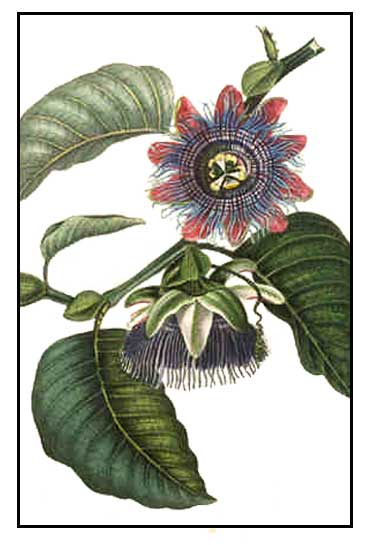
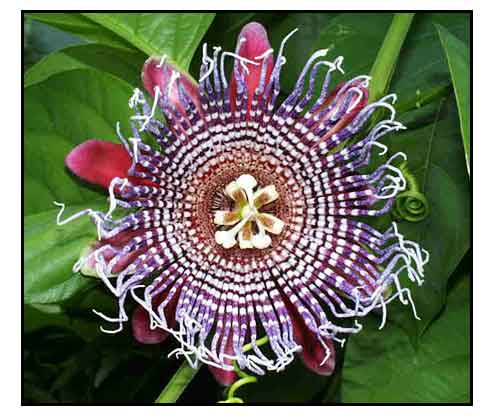
fragrant; petals are reddish, the corona-filaments are violet. Fruit is large, fleshy,
edible, ellipsoid, 15 to 20 centimeters long.
• A vigorous, tender evergreen perennial climber with nodding red flowers, each surrounded by white and purple filaments. It has smooth, cordate, ovate or acuminate leaves; petioles bearing from 4 to 6 glands; an emetic and narcotic root; scented flowers; and a large, oblong fruit, up to 12 inches (30 cm) in length, containing numerous seeds, embedded in a subacid edible pulp. (1)
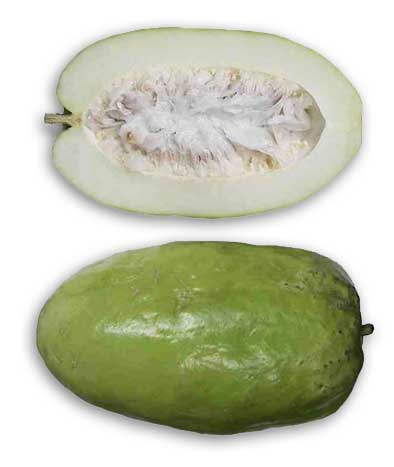 • A fast-growing, semi-woody vine, climbs to a usual height of 10 - 15 m (in some areas, up to 45 m). Foliage: Tendrils are located at the axils, with leaf-like, ovate shaped stipules (measuring up to 3.5 cm long). Leaves are broadly ovate to oblong-ovate, measuring 10 - 20 cm long and 8 - 15 cm wide, and alternately arranged along the stem. Base is rounded to cordate, while apex is abruptly acute. Leaf blade is thin, with visible sunken veins on the upper surface, and prominent on the undersides. Stems: Stems are 4-angled, prominently winged on the angles. Flowers: Flowers are solitary and fragrant. Each flower is about 12 cm in diameter, has a bell-shaped calyx, 5 sepals greenish on the outside while whitish, pinkish or purplish on the inside; 5 white and pink petals, measuring about 4.5 cm long; corona filaments are purple, white and blue. Fruit: Fruits are melon-like shaped, oblong, aromatic, measuring about 10 - 30 cm long and 15 cm wide. Fruit surface may be longitudinally 3-lobed or ribbed, skin is greenish white to pale yellow and thin. Flesh is white or pink and about 4 cm thick; the central cavity contains juice and yellowish sweet and acidic pulp, which enclose brown seeds. (21) • A fast-growing, semi-woody vine, climbs to a usual height of 10 - 15 m (in some areas, up to 45 m). Foliage: Tendrils are located at the axils, with leaf-like, ovate shaped stipules (measuring up to 3.5 cm long). Leaves are broadly ovate to oblong-ovate, measuring 10 - 20 cm long and 8 - 15 cm wide, and alternately arranged along the stem. Base is rounded to cordate, while apex is abruptly acute. Leaf blade is thin, with visible sunken veins on the upper surface, and prominent on the undersides. Stems: Stems are 4-angled, prominently winged on the angles. Flowers: Flowers are solitary and fragrant. Each flower is about 12 cm in diameter, has a bell-shaped calyx, 5 sepals greenish on the outside while whitish, pinkish or purplish on the inside; 5 white and pink petals, measuring about 4.5 cm long; corona filaments are purple, white and blue. Fruit: Fruits are melon-like shaped, oblong, aromatic, measuring about 10 - 30 cm long and 15 cm wide. Fruit surface may be longitudinally 3-lobed or ribbed, skin is greenish white to pale yellow and thin. Flesh is white or pink and about 4 cm thick; the central cavity contains juice and yellowish sweet and acidic pulp, which enclose brown seeds. (21)
Distribution
- Cultivated in the
Philippines for its fruit and as an ornamental vine.
- Introduced from tropical America.
- Now pantropic.
 Constituents Constituents
- Phytochemical screening yielded alkaloids, glycosides, and flavonoids.
- Leaves produce hydrocyanic acid, 0.009 - 0.20 %, therefore poisonous.
- Contains flavonoids, essential oil in trace amounts, gynocardin (a cyanogenic
glycoside), ß-carboline alkaloids, and a tri-substituted benzoflavone.
- Fruit and unripe seeds also contain hydrocyanic acid.
- Whole plant reported to contain norepinephrine and 5-hydroxytryptamine; the leaves, a cyclopropane triterpene glycoside, quadranguloside. Also, an angiotensin converting enzyme inhibitor and aldose reductase enzyme inhibitory.
(8)
- Nutrient analysis per 100 g of edible portion (analyses made in El Salvador) yielded: moisture 94.4 g, 78.4 g; protein 0.112 g, 0.299 g; fat 0.15 g, 1.29 g; crude fiber 0.7 g, 3.6 g; ash 0.41 g, 0.80 g; calcium 13.8 mg, 9.2mg; phosphorus 17.1 mg, 39.3 mg; iron 0.80 mg, 2.93 mg; carotene 0.004 mg, 0.019 mg; thiamine 0.003 mg (arils and seeds); riboflavin 0.033 mg, 0.120 mg, niacin 0.378 mg, 15.3 mg; ascorbic acid 14.3 mg (thick flesh); thick flesh and aril and seeds, respectively. (10)
- Study of methanol extract of dried vines of P. quadrangularis isolated a set of two diastercomers of phenylcyano glycosides, (7S)- and (7R)-phenylcyanomethyl 1'O-α-L-rhamnopyranosyl-(1-->6)-ß-D-glucopyranoside (1,2). (16)
Properties
- Passion fruit
is considered antispasmodic, sedative, narcotic.
- Considered analgesic, antiscorbutic, antispasmodic, astringent, diaphoretic, hypnotic,
narcotic, sedative, and vasodilating.
- Root thought to be narcotic.
- Leaves considered poisonous because of its hydrocyanic acid.
- Studies have suggested hemolytic, anxiolytic, venom neutralizing, anti-collagenase, anti-hyaluronidase, anti-elastase, sedative, antibacterial, cytotoxicity, anticancer, antihypertensive
properties.
Parts
used
Roots, bark,
flowers, fruit.
Toxicity
- Leaves, skin, and immature seeds contain a cyanogenic glycoside. Pulp contains passiflorine, which can cause lethargy and somnolence on excessive consumption. Raw roots reported to be emetic, narcotic, and poisonous. (10)
 Uses Uses
Edibility / Nutrition
- Eaten green as boiled vegetable; ripe, iced and sugared.
- Fruit contains vitamin
C, citric and malic acids.
- High in niacin.
- Flowers cooked as a vegetable or made into syrup.
- Fruit wall is often candied.
- Used as ingredient in fruit salads, together with papaya, pineapple, and bananas.
- Used for making fruit juice.
Folkloric
- Skin of the fruit , bark
of root, used for intestinal tapeworms and parasites.
- Used by traditional healers for snakebites.
(6)
- Root used for narcotic properties.
- Used for bronchitis, asthma, and whooping cough. Also used as anthelmintic.
- In Mauritius, used as diuretic and emetic.
- In Guiana, used as vomitive and taeniacide.
- Indigenous tribes in the Amazon have long used the leaves for its sedative and pain-relieving properties; also, as a heart tonic and for coughs.
- In Brazil, several species of genus Passiflora (maracuja) have widespread use as sedative and anxiolytic.
- In Brazil, fruit is valued as antiscorbutic and stomachic. Flesh prescribed as sedative for nervous headache, asthma, diarrhea, dysentery, neurasthenia, and insomnia. Leaf decoctions used as vermifuge and used in bathing for skin afflictions. Leaf poultices used for liver complaints. Root use as diuretic, emetic, vermifuge. (10)
- In the Amazon, tea made from leaves of tumbo used as narcotic and sedative. (12)
- The Garifuna of Eastern Nicaragua use decoction of leaves of fever, rashes, and sores. In Columbia, leaf and branch decoction used in external baths for snake bites and extract of branches and leaves used for neutralizing effect against Bothrops atrox venom. (13)
- In Saint Lucia, leaves of babadinn crushed in water are used as good bath for the skin. In cases of fos couch, patients wrapped in blanket sit over a pan of boiling water to absorb the vapor, then babadinn mixed with lard is applied to the skin. (14)
- In Columbian folk medicine, used for treatment of hypertension. (15)
- In Sierra Leone, leaves mixed with leaves of Amaranthus hybridus and macerated with palm oil and applied skin ailments three times daily.
(19)
Others
- Homeopathic medicine: Used for treatment of insomnia, epilepsy, tetanus and muscle spasms.
Studies
• Hemolysin / Cholesterol-Dependent Hemolytic Activity / Leaves: Hemolysins and cytolysins found in some plants are potential sources of bactericidal and anticancer drugs. Study demonstrated for the first time the presence of hemolysin in the leaves of P quadrangularis. The hemolysin was heat stable, resistant to trypsin, with dose-dependent hemolysin activity. Passiflora hemolysin is a saponin, with cholesterol-dependent membrane susceptibility, forming a stable complex with cholesterol, with rapid erythrocyte lysis kinetics. (3)
• Induction of Flavonoid Production by UV-B Radiation: Study evaluated the possible role of UV-B irradiation and elicitation on production of glycosyl flavonoids (orientin, isoorientin, vitexin, isovitexin) in Passiflora species (P. edulis, P. incarnata, and P. quadrangularis) in callus cultures. Among them, P quadrangularis showed a faster growth rate and more friable texture, and chosen for testing with elicitors. Callus-treated cultures showed more enhanced flavonoid production and higher antioxidant activity compared to untreated calluses. (4)
• Anxiolytic Effect: Study evaluated aqueous and hydroalcoholic extracts of P. quadrangularis for anxiolytic activity in rats using the elevated plus-maze, open field and holeboard tests. Results on the hydroalcoholic extract suggested anxiolytic activity. No positive results were seen with the aqueous extract. (5)
• Venom Neutralization: In a study of plants for neutralization of Bothrops atrox venom, Passiflora quadrangularis (leaves and branches) was one of 19 species, which in mixture, showed moderate neutralization (21-72%). When the extracts were independently administered by oral, IV or IP route, either before or after an i.d. venom injection, neutralization dropped below 25% for all extracts. (7)
• Antibacterial / Antioxidant / Leaves and Stems: Study evaluated the antioxidant and antibacterial activities of leaves and stems of Passiflora quadrangularis, P. maliformis, and P. edulis using petroleum ether, acetone, and methanol solvents. The methanol extract of P. quadrangularis showed the highest phenolic content and strongest antioxidant activity. Moderate inhibition was observed from the methanol and acetone extracts of P. quadrangularis against s. aureus and B. cereus. (11)
• Antihypertensive / Prevention of Vascular Remodeling in NO Deficit: Study evaluated the ability of EtOH extract in preventing hypertension and vascular remodeling induced by nitric oxide (NO) deficit in Wistar rats. All doses of P. quadrangularis prevented the hypertension induced by L-NAME. It significantly increase the relaxant effect induced by ACh in isolated aorta and decreased the thickness/lumen ration of aorta wall specimens. (15)
• Sedative Activity of Apigenin / GABAergic Pathway / Pericarp: Oral administration of aqueous extract of P. quadrangularis pericarp resulted in a significant prolongation of sleep duration in mice using the ethyl-ether induced hypnosis test which indicates sedative effect. Apigenin, the main flavonoid of the extract, induced a similar sedative response when applied along in an equivalent dose suggesting apigenin mediates the sedative effect. Blockage of the sedative effect by pretreatment with benzodiazepine antagonist flumazenil suggests an interaction of apigenin with gamma-aminobutyric acid type A (GABAa) receptors Results suggest the in vivo sedative effect of the extract and its main flavonoid apigenin may be due to an enhancement of the GABAergic system. (17)
• Optimization of Flavonoid Extraction / Improved Sedative Effect / Leaf: Study reported on the standardization of P. quadrangularis leaf extract with sedative activity. and evaluated the the stability of the optimized extract under stress conditions in Swiss ICR mice. Results showed the flavonoids from the optimized extract were photostable, and stable under neutral hydrolysis. Results demonstrated that the optimized extract improved the sedative effect compared to the extract in the ethyl ether induced hypnosis test. (18)
• Nanoemulsions / Cosmetic Application / Fruits: Study evaluated the anti-collagenase, anti-elastase, and anti-hyaluronidase activities of nanoemulsions containing P. quadrangularis fruit extracts. Results showed the epicarp and seed extracts exhibited collagenase, elastase, and hyaluronidase inhibition effects. The extracts incorporated into nanoemulsions showed to have good stability, non-irritating and safe for the skin. Skin evaluation in human volunteers after 60 days application revealed improvements in skin hydration and reduction in wrinkles. Results showed nanoemulsions containing P. quadrangularis fruit extracts have potential as effective cosmetic products. (22)
• Anticancer / Antioxidant / Leaves: Study evaluated the anticancer and antioxidant properties of hydroalcoholic extract of leaf, fruit, and seed of P. quadrangularis. DPPH assay showed similar antioxidant activity for leaf, seed and fruit with IC50s of 63, 68, and 60 µg/mL, respectively. Invitro anticancer activity was done using MTT assay in MCF-7 and HCT-116 cell lines, with Doxorubicin as standard. MTT assay on human breast cancer cell line (MCF-7) showed IC50 of 81.40 µg/mL for the leaf extract, and 4.54 µg/mL for Doxorubicin. In Human colon tumor cell line (HCT-116) IC50 was 93.04 µg/ml for leaf extract and 4.98 for Doxorubicin. Fruit and seed extracts showed less anticancer activity in both cell lines. (23)
• Cytotoxicity / Antitumor Potential / Leaves: Study evaluated the cytotoxicity of ethanolic extract of P. quadrangularis leaves on cancer cell lines by MTT assay. Antitumor effect was analyzed on mouse solid and ascites tumor models. PQ exhibited cytotoxicity on Dalton's lymphoma ascites (DLA) and Ehrlich's ascites carcinoma cells with IC50s of 9.4 and 9.2 µg/mL and antiproliferative effect of breast (MCF7) and colorectal (HCT116) cancer cell lines with IC50s of 166.5 and 107.09 µg mL. FRET and flow cytometry analysis indicated induction of apoptosis in PQ-treated cells. Extract showed no toxicity on normal rat intestinal cells. LC-MS analysis yielded presence of genistein, kaempferol, isovitexin, and quercetin, which are known for anticancer potential. Acute toxicity in mice showed PQ to be nontoxic. (24)
Availability
Wild-crafted.
Cultivated for its fruit and ornamental vine.
Seeds, teas, infusions, tinctures and extracts in the cybermarket.
|




.jpg)


.jpg)