 General
info General
info
- The genus Artocarpus (Moraceae) comprise about 50 species of evergreen and deciduous trees; an important source of edible fruit, timber and folkloric medicinal use.
-
Breadnut (kamansi, Artocarpus camansi)
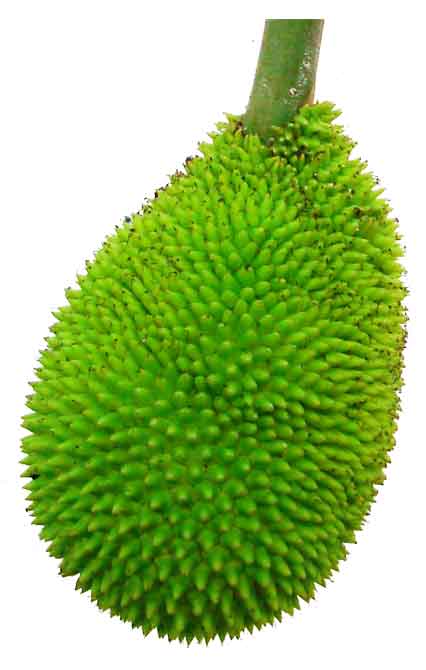
is often confused with its close relative breadfruit (A. altilis), but is distinguished by its large spiny fruits with little
pulp and numerous large, light brown seeds.
- Artocarpus camansi has often been considered to be a form of seeded breadfruit, Artocarpus altilis. Breadfruit, however, is a separate species that originated from its wild-seeded ancestor, breadnut. (5)
- The species was first described in Flora de Filipinas. Segun el sistema sexual de Linneo (1837) by the Spanish friar and Botanist Francisco Manuel Blanco from specimens in the Philippines. (28)
- Specific epithet camansi is derived from Tagalog kamansi, a local name for the tree in the Philippines. (28)
 Botany Botany
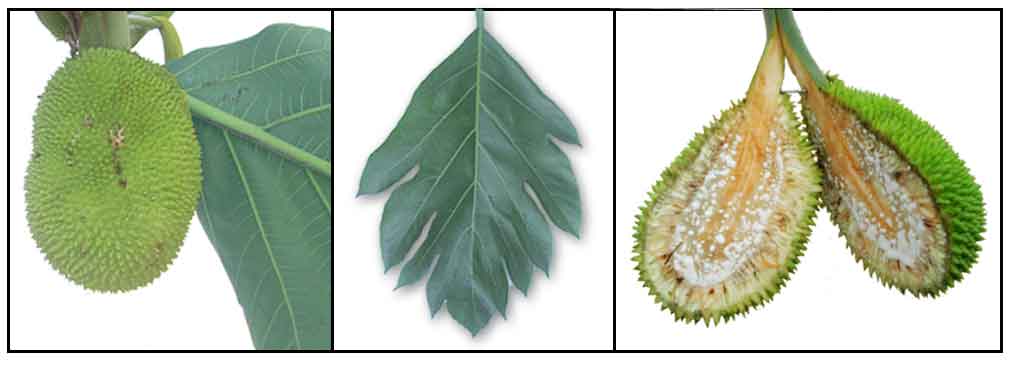
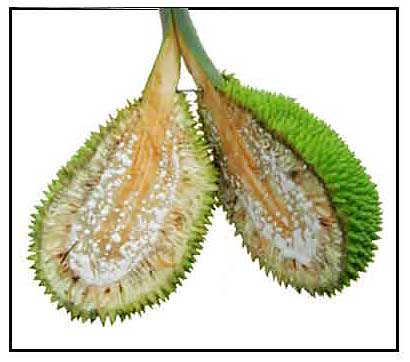
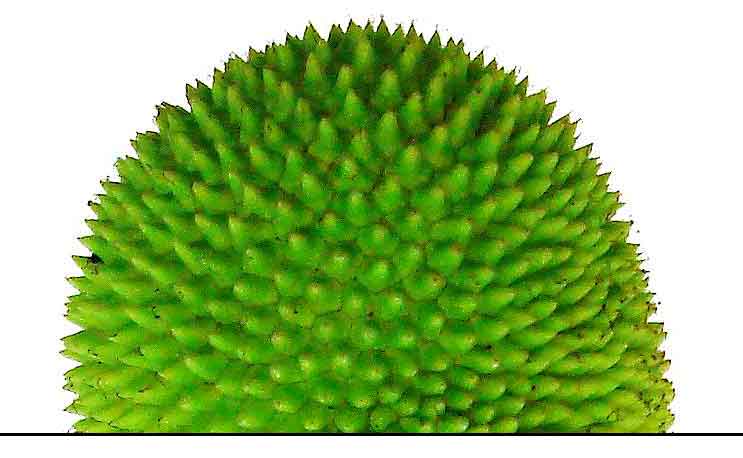
Kamansi is a large tree, 10 to 15 meters high, similar in habit to Artocarpus altilis. Leaves are large, leathery, ovate to oblong-ovate, 40 to 60 centimeters long, 25 to 45 centimeters wide, with deeply incised margins, 4- to 5-lobed. Male spikes are cylindric, greenish-yellow, 15 to 25 centimeters long, and 3 to 4 centimeters in diameter. Fruit is green, ovoid or somewhat rounded, 10 to 15 centimeters long, 7 to 12 centimeters in diameter, with a spiny surface, with little pulp. Tips of the anthocarps are narrowly conical, prolonged, 5 to 8 millimeters long, and 5 thick or less at the base. Seeds are numerous, light brown, ovoid or somewhat rounded, about 2.5 centimeters in diameter.
Kamansi differs from rimas (A. altilis) in the following: Fruit is seeded, the anthocarps are narrowly conical and prolonged, male inflorescence is club-shaped, stigmas are elongated, and the leaves have more divisions.
Distribution
-
Probably native to the Philippines.
-
Native to Bismark Archipelago, Maluku, New Guinea. (25)
-
Grows in tropical regions,
especially in seacoast areas.
- Reported from Cagayan and Laguna Provinces in Luzon; Leyte and Cebu.
- Occasional in the Quezon province.
- Cultivated in Manila.
Constituents
- Artocarpus species are rich in phenolic compounds including flavonoids, stilbenoids, arylbenzofurons and Jacalin, a lectin.
- Oil is rich in unsaturated fatty acid comparing well with melon seeds, soybean and groundnut oil.
- Seeds are a good source of minerals and contains more niacin than other nuts. A 100 g edible portion yields amino acids--methionine 3.2 g, leucine 2.6 g, isoleucine 2.4 g, and serine 2.1 g, comprising 50% of 14 amino acids analyzed. (5)
- A lectin was isolated and purified from the seeds of A. camansi Blanco. It was a complete lectin since it agglutinated erythrocytes without trypsin treatment and addition of metal ions.
(11)
- A dichlormethane extract of leaves yielded friedelinol (1), squalene (2), ß-sitosterol (3), stigmasterol (4), and phytol (5), while stems yielded polyprenol (6), cycloartenol (7) and cycloartenol acetate (8).(see study below) (13)
- Study of essential oil of leaf, stem-bark and nuts yielded a total of 32, 11, and 26 compounds representing 99.09%, 99.45%, and 99.89% of oils, respectively. Main constituents were: (leaf oil) m-xylene 36.82%, myristaldehyde 25.36%, phytol 6.21%, ethyl benzene 7.25%; (stem-bark) m-xylene 61.32%, o-xylene 18.76%, and ethyl benzene 16.21%; (nut oil) lanosteryl acetate 23.9%, olean-12-en-3y acetate 23.63%, 24-methylene cycloartenol 17.57%, m-xylene 15.26%, and squalene 2.85%. (see study below) (15)
- Nutrient analysis per 100 g yielded: (Principle) energy 103 Kcal, carbohydrates 27.12 g,
protein 1.07 g, total fat 0.20 g, cholesterol 0 mg, dietary fiber 4.9 g; (Vitamins) folates 14 µg, niacin 0.900 mg, pyridoxine 0.100 mg, thiamin 0.110 mg, vitamin A 0 IU, vitamin E 0.10 mg, vitamin K 0.5 µg; (Electrolytes) sodium 2 mg, potassium 490 mg; (Minerals) calcium 17 mg, copper 0.084 mg, iron 0.54 mg, magnesium 25 mg, manganese 0.060 mg, phosphorus 30 mg, selenium 0.6 µg, zinc 0.12 mg; (Phytonutrients) ß-carotene 0 µg, crypto-xanthin-ß 0 µg, lutein-zeaxanthin 22 µg. (16)
- Nutrient composition of breadnut seeds per 100 g of edible portion (dry weight basis) yielded: water 56.0-66.2%, protein 13.3-19.9 g, carbohydrate 76.2 g,
6.2-29.0 g, calcium 66-70 mg, potassium 380-1620 mg, phosphorus 320-360 mg, iron 8.7 mg, magnesium 10.0 mg, niacin 8.3 mg, sodium 1.6 mg. (From Ragone (2003) based on McIntoch & Manchew (1993), Negron de Bravo et al. (1983), and Quijano & Arango (1981). (18)
- In a study various leaf extracts, ethanol extracts showed highest total phenolic and flavonoid content, 47.46 mg GAE/g dried extract and 79.094 mg CE/g dried extract, respectively. (see study below) (22)
- GC-MS analysis of n-hexane crude extract of fruit peels yielded major compounds of hexadecanoic acid methyl ester (30.14%), 9,12-octadecadienoyl chloride, (Z, Z) - (8.44%) and 9-octadecenoic acid, methyl ester (30.91%).
(see study below) (31)
- Study of A. camansi isolated lupeol acetate in fruit peel for the first time. (see study below) (34)
 Properties Properties
- Fruit is highly perishable with a shelf life of not more than 2-3 days under ambient conditions. (30)
-
Vulnerary, laxative.
- Grown for their large, nutritive seeds.
- Studies have shown
cytotoxic, biosorbent, anti-dermatitis, antidiabetic, antioxidant, antimalarial properties.
Parts
used
Leaves and fruit.
Uses
Nutritional
- Fruits, particularly the young ones, are boiled and eaten as a vegetable.
- Seeds are rich in starch, eaten boiled or roasted.
- Ripe fruit is sweet. and flavorsome.
- Seed is rich in protein, low in fat; rich in minerals, especially niacin.
Folkloric
- Breadfruit is laxative.
Heated up, the slices are used for furuncles.
- Decoction of leaves used for baths in rheumatism.
- Tree latex used for hernia in children, applied with a belt or truss.
- Decoction of bark used for dysentery.
- Decoction of bark used as vulnerary.
- Latex massaged onto skin, for broken bones and sprains and bandaged
on the spine are for sciatica.
- Crushed leaves used for thrush.
- In the Visayas, bark decoction used for dysentery.
- Diluted latex used for diarrhea, stomach aches and dysentery.
- Juice from stems of leaves for ear infections.
- In the West Indies, decoction
of yellowing leaf used for high blood pressure and asthma.
- Tea also used for diabetes.
Others
- Wood: Lightweight, flexible, and easy to work with. Used for carving statues, bowls, fishing floats, etc. (5)
- Fuel: Fast burning wood.
- Repellent: Dried male flowers burned to repel mosquitoes and other flying insects. (5)
- Fodder: All parts of the mature and ripe fruits are edible and fed to pigs and other livestock. Breadnut is also an important food source for flying foxes and arboreal mammals in its native range. (10)
Studies
• Infant Food Formulation:
New product development studies have been carried out to formulate an infant food from breadfruit (Artocarpus altilis) pulp and breadnut (A camansi) seeds to provide a nutritious and palatable alternative. (3)
• Nutritional Composition of Breadnut Seeds:
Study showed the proximate composition of seeds as: protein, 4.87%; fat, 3.48%; and carbohydrate, 26.11%; ash, 3.43%, crude fiber, 1.20%. Highest mineral content was phosphorus, 363 mg/kg; potassium, 325 mg/kg; and sodium, 248 mg/kg. Predominant essential amino acid were leucine, phenylalanine, arginine, isoleucine, and lysine - in decreasing order. Oil was rich in palmitic 21.4%, oleic 12.4% and linolenic acid 14.8%. Results suggest the breadnut seed can be used as composite flour and a source of edible oil for human consumption. (4)
• Chemical Constituents / Cytotoxicity Against Cancer Cell Lines / Leaves:
Dichlormethane extract of leaves yielded friedelinol (1), squalene (2), β-sitosterol (3), stigmasterol (4) and phytol (5), while the stems yielded polyprenol (6), cycloartenol (7) and cycloartenol acetate (8). (6)
• Camansi Flour as Additive / Camanhon: Study produced fried Canton using an additive of Camansi flour from mature seeds with commercially used flour. Compared with other staple starch crops, camansi is a better source of protein, comparable to sweet potato and banana, and a good source of iron, calcium, potassium, riboflavin and niacin. Results proved to be both nutritive and good tasting. (7)
• Biosorbent for Methylene Blue / Peel: There has been an increase in the amount of dyes being disposed in wastewater or the natural ecosystem, seriously adding to environmental pollution. Study showed the oven-dried breadnut peel to be an effective and highly promising low-cost biosorbent for removal of methylene blue (MB). (8)
• Antidiabetic / Leaves: Study evaluated the antidiabetic effect of ethanol leaf extracts of Kluwih on mice using glucose tolerance test. EELK at doses of 50 and 100 mg/KBW showed antidiabetic effect better than 200 and 400 mg/KBW. Increasing the doses showed antagonistic effect, with ability to increase blood glucose levels. (9)
• Anti-Contact Dermatitis / TNCB-Induced Contact Hypersensitivity: Study evaluated a hot water extract of A. camansi leaves on contact hypersensitivity (CHS) in mice using 2,4,6-trinitrochlorobenzene (TNCB). The extract exhibited significant activity against the swelling produced during 24h and 48h post-challenge. The activity could be due to a polysaccharide and/or glycoprotein constituent. Results suggest extract of A. camansi leaves might be an effective natural product to treat allergic contact dermatitis. (12)
• Triterpenes / No Cytotoxcicity Against Cancer Cell Lines / Mild Antibacterial Activity / Leaves: A dichlormethane extract of leaves yielded friedelinol (1), squalene (2), ß-sitosterol (3), stigmasterol (4), and phytol (5), while stems yielded polyprenol (6), cycloartenol (7) and cycloartenol acetate (8). Cytotoxicity was tested using sulforhodamine B assay against human cancer cell lines: lung adenocarcinoma A549 cells, stomach adenocarcinoma AGS cells, colon adenocarcinoma HT29 cells and prostate cancer PC3 cells. Compounds 1,7, and 8 showed no cytotoxicity to the cancer cell lines. Friedelinol has showed antibacterial activity with no antifungal activity. Cycloartenol has exhibited moderate and selected antimicrobial activity against E. coli and P. aeruginosa. (13)
• Cytotoxicity Against Human Cancer Cell Lines / Leaves: Study evaluated crude extracts and fractions from Artocarpus camansi, Premna odorata and Gliricidia sepium against selected human cancer cell lines using MTT assay. P. odorata leaves and bark hexane fractions and Artocarpus leaves were all highly cytotoxic against selected human cancer cell lines (HCT116, MCF-7 and A549). (14)
• Antibacterial / Essential Oil: Study evaluated the volatile composition of leaf, stem-bark and nut of Artocarpus camansi. The leaf oil showed low activity against Shigella flexeri, Epidermic Methicillin-Resistant Staphylococcus aureus (EMRSA16 and 17), Pseudomonas aeruginosa (DRPA), and moderate activity against Salmonella typhi. Stem-bark showed moderate activity toward E. coli and S. typhi. Nut showed activity toward E. coli, S. flexneri, S. typhi and drug resistant isolates of P. aeruginosa. (see constituents above) (15)
• Proximate Composition / Phenolic Content / Antioxidant: Study evaluated the proximate composition, mineral and total phenolic contents (TPCs) and antioxidant capacity of core, pulp, and seed of A. camansi. Pulp yielded the highest ash (1.47%) and protein (1.29%) contents, and core had highest moisture (88.6%) content. On antioxidant testing, DPPH inhibition was in the order of seed > pulp > core. Study for TPC yielded 7.88 -22.1 mg gallic acid equivalent (GAE)/g for methanol extract and 1.69 - 5.22 mg GAE/g for water extract. Results suggest potential benefits for the food and health industries. (17)
• Antidiabetic / Bark: Study evaluated an ethyl acetate extract of bark for antidiabetic activity against male Swiss Webster mice model using glucose tolerance tests. Study isolated ß-amyrin acetate. Results showed a decrease in blood glucose levels. Fraction Group B showed greater blood sugar lowering than fraction of group P and ethyl acetate extracts. (19)
• Effect of Storage Environment and Time on Seed Viability: Study investigated the effect of methods and period of storage on viability of breadnut seeds using refrigerator and open shelf storage in two different seasons. Results indicate breadnut seeds cannot be stored for up to a week using study methods. (20)
• Low Cost Adsorbent for Methylene Blue / Core: Study investigated the adsorption characteristics of methylene blue on core of breadnut. Oven-dried A. camansi core was found to be very effective in removing MB compared to reported fruit biomasses. Thermodynamic studies showed the adsorption process was both spontaneous and exothermic. Results suggest great potential as a low cost adsorbent for removal of MB. (21)
• Antioxidant / Antibacterial / Leaves: Study evaluated total ethanol, ethyl acetate, and hexane extracts from leaves for phenolic and flavonoid content, antioxidant capacity by DPPH scavenging activity, and antibacterial activity using well diffusion assay. Ethanol extracts showed highest total phenolic and flavonoid content, 47.46 mg GAE/g dried extract and 79.094 mg CE/g dried extract, respectively. Ethanol extract showed lowest IC50 of 73.16 on DPPH scavenging. The ethanol extract showed highest antibacterial activity with highest inhibition against S. aureus and E. coli. (22)
• Antimalarial / Plasmodium berghei / Leaves: Study evaluated the in vivo antiplasmodium activity of methanol extract of leaves in mice (Mus musculus) Balb/c infected with Plasmodium berghei. Parameters observed were parasite growth and parasite inhibition. Results showed lowest parasite growth (1.636%) and largest parasite inhibition (72.83%) at dose of 100 mg/kg BB. An extract is considered to have positive antimalarial activity if it can reduce parasitemia by 30% or more. Results suggest the dose of 100 mg/kg of methanol extract of leaves has potential activity as antimalarial. (23)
• ß-Sitosterol / Antidiabetic / Bark: Study evaluated various solvent extracts and fractions of A. camansi. ß-sitosterol was a pure isolate of fraction B. Study for antidiabetic activity showed extract of n-hexane, fraction group A and fraction group B can lower blood sugar levels of male Swiss Webster mice. Group fraction of B showed highest lowering of blood glucose compared to n-hexane extract and group A. (24)
• Potential as Foodstuff: The fruits of Artocarpus camansi have been used as vegetable ingredient and baby food. Its use as food ingredient is related to its nutritional content. The seeds are rich in protein, carbohydrates, amino acids, fats and minerals. AC seeds can be used as composite flour and oil can be a good source of vegetable oil for human consumption. The nutritional content of seeds is influenced by processing. Fermentation and boiling increase the nutritional profile of A. camansi. Water content, crude protein and ash is higher in fermented beans, while fat, fiver, carbohydrates, vitamins A and C were higher in raw seeds. Essential amino acids, leucine, lysine, alanine, histidine, tyrosine, phenylalanine were significantly higher in fermentation while other amino acids were higher in boiled. Fermented seeds can be used as condiment in soups because the contain beneficial microorganisms that increase the nutritional value of food and help reduce food-borne disease microbes. The fruit can be developed as baby food by combining breadfruit and breadnut seeds, corn seeds, and peanuts. A. camansi has great potential to be developed as an economic commodity. (26)
• As Meat Replacement for Meatballs: Study evaluated the use of breadnut as a meat replacement for meatball and the most preferred formulation [25% breadnut/75% ground beef (1), 50/50 (2), 75/50 (3)], sensory acceptability, cost of direct materials, and shelf-life of breadnut meatball. Out of three formulations, formulation 1 (25% breadnut and 75% ground beef) was the most preferred sample. There was no significant difference in sensory acceptability. Shelf life of the formulated product was two weeks from day of formulation. (27)
• Bioethanol from Rind Waste: Biofuels can be an alternative energy and contribute to a clean green environment. Breadnut peel waste is high in carbohydrate and sugar with potential to be optimized into bioethanol. Study evaluated the effect of variations in yeast mass and fermentation time on the bioethanol content of breadnut rind through the distillation process. Optimum results were found in the variation of yeast mass of 8 grams and fermentation time of 96 hours. Results suggest that breadnut rind waste processed through fermentation using Saccharomyces cerevisiae can be used as material to produce bioethanol as a sustainable energy source. (29)
• Postharvest Physiology / Utilization / Review: Paper provides a critical review on optimization of quality during harvesting, postharvest handling, utilization of breadnut, nutritional and culinary qualities, market potential, and use in traditional medicine, along with its short shelf half life and high perishability. The review collates findings on postharvest physiology and utilization of breadnut, and provides information useful for tree breeding programs, in order to popularize it as a commercial crop and promote food security at household and community levels. (30)
• Antidiabetic / Fruit Peels: Study evaluated extracts of Kulu (A. camansi) fruit peels for antidiabetic activity against male Swiss webster mice. The n-hexane crude extract was the most active (65.59%) in decrease blood glucose, compared to glibenclamide. (see constituents above) (31)
• Antibacterial / Antiproliferative
/ Fruit, Stems, Leaves: Study evaluated the antibacterial and antiproliferative extracts of 35 samples of different parts (bark, fruit, leaves, roots) from 13 Cambodian and 19 Philippine medicinal plant species used in folk medicine for treatment of diarrhea. Artocarpus camansi fruit extract inhibited Bacillus cereus and both clostridia (Clostridium difficile and C. perfringens) species at MICs ranging from 128 to 256 µg/mL. A. camansi showed selective cytotoxic effect on intestinal cancer cells. Methanolic and DCM extract of stems and leaves yielded terpenoids and phytosterols. Among them, friedelinol, cycloartenol, and cycloartenol acetate inhibited the growth if HT-29 cells; squalene showed profound chemopreventive activity against colon carcinogenesis; and ß-sitosterol induced apoptosis in human colon tumors. (32)
• Properties and Potential of Breadnut Seed Flour: Breadnut is recognized as a potential food source. Study of proximate composition of seed flour yielded 75% carbohydrates, 9.07% fat, and 6.16% protein. The breadnut flour showed high antioxidant capacity with DPPH scavenging activity of 97.33%. The flour blended with wheat flour (50:50) showed potential in terms of water absorption capacity, fat absorption capacity, emulsion capacity, and foaming ability. Study illustrates the potential of breadnut as a source of energy and other nutrients, and its functional behavior as an alternative and/or composite to wheat flour. (33)
• Lupeol Acetate from Fruit Peels: Study reported the presence of lupeol acetate in A. camansi fruit peel for the first time. Lupeol acetate has many benefits: antinociceptive, anti-inflammatory, antimicrobial, antimalarial, antituberculosis. Lupeol compounds can reduce activity of α-amylase, inhibit tyrosine phosphatase 1B, and has shown inhibitory activity against glutathione S-transferase and acetylcholinesterase. (34)
• Dietary Fiber and Fatty Acid Composition of Seed Flour: Study evaluated the dietary fiber and fatty acid composition of boiled, roasted, fermented and germinated breadnut seed flour. Dietary fiber composition of seed flour ranged from 4.94% (fermented) to 5.42% (roasted). Seed flour showed greater amount of non-essenntial fatty acid, which were highly significant (p<0.05) in oleic acid (57.93%) for roasted seed flour, followed by linoleic acid (25.76%) in fermented breadnut flour. All processed breadnut seed flours showed appreciable amounts of dietary fiber and essential fatty acids than non-essential fatty acids. Study recommends breadnut seed for wheat substitution in the bakery industry and culinary uses; and also, for weight loss programs. (35)
• Sensory Evaluation, Shelf-Life and Nutritional Composition of Breadnut Cookies: Study evaluated formulations of chocolate cookies made with mixtures of breadnut seed flour and all-purpose flour and their shelf-life. Formulations were in different ratios of all-purpose flour and breadnut seed flour (0:100, 25:75, 50:50, 75:25, 100:0) with 100% all-purpose flour as control. Formulations were evaluated for color, odor, crispness, flavor, and general acceptability. While all formulations were acceptable, the 50% BSF was most acceptable based on general acceptability score, with safety and guaranteed desirable sensory properties for six months. (36)
• Immunomodulatory / Delayed-type Hypersensitivity Reaction / Leaves: Allergic dermatitis is a delayed-type hypersensitivity reaction after exposure to allergens. Study evaluated mature leaves for activity mediating contact hypersensitivity induced in mice induced by 4,6-trinitrochlorobenzene in acetone. Various doses of extract were used (100-1000 mg/kbw) and prednisolone (20 mg/kbw) as control. Extract and control were able to inhibit ear swelling after 24 hours, and the 1000 mg/kbw for 46 hours. Results suggest phytochemicals in the extract that can modulate immune response. (37)
Availability
- Wild-crafted.
- Seeds in the cybermarket.
|