|
Gen info
- Ipomoea is the largest genus in the plant family Convolvulaceae with over 600 species, occurring throughout the tropical and subtropical regions of the world, comprising annual and perennial herbaceous plants, lianas, shrubs, and small trees; most of the species are twining climbing plants. (25)
- The genus name Ipomoea derives from Greek ips, ipos meaning 'woodworm' and homoios meaning 'resembling', referring to the twining habit. (25)
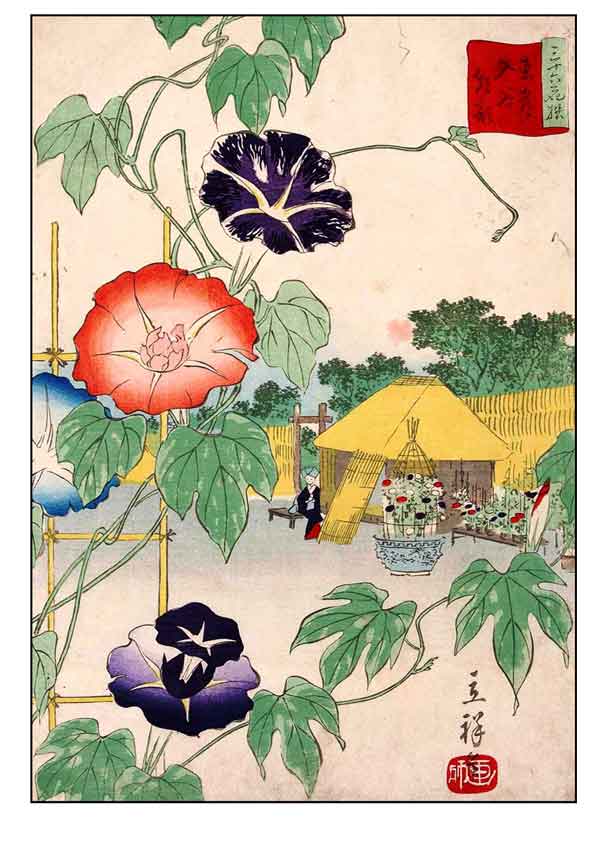
- Although not native to Japan, the species is referred to as "Japanese morning" in Japan where morning glories are popular. It is believed to have been introduced from China in the Heian period of the 8th to 9th centuries. Ipomoea nil is known as 'Asagao' in Japan, where it has been cultivated as an ornamental for centuries. The fad for growing potted morning glories has increased into morning glory markets held in large cities in Japan, the largest of which is the Iriya Morning Glory Market called "Iriya Kishibojin" in Iriya, Tokyo, held July 608. (Below is the art work "Morning Glories in Iriya, Eastern Capital" (1866), No 28 of "The Thirty-Six Selected Flower Scenes by Hiroshige II). (29)
- Among Christians, the morning glory flowers depicts the essence and the brevity of life -- its dazzling bloom uncurling before dawn, fading and closing like an little umbrella by mid-day, lasting only a day to be replace by new blossoms the following morning.
Botany
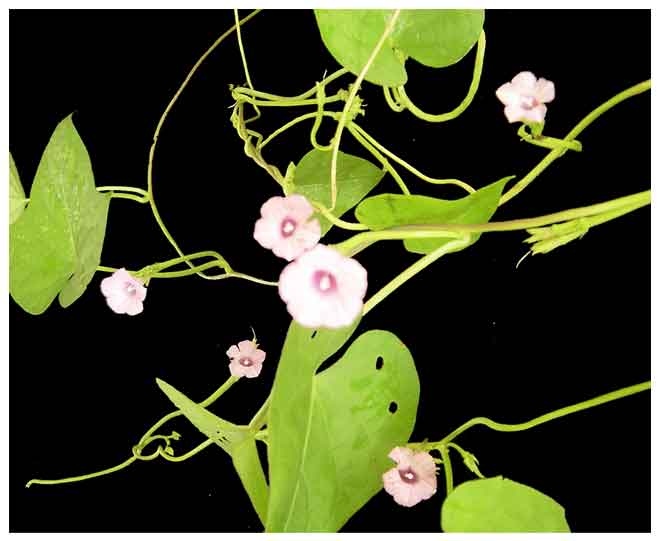
Kamokamotihan is a twining, rather slender, herbaceous, more or less hairy, annual vine reaching
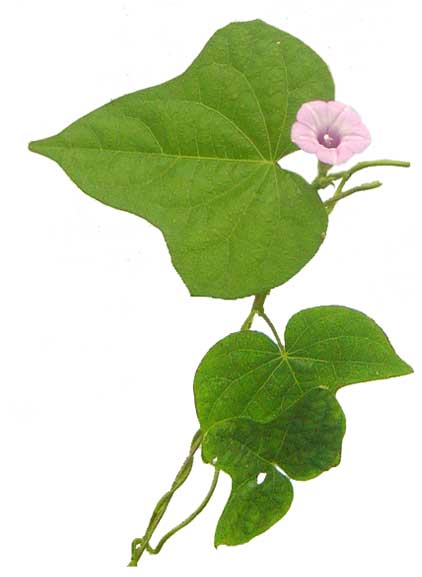
a length of several meters. Leaves are prominently 3-lobed, subovate,
8 to 15 centimeters long, heart-shaped at the base. Peduncles are solitary, shorter
than the petioles, borne in the axils of leaves, each with 1 to 6 flowers.
Calyx is green, very hairy at the base, and about 3 centimeters long. Corolla
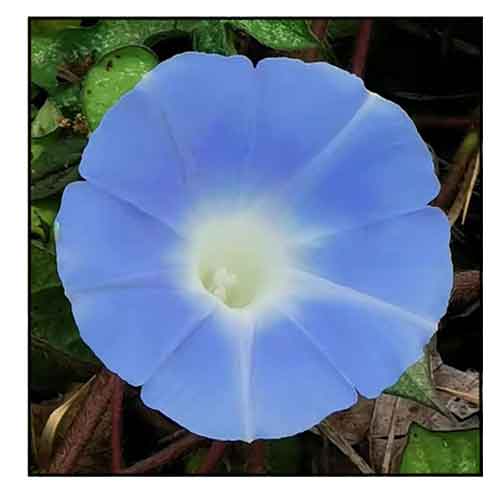
is pale blue, or the tube white within, turning purplish pink, about
5 centimeters long, with the limb shallowly 5-lobed. The capsules are ovoid,
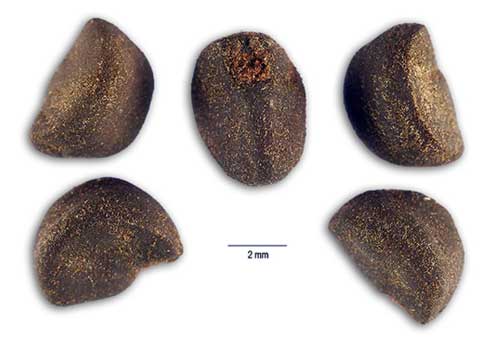
about 1 centimeter diameter, each containing 2 black and smooth seeds.
 Distribution Distribution
- Introduced to the Philippines.
-
Found in Abra, Lepanto, Bontoc, and Rizal Provinces in Luzon, In thickets and waste
places at low and medium altitudes.
- Some forms cultivated for their flowers.
- Native of tropical America, but pantropic in distribution.
Constituents
• The active
principle is the kalandana resin, called "Pharbitisin" in
India. It is considered comparable to the resin of jalap or the
convolvulin from Ipomoea purga.
• Phytochemical studies of various fractions yielded reducing sugars, alkaloids, terpenoids, saponins, flavonoids, and tannins.
• Compositional analysis of seeds yielded oil (14.09), fiber (16.55). Major fatty acids were oleic acid and linoleic acid. (11)
• Seeds of Pharbitis nil yielded two new oleanene-type triterpene glycosides, pharbitosides A and B (1 and 2), together with ß-sitosterol, ß-sitosterol glucoside (daucosterol), caffeic acid, and methyl caffeate. (14)
• Study of stem extracts yielded saponins, tannins, alkaloids and flavonoids and cardiac glycosides. Nutrient analysis yielded 1.2% lipids, 30% crude fiber, 7.0% crude protein, 57% carbohydrate, 2% moisture, 2.0% ash content, 0.5% sulphated ash. Non-nutrient analysis yielded 0.0004 mg/100g tannic acid,
0.0021 mg/100g oxalate, 0.0002 mg/100 g cyanogenic glycoside.
(15)
• Analysis of seed and seed oil yielded 7.84% oil, 17.31% protein, 2.47& moisture, 1.83 unsaponifiable matter, 187.81 saponification value, 121.33 iodine value, 1.4769 refractive index. (18)
• Fatty acid composition of seed oil yield3ed 2.83% lauric acid, 2.31% myristic acid, 13.47% palmitic acid, 11.39% stearic acid, 23.16% oleic acid, 33.50% linoleic acid, 9.56% linolenic acid, 3.77% arachidic acid, 33.77 saturated fatty acids, 66.22 unsaturated FA, 43.06 polyunsaturated FA, and 1.275 P/S index. (18)
• Percent proximate composition of I. hederacea seeds yielded crude protein 23.36, total lipids 14.09, total carbohydrates 37.06, crude fiber 16.55, moisture 5.29, and ash 3.65. (19)
• Study of seeds for amino acids yielded isoleucine (5.03%), leucine (6.59%), lysine (4.25%), methionine (1.19%), phenylalanine (6.24%), threonine (3.07%), tryptophan (1.88%), valine (7.10%), arginine (5.50%), histidine (3.55%), alanine (3.09%), aspartic acid (10.82%), cystine (0.90%), glutamic acid (22.71%), glycine (5.36%), proline (4.46%), serine (4.02%), and tyrosine (2.58%). (19)
- Study of seeds of Ipomoea nil isolated one new ent-kauran diterpene, 7ß, 16ß, 17-trihydroxy ent-kauran 19-(6ß)-olide (1), along with eight known compounds. (see study below) (31)
 Properties Properties
• Resin has a nauseous and acrid taste with an unpleasant odor, especially
when heated.
• Seeds considered cathartic, analgesic, antiseptic, anticholinergic, diuretic, laxative, antifungal, anthelmintic.
• Studies have shown antioxidant, nematicidal, hepatoprotective, antibacterial, acaricidal, analgesic, cytotoxic, antiasthmatic, antifatigue, anti-inflammatory properties.
Part utilized
Seeds
Uses
Folkloric
- No reported folkloric medicinal use in the Philippines.
- In India, besides the resin, the pharmacopoeia
includes an extract, tincture and compound powder.
- Pounded plant used in hair wash for head lice.
- Root decoction used as emmenagogue.
- In many parts of India, roasted seeds are used as purgative; the powdered
seeds used for constipation.
- In China, seeds are used as diuretic, antihelmintic, deobstruent; prescribed
for constipation and dropsy, also to promote menstruation and as an
abortifacient.
- In India, paste of seeds used cosmetically, applied topically for dry skin and to remove freckles. Seeds used for leucoderma and scabies, gout, cephalalgia, hepatopathy, and splenopathy. Seeds rubbed on male genitalia to treat erectile dysfunction. (19)
- In the Orissa district of India, dried, roasted and powdered seeds are applied with water to the scalp for treatment of dandruff, rinsed after 10-15 minutes, repeated three times in a week. (24)
Others
- Superstition: In Nigeria, plant used as a love charm.
 Studies Studies
• Phytochemicals: Study
isolated five ecdysteroids (hederasterone A, hederasterone A-20,22 monoacetonide
and hederasterone B) , two steroidal glycosides, one triterpene and
two aromatic acids. One compound showed inhibition of butyrylcholinesterase,
another inhibited lypooxygenase. (1)
• Hepatoprotective / Antioxidant: Ethanol extract of Ipomoea hederacea was shown to have hepatoprotective and antioxidant potential against carbon tetrachloride induced hepatotoxicity in rats. (3)
Study of ethyl acetate extract of seeds in CCl4-induced hepatotoxicity showed significant inhibition of serum marker enzymes comparable with standard silymarin. (13)
• Antioxidant: Study
of an ethyl acetate fraction yielded the highest phenolic content and highest antioxidant activity compared to other fractions. (5)
• Nematicidal: Study
evaluated the potential toxicity of selected medicinal plants against juveniles of the root-knot nematode Meloidogyne spp and Cephalobus litoralis. Ipomoea hederacea exhibited moderate activity. (6)
• Antibacterial: In a study
screening the antimicrobial activity of selected flora of Pakistan, Ipomoea heredacea showed highest activity against Bacillus subtilis and highest activity against the fungal strains. (7)
• Seeds / Antibacterial: Various seed extracts were studied for antibacterial activity. The methanol extract was found to be more active than other extracts against E. coli, Pseudomonas aeruginosa and fungi. Chemical constituents like saponins and alkaloids were probably responsible for the antimicrobial activity of the crude drug. (8)
• Toxicity Study/ Analgesic: Mice study evaluating the toxic and non-toxic profile of Ipomoea hederacea showed a starting lethal dose of 300 mg/kg with a calculated LD50 value of 229.2 mg/kg dose. Dose-dependent toxic behavior included convulsion, tremor, unsteady gait, respiratory distress to death. Hot plate analgesic activity exhibited analgesic potential. (9)
 • Antimicrobial / Seeds: A methanol extract of seed exhibited varying levels of antibacterial activity against E coli and Pseudomonas aeruginosa. Methanol and chloroform extracts showed moderate activity against Alternaria brassica, A. braceacola, and Aspergillus niger fungal strains. (10) • Antimicrobial / Seeds: A methanol extract of seed exhibited varying levels of antibacterial activity against E coli and Pseudomonas aeruginosa. Methanol and chloroform extracts showed moderate activity against Alternaria brassica, A. braceacola, and Aspergillus niger fungal strains. (10)
• Acaricidal Activity / Seeds: Isolated fraction 8 (methyl linoleate) from seeds showed strong acaricidal activities against adult and egg of Tetranychus cinnabarinus. Results suggest a potential of P. pupurea seeds as new resource of botanical acaricide. (16) Isolated fraction 8 from seeds showed a strong toxic effect on T. cinnabarinus through various degrees of inhibition of AChE, MAO, and ATPase related to nervous system, which can lead to blocking neurotransmission and death of mites. Results suggest potential for development of methyl linoleate as a new pesticide. (17)
• pH
Indicator Property / Flowers: Study investigated the indicator property of aqueous extract of flower pigments and compared results with already existing synthetic indicators. Results suggest the flower pigments has potential as substitute to synthetic acid-based indicators. (20)
• Antioxidant / Cytotoxic: Study evaluated successive petroleum ether and methanolic extracts different parts viz., leaves, stems, roots, and whole plant of Ipomoea nil, I. batatas, and I pes-caprae for their antioxidant and cytotoxic activities. The successive methanolic extract of selected Ipomoea plants showed potent ability to scavenge different types of free radicals generated by various in vitro assays. All methanolic extracts and free phenolics showed good cytotoxicity against Hep-2 cells line with CTC50 value in the range of 50-100 µg/mL. (21)
• Ecdysterone / Extraction / Seed: The phytoecdysteroids family is rapidly growing, with recent date showing over 250 ecdysteroid analogs. Plant extracts are a significant source of ecdysteroids for medicinal preparations that can increase the quality of human life. The pulverized seed of Ipomoea hederacea (I. nil) is an indigenous source of ecdysteroid, with a high content of 20E (20-hydroxyecdysone). Although ethyl acetate is not a common solvent for extraction of ecdysteroids, it has the advantage of avoiding the extraction of unwanted material. (22)
• Chalcone Isomerase-Like Protein / Enhancement of Flavonoid Production and Flower Pigmentation: Flavonoids are major pigments in plants, and their biosynthetic pathways is one of the best studied metabolic pathways. This study identified three mutations within a gene that resulted in pale-colored flowers. The gene was designated EFP (enhancer of flavonoid production). Study results conclude that EFP is an enhancer of flavonoid production and flower pigmentation. (23)
• Anti-Asthmatic / Seeds: Study evaluated the antioxidant, bronchodilatory, and anti-asthmatic potential of aqueous methanolic crude extract of Ipomoea nil seeds. A bronchodilator assay on rabbit's trachea as well as in vivo OVA-induced allergic asthmatic activity was performed on mice. HPLC confirmed the presence of various polyphenolics and flavonoids i.e., gallic acid, vanillic acid, chlorogenic acid, quercetin, kaempferol, and others. Oral gavage of extract showed better bronchodilation profile as compared to carbachol and K+-induced bronchospasm. More significant (p<0.01) reduction in OVA-induced allergic hyper-responses i.e., inflammatory cells grade, antibody IgE and altered IFN-α in airways were observed at three different doses of extract. Results suggest the existence of antioxidants, calcium antagonists, and enzymes' inhibition profile validates folkloric consumption of the plant for treatment of respiratory ailments. (26)
• Antifatigue / Seeds: Study evaluated the effect of Ipomoea nil seed extract on fatigue. Arbitrary doses of 100mg/200g BW, 250mg/200g BW, 450mg/200g BW were administered to male sprague dawley rats once daily. Forced Swimming Test was used before and after treatment. Twelve days treatment was more effective than 6 days and the higher the dose, the more effective it was in treating fatigue. Three doses increased glucose and hemoglobin levels and increased swimming time indicating antifatigue activity and elevated exercise performance. (27)
• Cytotoxicity against Human Tumor Cell Lines / Anti-Inflammatory / Seeds: Study of air-dried Pharbitis nil seeds extracted isolated four new lignans, pharbilignans A-D (1-4) from the most active ethyl acetate fraction of an ethanol extract. Tested fro inhibitory effects on four human tumor cell lines using sulforhodamine B (SRB) bioassay, pharbilignan C (3) showed potent cytotoxicity against A549, SK-OV-3, SK-MEL-2, and HCT15 with IC50s of 1.42, 0.16, 0.20, and 0.14 µM, respectively. Anti-inflammatory testing of isolates showed pharbilignan C (3) strongly inhibited nitric oxide (NO) production in the lipopolysaccharide (LPS)-activated BV-2 microglia cell line with IC50 of 12.8 µM. (28)
• Antioxidant / Seeds: Study of seeds of Ipomoea nil isolated one new ent-kauran diterpene, 7ß, 16ß, 17-trihydroxy ent-kauran 19-(6ß)-olide (1), along with eight known compounds. Trans-caffeic acid (3), phenylpropanoid (4), and caffeoylquinic acid derivatives (5-9) could inhibit ROS generations induced in human keratinocyte HaCaT cells with IC50s of 0.94-28.40 µM. Compounds 3 and 5-9 showed DPPH free radical scavenging properties with IC50 range of 14.86-68.27 µM. Results suggest potential application for skin disorders caused by oxidative stress damage. (31)
• Antineurotoxic / Antivenom / Seeds: Study evaluated the effect of cobra vine seeds (Ipomoea nil) as anti-neurotoxin. Cobra vine seeds were extracted and filtrates were dried separately and attached to a ROTAVAP apparatus. Frog gastrocnemius muscle was used to evaluate the cobra toxin and antivenin in 5 different time intervals. Muscle that was almost paralyzed by the cobra toxin contracted vigorously after the antivenin was injected. Action potential study showed an inhibitory effect for the venom and a staircase effect after the antivenin was injected. ANOVA showed significant difference on amplitude of muscle contraction between venom and anti-venin (250 mg/mL concentration). (32)
• Antimicrobial / Seeds and Whole Plant: Study evaluated and compared the antimicrobial activity of aqueous and organic (DCM, ethanol, methanol) extracts of seed and whole plant (leaves, flower and bark) against G+ and G- bacteria (S. aureus, B. pumilus, S. pneumonia, E. coli, Citrobacter freundii, and K. pneumonia) and fungi (C. albicans and A. niger). Methanol and ethanolic extract of seeds showed significant antibacterial activity against Staphylococcus aureus with % inhibition of 89.88 and 85.67%, respectively. The antimicrobial activity varied from part to part and plant material used. Results suggest the organic extract of seed (methanolic and ethanolic) possess greater potential against pathogenic bacteria and fungal species as compared to whole plant organic extract. (33)
• Silver Nanoparticles / Antibacterial / Leaves: Study reports on the green synthesis of silver nanoparticles using leaf extra t of Ipomoea nil. Using agar well diffusion method, the AgNPs showed antibacterial effects against five types of pathogenic bacteria i.e., E. coli, Salmonella, Bacillus, Proteus and K. pneumonia. (34)
Availability
- Wild-crafted.
- Seeds and extracts in the cybermarket.
|