 Botany Botany
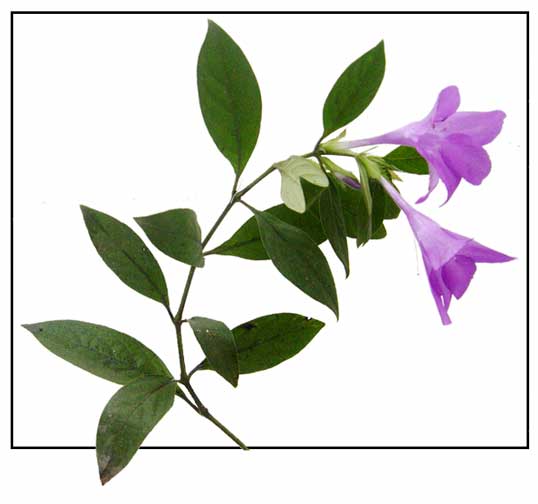
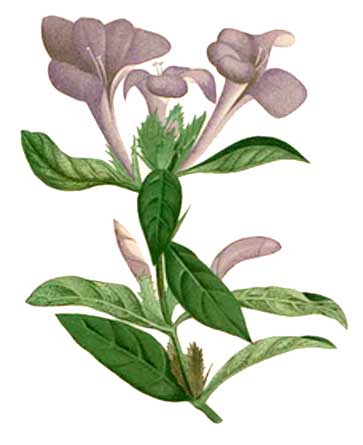
Kolintang-violeta is an erect, unarmed, branched
ornamental shrub, 1 to 3 meters high. Branches are sparingly hairy. Leaves
are oblong to elliptic, 4 to 10 centimeters long, pointed at the tip and somewhat hairy beneath.
Flowers are borne singly or in pairs, and terminal or in the upper axils
of the leaves. Bracteoles are linear. Two outer sepals are green, ovate-lanceolate, nearly 2 centimeters long, persistent, and laciniately toothed. Corolla is 6 to 7 centimeters long, slender-tubed, winged above;
limb is 4 to 5 centimeters in diameter, violet or nearly white, or streaked with
violet and white.
Distribution
- Widely cultivated ornamental
hedge plant.
- Also occurs in India, China, and Malaya.
- In Australia, listed as an environmental weed.
Constituents
- Phytochemical screening of crude extract of leaves yielded amino acids, carbohydrates, flavonoids, proteins, phenolic groups, saponins steroids, tannins, and terpenoids. (9)
 -
Three phenylethanoid glycosides viz; (desrhamnosylacteoside) (1), (acteoside) (2) and (poliumoside) (3) were isolated and identified from the callus cultures of Barleria cristata. (6) -
Three phenylethanoid glycosides viz; (desrhamnosylacteoside) (1), (acteoside) (2) and (poliumoside) (3) were isolated and identified from the callus cultures of Barleria cristata. (6)
- Study of bark extracts yielded yielded a new flavonoid compound, 6-O-α-L-rhamnopyranoside-3,7,3'-O-trimethylated-8- hydroxyquercetin, together with known flavonoids flavonoids 6- O-α-L-rhamnopyranoside 3-methoxy quercetin, quercetagetin, tamarixetin, gossypetin and quercetin. (See study below) (8)
- Leaf and bark extracts yielded terpenoids, anthraquinones, alkaloids, flavonoids, and saponins. (see study below) (14)
- Study of organic extracts of whole plants of B. cristata isolated 4-hydroxy-trans-cinnamate derivatives (1-3) and a triterpene, namely oleanolic acid (4).
(15)
- Study of aerial parts yielded a new iridoid glycoside, barlupulin C methyl ester (1) together with two known phehylethanoid glycosides, poliumoside and decaffeoylacteoside, (2 and 3) and three known phenolic glycosides, protocatechuic acid 4-O-β-glucoside, vanillic acid 4-O-β-glucoside, and leonuriside A (4-6). (see study below) (18)
- Thanolic extract of leaves have yielded secondary metabolites such as alkaloids, steroids, triterpenes, , phenols, flavonoids, saponins, tannins, proteins, and amino acids. Major phytoconstituents are phenolic compounds, flavonoids, phenylethanoid and iridoidal glycosides. (19)
- Flowers have yielded ß-sitosterol, quercetin, quercetin 3-ß-D-glucoside, apigene, naringenin, and apigenin-7-glucuronide.
(19)
- Trace elements in the leaves included lead, zinc, iron, chromium, copper, nickel and cadmium.
(19)
- Ethyl acetate fraction yielded five known compounds: verbascoside (1), isoverbascoside (2), dimethoxyverbascoside (3), phydroxy-benzoic acid (4), and apigenin-7-O-glucoside (5). (see study below)
(23)
- Study of leaves yielded two phenolic compounds (p-coumaric acid and α-tocopherol), two flavonoidal compounds (luteoline and 7-methoxy-luteoline), and two iridoidal glycosides (barlerin and schanshiside methyl ester). (25)
Properties
- Considered antidotal.
- Studies have suggested
antibacterial, anti-inflammatory, antioxidant, hepatoprotective, antidiabetic properties.
Parts used
Roots, leaves, seeds.
Uses
Folkloric
- Seeds used as antidote for
snake bites.
- Roots and leaves used to reduce swellings.
- Infusion of roots and leaves used for coughs.
- Used for treatment of cough.
- Elsewhere, used for toothaches, anemia and inflammatory disorders.
- In India, used for the treatment of toothache, anemia, snake bites, diabetes, lung disorders, and inflammatory conditions.
(19) Infusion of roots and leaves applied to boils and sores to reduce swelling. Decoction or paste of whole plant used for tuberculosis. Seeds used as antidote for snake bites. Bitter juice of leaves and roots used for disphoretic and expectorant properties. (26)
- Used for wounds and burns, gingivitis, nocturnal ejaculation, tuberculosis.
(19)
- Leaves chewed for relief of toothaches; plant juices for fever and phlegm; paste applied on feet to prevent cracking; root decoction used for anemia and cough; root infusion applied to boils and sores to diminish swelling; dried bark used for whooping cough.
(19)
Studies
• Anti-Inflammatory / Leaves: Methanol extract of leaves of Barleria cristata was evaluated for anti-inflammatory activity. The effect was compared to the activity of indomethacin and cyproheptadine as reference standard. Results revealed BC possesses significant anti-inflammatory activity. (1)
Study of aqueous extract of BC leaves exhibited anti-inflammatory activity with significant dose-dependent inhibition of carrageenan-induced paw edema, prostaglandin activity, vascular permeability. (2)
• Phytochemicals / Antioxidant Activity: Phytochemical screening yielded alkaloids, flavonoids, glycosides, saponins, phenols and tannins in the ethanol and aqueous extracts of BC. The 50 % ethanol extract of leaves showed significant antioxidant activity probably from the occurrence of secondary metabolites. (3)
• Antioxidant: In the ORAC antioxidant assay, a methanolic extract of Barleria cristata, J. procumbens, and S. auriculara exhibited antioxidant activity with ORAC units of 3.1-3.9. (4)
• Hepatoprotective / Leaves: Study evaluated an ethanolic extract of leaves for hepatoprotective activity in a CCl4-induced liver damage model in male Wistar albino rats. Results showed hepatoprotective activity which was attributed to alkaloids and flavonoids. The extract did not show any mortality up to a dose of 2000 mg/kbw. (5)
• Anti-Diabetic / Seeds: Study evaluated alcoholic extracts of dried seeds of Barleria cristata for hypoglycemic activity in alloxan-induced diabetic Wistar rats. Results showed significant blood glucose reduction. (7)
• Antibacterial / Flavonoids / Bark: Study evaluated various extracts for antimicrobial activity against Staphylococcus aureus, Bacillus subtilis, Streptococcus mutans and Escherichia coli. An ethanolic extract exhibited the largest zone of inhibition against the tested bacteria. Study yielded a new flavonoid compound, 6-O-α-L-rhamnopyranoside-3,7,3'-O-trimethylated-8- hydroxyquercetin, together with known flavonoids flavonoids 6- O-α-L-rhamnopyranoside 3-methoxy quercetin, quercetagetin, tamarixetin, gossypetin and quercetin. Gossypetin 8-methyl ether showed the highest antibacterial activity. (8)
• Hypoglycemic Effect / Leaves: Study of ethanolic leaf extract revealed the non-toxic nature of B. cristata. A 400 mg/k dose brought an effective hypoglycemic activity in wistar albino rats. (10)
• Anti-Inflammatory / Radical Scavenging Activity: Study of a methanol extract of Barleria cristata leaves exhibited significant anti-inflammatory against carrageenan induced paw edema in rats and prostaglandins inhibitory activity in mice and radical scavenging activity in in vitro methods by DPPH and NO radicals. (11)
• Cytotoxic / Antioxidant / Leaf and Bark: Study investigated various solvent extracts of B. cristata for cytotoxic and antioxidant activities. Leaf and bark extracts yielded terpenoids, anthraquinones, alkaloids, flavonoids, and saponins. Extracts were tested for cytotoxic activity using Brine shrimp lethality assay. The majority of extracts showed dose dependent activity. Methanol extract of both leaf and bark showed highest activity at 94% and 83%, respectively. The methanol leaf and bark extract showed highest nitric oxide radical scavenging activity, with the bark extract showing more potency (>80%). Methanol and acetone extract of both leaf and bark showed significant cytotoxic and antioxidant activities. (14)
• Antihyperglycemic / Leaves: Study investigated the antihyperglycemic and antioxidant effect of ethanolic leaf extracts of B. cristata in streptozotocin-induced diabetic rats. Results showed significant reduction of blood glucose (P<0.05) in diabetic rats. The antidiabetic effect may be through potentiation of pancreatic secretion of insulin or increase of glucose uptake by muscle cells. (16)
• Silver Nanoparticles / Mosquitocidal Potential: Compared to leaf aqueous extract, biosynthesized AgNP showed higher toxicity against An subpictus, Ae. albopictus, and C. tritaeniorhynchus with LC50 values of 12.46, 13.49, and 15.01 µg/mL, respectively. Study showed B. cristata-fabricated AgNPs are a promising and eco-friendly tool against young instar populations of mosquito vectors of medical and veterinary importance. (17)
• Iridoid and Phenylethanoid Glucosides / Aerial Parts: Study of aerial parts yielded a new iridoid glycoside, barlupulin C methyl ester (1) together with two known phenylethanoid glycosides (2 and 3) and three known phenolic glycosides (4-6). (see constituents above) (18)
• Toxicity Studies / Leaves and Roots: Acute toxicity study of leaf extract of B. cristata reported safety up to dose level of 2000 mg/kg p.o. in Wistar albino rats. There was no toxicity or death within 24 hours. A methanolic extract of roots showed no side effects or mortality in mice up to 5 g/kg p.o. during a 24-hr observation period. (19)
• Topical Anti-Inflammatory Activity: Acute evaluated the topical anti-inflammatory activity of various extracts of Barleria cristata and B. prionitis against croton oil-induced edema in female rats. Ibuprofen was used as standard. Maximum effect was noted at dose of 200 mg/ml for all extracts of both species. B. prionitis showed best topical activity with 88.31% inhibition of ear edema. (20)
• Biological Activities / Leaves: Study evaluated a methanol extract of leaves and various partitionates for antioxidant, cytotoxic, thrombolytic, membrane stabilizing and antimicrobial activities. Extractives exhibited weak free radical scavenging activity. A CCl4-soluble fraction exhibited an IC50 of 300.82 µg/,;, with total phenolic content of 89.22 mg of GAE/g of extractives. Brine shrimp lethality bioassay of a hexane soluble fraction yielded an LC50 of1.52 µg/ml. Extractives showed mild thrombolytic activity, with the aqueous soluble fraction exhibiting 45.0 % clot lysis compare to streptokinase and water with 65.66% and 3.79%, respectively. A chloroform solutble fraction showed activity against microbial growth with inhibition range of 7.0 to 26.0 mm. (21)
• Antidiabetic / Antioxidant / Leaves: Study evaluated the in vitro antidiabetic and antioxidant activity of Barleria cristata leaves extracts. An ethanol and petroleum ether leaf extract showed dose-dependent increases in inhibitory activity on α-amylase and α-glucosidase enzymes and antioxidant activity. (22)
• Carcinogenesis Blockers against Menadione Cytotoxicity: / Phenolics: Study evaluated phenolic compounds isolated from B. cristata var. alba for potential to induce cancer chemopreventive enzyme marker NAD(P)H quinone reductase 1 (NQO1) in murine Hepa-1c1c7 cell model. The EA fraction yielded five known compounds, of which compound 2, isoverbascoside, was shown to potently induce the activity of the enzyme in a dose-dependent manner. It showed strongest activity to protect Hepa-1c1c7 against the toxicity of menadione, a quinone substrate for NQO1. Activity was attributed to the compound's potential to induce both catalytic activity and protein expression of NQO1 as shown by enzyme assay and Western blotting, respectively. (see constituents above) (23)
• Antimicrobial / Saponins / Leaves: A simple HPTLC method evaluated the saponin profile of B. cristata crude leaf extract. The saponin fraction was evaluated for in vivo activity against four bacterial and four fungal species by agar disc diffusion method. The most inhibited organisms were K.lebsiella pneumonia, Staphylococcus aureus, Escherichia coli, and Aspergillus parasites. (24)
Availability
Wild-crafted.
|