|
 Gen info Gen info
- Combretum indicum, commonly known as Rangoon creeper or Burma creeper, is a vine with red flower clusters in the family Combretaceae.
- Seeds of C. indicum and related species, Quisqualis fructus and Q. chinensis, contain the chemical quisqualic acid, an agonist for the AMPA receptors (AMPARS), which are ligand-gated ion channels that play a critical role in the central nervous system. The chemical is linked to excitotoxicity (cell death. The seeds are used for treating roundworm and pinworm infections, toxic to the parasites and kills it in the digestive tract.
- Niog-niogan belongs to Secretary of Health Juan Flavier's 1992 brochure of 10 medicinal plants (akapulko, ampalaya, bawang, bayabas, lagundi, niyog-niyogan, pansit-pansitan, sambong, tsaang-gubat, yerba buena), which provided underpinning and roots for the 1977 TAMA (Traditional and Alternative Medicine Act).
Botany
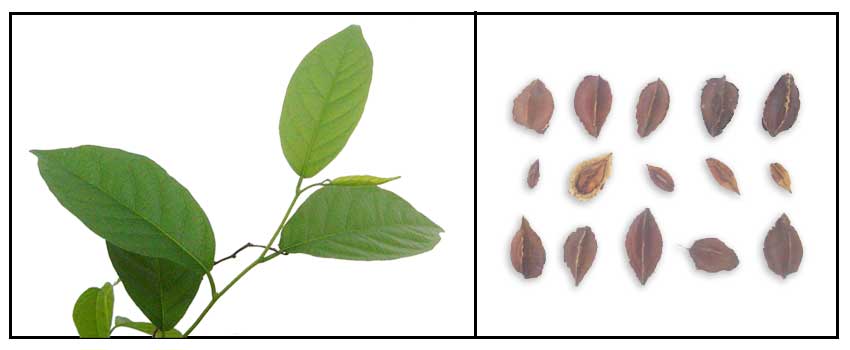
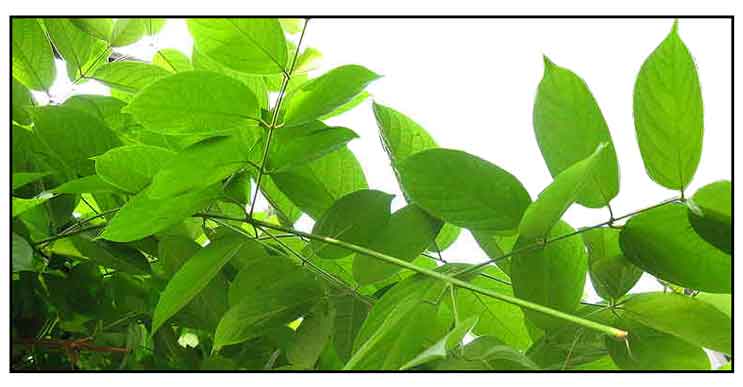
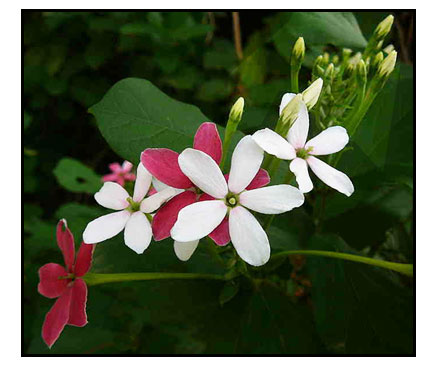
• Niog-niogan is a large climbing, woody shrub reaching a length of 2 to 8 meters. Brown hairs give the younger parts a rusty appearance. Leaves are oblong to elliptic, opposite, 7 to 15 centimeters long, rounded at the base and pointed at the tip. Flowers
are fragrant, tubular, showy, first white, then becoming red, reddish-purple or orange, exhibiting the range of colors in clusters, on
the same flower stalk. Fruit is narrowly ellipsoid, 2.5 to 3 centimeters long, with five, sharp, longitudinal angles or wings. Seeds are pentagonal and black.
Distribution
- Native to the Philippines.
-
Throughout the Philippines, in thickets, secondary forests, sandy-gravelly riverbanks.
- Ornamentally planted for its fragrant flowers.
- Also native to Assam, Bangladesh, Bismarck Archipelago, Borneo, Cambodia, China South-Central, China Southeast, Christmas I., Hainan, India, Jawa, Laos, Lesser Sunda Is., Malaya, Maluku, Myanmar, Nepal, New Guinea, Northern Territory, Queensland, Sri Lanka, Sulawesi, Sumatera, Taiwan, Tanzania, Thailand, Vietnam, West Himalaya, Western Australia. (19)
- Introduced in most tropical countries.
 Constituents Constituents
- Phytochemical screening yields major classes of constituents: alkaloids, carbohydrates, protein, amino acid, saponins, glycosides, steroids, tannins, flavonoids and phenolic compounds.
- A water extract of gum from the seeds gave an alkaloidal reaction; 3.87% of potassium sulphate was found.
- Seeds yielded the presence of oleic acid and palmitic acids in the oil; and sitosterol and isolated acetyl derivative from the saponifiable matter.
- Plant yields a fatty oil, 15%; gum; resin.
- The nut yields 12.96 percent moisture; a yellow oil, 28.37 percent of the original nut.
- Studies yield quisqualic acid, quisqualin A.
- An analysis of the seed reported the presence of oleic and palmitic acids in the oil, in addition to sitosterol, and an acetyl derivative from the saponifiable matter.
- Leaves yield rutin, trigonelline, L-proline, L-aspargine, and quisqualic acid.
- Flower gum yields pelargonidin-3-glucoside.
- Floral volatiles by n-hexane extraction yielded 24 constituents, amounting to 74.88% of the total composition. Major components of the oil were hydrocarbons (61.38%) among which α-pinene, the major terpenoid,
and 1-ethyl-1-phenyl decane (8.13 %), the dominant aromatic. Petroleum ether extract of of leaves yielded palmitic acid (27.73%) as the major component of the saponifiable component, and α-amyrin, of the unsaponifiable portion. Crude protein was 2.06%. An unusual protein, dihydro-quisqualic acid, was isolated for the first time. Galactose, glucose, arabinose and L-rhamnose were identified as free sugars.
- Study of Q. indica bark extract showed an extractive yield of 0.96 g and a total flavonoid content of 61.43 ± 1.16 mg rutin equivalent/g DW.
(29)
- Study of crude extract of dried powder of leaves of C. indicum
isolated five compounds: vtexin, orientin, isoorientin, D-glucose,, and D-fructose. The compounds were isolated from this species for the first time. (38)
- Study of leaves yielded 8 compounds: asiatic acid (1), arjunolic acid (2), oleanolic acid (3), benzyl-β-D-xylopyranosyl-(1′′ → 6′)-β-D-glucopyranoside (4), nudifloric acid (5), vanillin (6), gallic acid (7), and β-sitosterol (8). (42)
 Properties Properties
- The taste resembling coconuts.
-
Oil from the seeds are purgative.
- Considered anthelmintic, anti-inflammatory.
- Study on ascariasis reported the plant to possess anthelmintic properties.
- Excessive dosing reported to cause hiccups.
- Fruit is considered tonic and astringent.
- Studies have suggested
antoxidant, acetylcholinesterase inhibitory, larvicidal, anti-inflammatory, antipyretic, immunomodulatory, anticonvulsant, antihyperglycemic, antidiarrheal, anthelmintic, antimutagenic, antimicrobial, cytotoxicity, insecticidal, antitumor, antityrosinase, wound healing properties.
Parts
utilized
Seeds (dried nuts)
, leaves, flowers.
 Uses Uses
Edibility
• Tender shoots are edible.
• Flowers are edible, although lacking in flavor; added to salads to provide color.
• Ripe seeds
are reportedly sweet and pleasant to eat if the seed coat is removed.
Folkloric
• Dried seeds preferable for deworming. For adults: Dried nuts-chew 8 to 10 small- to medium-sized dried
nuts two hours after a meal, as a single dose, followed by a half glass
of water. If fresh nuts are used, chew only 4-5 nuts. Hiccups occur
more frequently with the use of fresh nuts. For children 3-5 years old: 4-5 dried nuts; 6 - 8 years old: 5-6
dried nuts; 9-12 years old: 6-7 dried nuts.
• Roasted seeds
for diarrhea and fever.
• Plant used as a cough cure.
• Leaves applied to the head to relieve headaches.
• Pounded leaves externally for skin diseases.
• Decoction of boiled leaves used for dysuria.
• Ifugao migrants use it for headache.
• Ayta communities in Dinalupan, Bataan, apply heated leaves on snake and animal bites.
(30)
• Ripe seeds roasted and used for diarrhea and fever.
• In Thailand, seeds used as anthelmintic;
flowers for diarrhea.
 • In India and Ambonia, leaves used in a compound decoction to relieve flatulent distention of the abdomen. Leaves and fruits are reported to be anthelmintic; also used for nephritis. • In India and Ambonia, leaves used in a compound decoction to relieve flatulent distention of the abdomen. Leaves and fruits are reported to be anthelmintic; also used for nephritis.
• In India and the Moluccas, seeds are given with honey as electuary for the expulsion of entozoa in children.
• In Indo-China, seeds are used as anthelmintic and for rickets in children.
• The Chinese and Annamites reported to use the seeds as vermifuge.
• In China,
seeds macerated in oil are applied to parasitic skin diseases. Seeds are also used for diarrhea and leucorrheal discharges of children.
• In Amboina, compound decoction of leaves used for flatulent abdominal distention.
• In Bangladesh, used for diarrhea,
fever, boils, ulcers and helminthiasis.
• In Vietnam, fruits used for treatment of ascariasis and oxyuriasis in children and for infantile malnutrition due to intestinal parasitosis. Fruit decoction used as gargle for toothache. In Thailand, seeds used as anthelmintic and leaves used for healing of abscesses. In the Moluccas and India, seeds given with honey as electuary for expulsion of entozoa in children; roasted ripe seeds used for diarrhea and fever. Malays use leaf juice as lotion for boils and ulcers; leaves applied directly to headaches. (31)
• In the District of Karnataka, Dakshima Kannada, the folklore people use leaf decoction for curing helminthiasis. (35)
• In Papua New Guinea, plants eaten daily by men and women as a method of birth control. In the Indian Ocean islands, decoction of leave used as bath for children with eczema. In Vietnam, root decoction taken for rheumatism. (43)
Others
• Crafts: In West Africa, the long, flexible stems are used for basketry, fish weir, and fish traps. (43)
Caution
• Adverse reactions: Diarrhea, abdominal pain,
distention and hiccups are more likely if nuts are eaten in consecutive
days or when fresh nuts are eaten.
Studies
• Polyphenols / Antioxidant / Flowers: Flower extract yielded high polyphenol contents
and showed strong antioxidant activity.
• Acetylcholinesterase Inhibitor / Flowers: Acetylcholine is one of the most important neurotransmitters in the central or peripheral nervous system. The methanolic extract of Q indica flower dose-dependently inhibited
acetylcholinesterase activity. (1)
• Fixed Oil Storage Effect: Study showed one year storage does not significantly affect the physical constants of the fixed oil. (2)
• Larvicidal Activity / Aedes aegypti Mosquito: In a study screening 11 plant species of local flora against the IV instar larvae of Aedes aegypti, Quisqualis indica was one of the plants that showed some larvicidal activity against Ae aegypti, albeit, at comparatively higher doses. (4)
• Antipyretic / Leaves: Study evaluated the antipyretic activity of the methanolic extract of leaves of Q. indica in brewer yeast-induced pyrexia model in rat. Results showed significant dose-dependent antipyretic activity. (5)
• Anti-Inflammatory: Study evaluated the anti-inflammatory activity of a hydroalcoholic extract in Wistar rats. Oral administration of the extract showed dose-dependent and significant anti-inflammatory activity in acetic acid- induced vascular permeability and cotton-pellet granuloma model, comparable to Diclofenac. the anti-inflammatory activity was attributed to bradykinin and prostaglandin synthesis inhibition property of the polyphenols. (6)
• Immunomodulatory / Flowers: Study evaluated the immunomodulatory activity of a hydroalcoholic extract of flowers in Wistar rats in a cyclophosphamide-induced myelosuppression model. Results showed significant immunomodulatory activity. (7)
• Phytochemicals / Anti-Inflammatory / Analgesic / Anticonvulsant / Antihyperglycemc / Antipyretic: Phytochemical studies floral volatiles and leaves were done. (See constituents above) Alcoholic extract showed remarkable anti-inflammatory, analgesic, anticonvulsant and antipyretic effects. The isolated mucilage exhibited significant anti-hyperglycemic effect. Antimicrobial testing showed pronounced effects against most of the tested microorganisms. (11)
• Intestinal Ascariasis / Comparative Study with Pyrantel Pamoate: In a comparative study of Q. indica and pyrantel pamoate in the treatment of intestinal ascariasis, 85% complete cure was seen with Quisqualis indica and 90% for Pyrantel pamoate. There was 15% and 10% decrease in ova count for Q. indica and P. pamoate, respectively. A second dose resulted in compete eradication. QI had 10% side effects compared to 55% with PP. (12)
• Anti-Diarrheal / Leaves: Study evaluated a petroleum ether extract of leaves of Q. indica against experimentally induced diarrhea. The plant extracts showed dose-dependent significant anti-diarrheal effects in all treated groups, with results compared to loperamide PO and atropine sulfate IP. (13)
• Analgesic / Anti-Inflammatory / Leaves: Study evaluated a methanolic extract of Q. indica leaves in rodents. Results showed significant anti-inflammatory and both central and peripheral analgesic activities. (14)
• Hypolipidemic Effect / Aerial Parts: Study evaluated the hypolipidemic effect of methanolic extracts of aerial parts and flowers on passive smoking induced hyperlipidemia in rats. Results showed significant concentration- and dose-dependent reduction of harmful lipid layer in blood serum. There was reduction of LDL, VLDL, cholesterol, and triglycerides with elevation of HDL. (16)
• Antimicrobial Effect / Flowers: In a study of methanol extract of flowers of Q. indica, C. gigantea, P. tuberose, the dry flower extract of Quisqualis indica showed the best antimicrobial property of the flowers studied. (17)
• Antimutagenic: Expressions from 17 plants, including Quisqualis indica, reduced the mutagenicity potential of mitomycin C, dimethylnitrosamine and tetracycline and exhibited antimutagenic effects. (18)
• Antibacterial / Flowers / Aerial Parts: Study investigated the antibacterial activity of crude flower extracts of Combretum indicum against gram-positive and gram-negative pathogenic bacterial strains. Different solvent extracts showed marked inhibition against the tested human pathogenic bacterial strains, with Staphylococcus aureus showing higher susceptibility compared to the other bacterial strains. The methanol extract was the most effective compared to ethanol and aqueous extracts. (20) Study of various extracts from dried aerial parts showed significant activity against four bacteria viz., E. coli, K. pneumonia, S. aureus, and S. pneumonia, comparable with ampicillin. (28)
• Cytotoxicity / Leaves and Flowers: Study investigated crude extracts of leaves and flowers of Quisqualis indica for cytotoxic activity on MTT assay of L269 cells. Various extracts of leaves and flowers showed varying cytotoxic activity. The ethyl acetate extract of flower showed the most effective cytotoxic activity at 500 µg mL-1 (70.3%). (21)
• Acute and Subacute Toxicity Study / Seeds: Study investigated the toxicity of seeds of Quisqualis indica in mice and rat to gain information on safety as a human anthelmintic. Mice receiving a water extract equivalent of 20.0 g/k/d orally showed no acute toxicity. Subacute toxicity study in Wistar rats showed that after receiving the extract equivalent to the seed of 6.0, 10.0 and 20.0 g/kg/day for 2 days the animals showed abnormal clinical signs; the notable ones were clonic with tonic seizures followed by respiratory arrest and death. All rats died after receiving the highest dose only for 3 consecutive days. (22)
• Silver Nanoparticles / Petals: Study reports on the ecofriendly, cost effective, and convenient green synthesis of AgNPs using flower petal extract of Combretum indicum. (23)
• Natural Indicator in Acid-Base Titration / Flowers: Study reports on the use of Combretum indicum flower ethanol extract in the development of a green indicator as alternative to synthetic acid-base titration indicators in the laboratory. (24)
• Insecticidal / Flower: Study evaluated methanol and EA extracts of Quisqualis indica flowers for antifeedant and insecticidal action against third instar larvae of Spodoptera litura Fabricius under laboratory conditions. Antifeedant activity was significantly superior in crude 5% methanol extract of flower (31.87%) compared to other treatments. Maximum insecticidal action (93.51% larval mortality) was seen with the 5% methanol extractant, comparable to chemical quinalphos 0.05%. Results suggest a potential for botanical pesticide production. (25)
• Phytoconstituents / Biologic Activities: Quisqualis indica yields phytoconstituents such as trigonelline (alkaloid), L-proline (a-amino acid), L-asparagine (a-amino acid), quisqualic acid (agonist for AMPA receptors), rutin (flavonoid), and two forms of cysteine synthase, isoenzyme A and isoenzyme B. Various activities are attributed to these phytoconstituents viz., anti-inflammatory, antipyretic, immunomodulatory, anti-staphylococcal, anthelmintic, antiseptic activities, among others. (26)
• Effect on Experimental Esophagitis / Flowers: Study investigated a flower extract of Q. indica for free radical scavenging effects against experimental esophagitis in albino Wister rats. Results showed treatments with pantoprozole and flower extracts significantly inhibited gastric secretion, total acidity, and esophagitis index. Various oxidative stress parameters were restored to normal level. Collectively, the findings suggest anti-esophagitis potential for the flower extract. (27)
• Antioxidant / Total Phenolic Content / Cytotoxic / Leaves: Study evaluated the antioxidant, cytotoxic, and total phenolic content (TPC) of different fractions of Q. indica leaves. Antioxidant activity on DPPH assay ranged from 24.38 to 72.10 µg/ml. Among all tested fractions EtOAc was the most active. Cytotoxic activity was evaluated by brine shrimp lethality test (BSLT) and MTT assay against liver carcinoma cell line (HepG2). Defatted 90% MeOH and n-BuOH fractions showed highest TPC (345.99 ± 1.45 and 3.8078 ± 1.46 mg GAE / g DE, respectively). Cytotoxic activity against HepG2 showed the CH2Cl2 and n-BuOH to be the most cytotoxic fractions (IC50=11.9, 17.9 µg/ml, respectively) compared to Doxorubicin (IC50 of 4 µg/ml). (32)
• Antidiabetic/ Antidyslipidemic / Leaves: Study evaluated the crude methanolic extract of leaves of C. indicum for antihyperglycemic and antidyslipidemic activities in STZ-induced diabetic rats. In-vivo results showed concentration-dependent and significant (p<0.05, 0.01, 0.001) reductions of elevated blood glucose, total cholesterol, triglycerides and LDL cholesterol levels in treatment groups. There was significant (p<0.001) rise in HDL cholesterol. (34)
• Anthelmintic / Leaves: Study evaluated the effect of leaf decoction of C. indicum against adult Indian earthworms Lumbricus terrestris. Results showed significant anthelmintic effect, more effective than the standard drug Albendazole. (35)
• Antitumor / Antioxidant / Flavonoids: LC-ESI-MS/MS study of aqueous methanolic extract of aerial parts for potential antioxidant and antitumor activity. Antioxidant activity was evaluated by DPPH, reducing power, ABTS, FRAP and ion metal chelating assays. On Ehrlich ascites carcinoma cells, the extract reasonable impact on viability of carcinoma cells at all tested concentrations in a dose dependent manner. High concentration of the extract achieved cytotoxic effect convergent to that achieved with drug vincristine. Results showed potential for use as antioxidant and antitumor agents. (36)
• Antityrosinase / Antioxidant / Leaves: Study evaluated the antioxidant and antityrosinase activities of C. indicum leaves using surfactants (Triton X-100 and Vitamin E TPGS) at concentrations
of 1%, 2%, and 3% along with various alcohol solvents. Anti-tyrosinase activity was assessed through a mushroom tyrosinase inhibitionn assay. Ethanol at concentration of 50% was the optimum solvent to extract CI leaves, and demonstrated good antioxidant and anti-tyrosinase action with high percentage of yield and total phenolic content. Results contribute to the better understanding and applications of the extract in cosmetics, notably in treatment of oxidative stress and hyperpigmentation. (37)
• Anthocyanins / Antioxidant Potential of White and Red Flowers: Study evaluated major anthocyanins following the temporal accumulation in color changing flowers of C. indicum from white to red. HPLC-DAD determined cyanidin 3-O-glucoside as the major anthocyanin accumulating in the petals. Acid hydrolysis of anthocyanin extracts confirmed cyanidin as the major anthocyanidin in floral tissue. Study for antioxidant potential of flower extracts by DPPH assay showed the methanol extract with highest free radical scavenging capacity, and petals of red stage with maximum activity. FRAP and ABTS assays also showed highest activity in the red stage. (39)
• Silver Nanoparticles / Antioxidant / Catalytic / Leaves: Study reports on eco-friendly synthesis of silver nanoparticles using leaf extract of Combretum indicum. Study highlighted the catalytic effectiveness of CI-AgNPs in degradation of amido black 0B (AB10B). The AgNPs also exhibited excellent antioxidant activity in DPPH assay. (40)
• Wound Healing / Flowers: Study evaluated the wound healing effect of ointment formulation (25, 50 and 75%) of C. indicum methanolic extract of flower on a burn wound model in male mice. Positive controls were Burnazin and Vaseline. Results indicated the flower extract accelerated (p<0.05) wound healing process, increased hydroxyproline levels and total DNA content, and repair of damage tissue by acceleration of proliferative phase. The 75% extract ointment showed best results. (41)
Availability
- Wild-crafted.
- Ornamental cultivation.
- Plants, seeds in the cybermarket.
|