|
Taxon confusion
Physalis, a genus of the family Solanaceae consists of about 100 species. Among these, Physalis minima has been confused with P. angulata (putokan). Some compilations list them as synonyms, others list them as separate species. In Bangladesh, the two have long been misidentified. A critical examination separates them as species. (9)
Botany
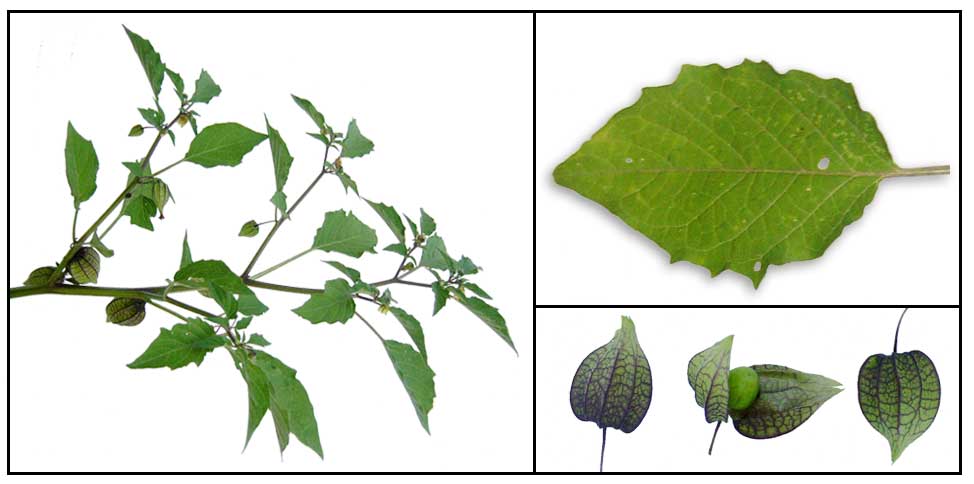
Pantug-pantugan is an erect, branched, hairy
annual herb, growing 0.5 to 0.8 meter high. The branches are terete
and often tinged with purple, the ultimate ones slightly angular. Leaves
are ovate, 6 to 12 centimeters long, 4.5 to 7 centimeters wide, with pointed tip, rounded
or slightly heart-shaped base, nearly entire or with faintly undulately lobed
margins. Flowers are solitary, axillary, about 8 millimeters long. Corolla is
pale yellow, with 5 large, purple spots at the base inside. Fruit
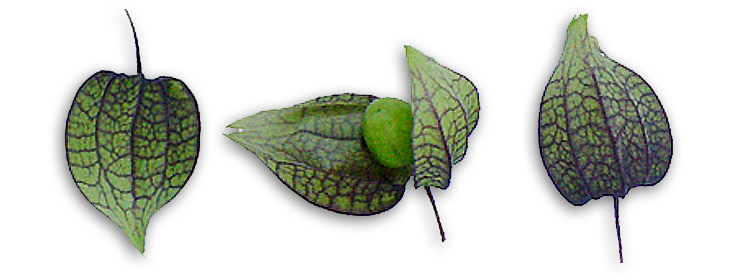
is round, fleshy and edible, about 1 centimeter in diameter. Calyx is inflated,
accrescent, and ovoid, about 3 centimeters long, 2 centimeters in diameter, green,
with 5 prominent and alternating slender and purplish ribs.
Distribution
- Found from the Babuyan Islands and northern Luzon to Mindanao and Palawan.
- Often
common in open, waste
places at low altitudes, ascending up to 1,600 meters.
- Pantropic weed.
Constituents
- Phytochemical studies yield alkaloids, anthraquinones, flavonoids, cardiac glycosides, phenols, quinones, reducing sugars, saponins, steroids, starch, tannin and terpenoids from the stem, leaf, and unripe fruit.
- Ethanolic extract of leaves yielded major
compounds, viz. acetamide, 2,2,2- trifluoro-N-methyl- (7.2%), 2-cyclopenten-1-one, 2- methyl- (3.83%), phytol (17.88%), n-Hexadecanoic acid (29.81%), octadecanoic acid (5.04%), oleic acid (3.55%), 9,12-octadecadienoic acid (Z,Z)- (12.47%), hexaethylene glycol monododecyl ether (5.6%) and 9,12,15-octadecatrienoic acid, (Z,Z,Z) (14.63%). Ethanolic extract of roots yielded n- Hexadecanoic acid (4.06%), 2-[2-[2-[2-[2-[2-[2-(2- Hydroxyethoxy)ethoxy]ethoxy]ethoxy] ethoxy]ethoxy]eth oxy]ethanol (1.43%), O-Methyl-DL-serine,N- dimethylaminomethylene-,ethyl ester (63.20%) and Ethyl dl-(1-naphthyl)glycolate (4.94%). (18)
- Fruits yielded major compounds, viz. acetamide, 2,2,2-trifluoro-N-methyl- (3.90%), 4H-pyran-4-one, 2,3-dihydro-3,5-dihydroxy-6- methyl-(8.40%), 5-hydroxymethylfurfural (14.07%), (Z)- 3-phenyl-2-propenoic acid (3.33%), n-hexadecanoic acid (28.98%), octadecanoic acid (3.35%), octadec-9-enoic acid (9.15%), 9,12-octadecadienoic acid (Z,Z)- (16.09%), 2-Isopropoxyethyl propionate (9.28%) and 9,12,15- octadecatrienoic acid, (Z,Z,Z)- (3.47%).
(18)
- Study for bioactive compounds in leaves yielded heneicosanoic acid (25.22), bicyclo [4.1.0] hepta-2, 4-dien (27.41), octadecanoic acid (CAS), stearic acid (31.19) and octadeca-9, 12-dienoic acid (32.02). Phenolic compounds profile yielded ellagic acid (4.13 min), catechol (3.59 min), gallic acid (4.12 min) and catechin (7.41 min).
(19)
- Study yielded a novel withanolide, withaphysalin P (1) and six other new withaphysalins (2-7), together with three known withaphysalins (8-10)
. (see study below) (6)
- Study of various solvent extracts of dried powder yielded a TPC (total phenolic content) range of 60.27 ± 1.73 - 151.25 ± 2.50 mg GAE/g dry weight and TFC (total flavonoid content) range of 56.66 ± 0.80 - 158.84 ± 2.30 mg / QE/g dry weight. (see study below) (27)
- Phytochemical screening of leaf extract yielded flavonoids, alkaloids, tannins, saponins, steroids, cardiac glycosides, reducing sugars, and terpenoids. TFC was 61.3 mg/g of flavonoid. (see study below) (28)
- Bioactvity-guided phytochemical study of ethyl acetate extract of P. minima
yielded eight compounds elucidated as 3-isopropyl-5-acetoxycyclohexene-2-one-1 (1), isophysalin B (2), physalin G (3), physalin D (4), physalin I (5), physordinose B (6), stigmasterol-3-O-β-D-glucopyranoside (7) and 5α-6β-dihydroxyphysalin R (8). (see study below) (29)
- Study of whole plant for steroidal chemical constituents yielded seven compounds, two were physalins, identified as 16, 24-cyclo-13, 14-secoergost-2-ene-18, 26-dioicacid-14:17, 14:27-diepoxy-5α, 6β, 13α, 20α, 22β, 25β-hexahydroxy-1, 15-dioxo-γ-lactone-δ-lactone (1) and physalin D (2), and five were withanlides, named physagulin L (3), physagulin M (4), physaminimin F (5), physagulin K (6), and withagulatin A (7).
(30)
- GC-MS analysis of
methyl esters of fatty acids in minima oil extracted from Physalis minima yielded nine quantifiable fatty acids. Both saturated and unsaturated fatty acids were identified. Palmitic acid was highest at 46.83%. Linoleic acid and linolenic acid were 16.98% and 14.80%, respectively. (31)
- Study of whole plant yielded two new physalins, 16,24-cyclo-13,14-secoergosta-2-ene-18,26-dioic acid=14: 17,14:27-diepoxy11ß,13,20,22-tetrahydroxy-5a-methoxy-1,15-dioxo-y-lactone &-lactone (1), and 16,24-cyclo-13m14-secoergosta-2-ene-18-26-dioic acid-14L 17,14:27-diepoxy-5a- 11ß, 13,20,22-pentahydroxy-1,6,15-trioxo-y-lactone &-lactone (2). (see study below)
(34)
- Study of whole plant of Physalis minima isolated nine new withaphysalin-type withanolides (1-9), named physaminimines (G-O). (See study below)
(36)
- Study isolated two isomeric C28-sterols, physalindicanols, from P. minima var. indica and were elucidated as ergosta-5,25-dien-3ß,24-diol and ergosta-5-24(28)-dien-3ß,25-diol.
The isolated sterols are regarded as precursors in the elaboration of complex C-28-steroidal lactones, native to the plant and related species. (40)
Properties
- Bitter tasting, cooling
in effect.
- Fruit is alterative, diuretic,
aperient.
- Plant is considered appetizer, antipyretic, anti-inflammatory, antitussive, diuretic, laxative, expectorant, purgative, and tonic.
Parts utilized
Roots, leaves, fruits.
Uses
Nutritional
- Fruit is edible, with a taste of a sweet cherry tomato.
Folkloric
- In Java, root is used as vermifuge.
- Root extract used for fever.
- Poultice of leaves, smeared with oiled and heated, applied to ulcers.
- Decoction of leaves with Plantago major used for gonorrhea; also, diuretic.
- Fruit used as alterative, diuretic and aperient; used in dropsy, urinary diseases, and gout.
Used for colds and fever, swelling pain of the throat, bronchitis.
- Fruit used for gout; also used to infuse vigor and offset premature decay.
- In Konkan, plant paste made with rice water used to restore flaccid breasts.
- Poultice of fruits used for headaches and intestinal pains.
- In the Punjab, used for gonorrhea.
- Malays used a poultice for headaches and intestinal pains
- Pounded
fresh material may be used as poultice or decoction of the same may
be used as wash for eczema infection.
- Juice of leaves, mixed with mustard oil and water, used for
earaches.
- In India, used for dysuria,
ascites, ulcers, cough, bronchitis, pruritus and erysipelas. Used as a tonic, diuretic and purgative; as a remedy for spleen disorders. Also used for diabetes.
- In the Malay Peninsula, leaves smeared with coconut oil are heated and applied to ulcers, wounds, and pustules. Roots used as anthelmintic and to treat fever and headache. (25)
Studies
• Antifertility:
Study of extract of P minima on female albino rats exhibited variations
in ovarian and uterine weights and significant histopathologic changes
in the histoarchitecture of the female reproductive system. (1)
• Antimicrobial / Leaf and Callus Extracts:
Antimicrobial activity of Rauvolfia tetraphylla and Physalis minima
leaf and callus extracts: Leaf and callus extracts of R. tetraphylla
and P. minima inhibited bacterial and fungal growth. (2)
• Phytochemicals / Withaphysalin D:
Study yielded Withaphysalin D, a new withphysalin. (3)
• Anti-Inflammatory / Analgesic:
Study of the whole plant of Physalis minima on rats showed marked anti-inflammatory and analgesic activities. The antipyretic activity was insignificant. Results showed PM as a potential candidate as an anti-inflammatory and analgesic agent. (4)
• Cytotoxic / Anti-Cancer / Human Lung Adenocarcinoma Cell Line:
In the study, the chloroform extract of Physalis minima exhibited remarkable cytotoxic activities on human lung adenocarcinoma cell line in time- and dose-dependent manners. Its apoptotic effect suggests potential for development as an anticancer drug. (5)
• Withaphysalins / Anticancer: Study yielded a novel withanolide, withaphysalin P with six other new withaphysalins 1-7 and three known withaphysalins 8-10. Some compounds showed moderate cytotoxic activity against two human cancer cell lines – colorectal-carcinoma and non-small cell lung cancer. (6)
• Hypoglycemic / Alpha-Glucosidase Inhibition:
Physalis minima extract showed in-vitro inhibitory activity of intestinal alpha glucosidase enzyme maltase with decrease intestinal absorption of monosaccharides through inhibition of disaccharide hydrolysis. (7)
• Apoptotic Effects / Anti-Breast Cancer:
A chloroform extract of Physalis minima produced significant inhibition against human T-47D breast carcinoma cells. It induced apoptotic cell death via p53-, caspase-3-, and c-myc-dependent pathways. (8)
• Antibacterial / Berries:
Study of methanol and chloroform extracts of mature berries of P. minima exhibited potent inhibitory activity against all the bacterial strains tested. Polar compounds in the crude extract were responsible for the antimicrobial action. (10)
• Antibacterial / Leaf and Stems: Study showed leaf and stem extracts to have moderate antibacterial activity when evaluated against Bacillus cereus, B. subtilis, Citrobacter sp., Enterobacter aerogenes, E. coli, K. pneumonia, P. aeruginosa, P. fluorescens and S. aureus. Overall antibacterial assay showed the ethanolic extract to be more effective than other solvents. (12)
• Anti-Lipid Peroxidation:
Study evaluated the free radical scavenging activity of ethanolic extracts of Piper trioicum and Physalis minima, with goat liver as the lipid source. Results showed suppression of lipid peroxidation. In the study, P. trioicum extract showed more activity than Physalis minima. (11)
• Diuretic Activity / Leaves:
Study evaluated the diuretic effect of petroleum ether extract of P. minima in albino rats. Results showed significant increase in urine volume, with increased excretion of potassium and sodium. The effect was similar to furosemide. (15)
• Antioxidant / Stems and Leaves:
Study evaluated the in vitro antioxidant activity of crude extracts of stems and leaves of P. minima by DPPH and reducing power assay. The methanolic extract of leaf showed higher activity to others extracts of stem and leaves. The entire tested sample showed lower scavenging activity than standard ascorbic acid. (16)
• Free Radical Scavenging Activity / Leaves :
Study screened an ethanolic extract for in vitro antioxidant activity by various radical scavenging assays. Results showed marked concentration dependent antioxidant activity and may be attributed to the presence of bioflavonoids in the leaf. (17)
• Antidiabetic / Toxicity Study: Study evaluated the hypoglycemic effects of P. minima extracts in alloxan-induced diabetic rats.
Chronic administration of flower and leaf extract showed a fall in fasting blood sugar of rats. Toxicity study showed the medium lethal dose (LD50) f the extract is higher than 1 g/kg body weight. (20)
• Hypoglycemic Effect: Study evaluated the effect of methanolic extract of Physalis minima on blood glucose level and sperm quality in normoglycemic mice. Results showed a significant dose dependent decrease (p<0.05) in blood glucose of treatment groups, without affecting sperm quality in male mice. (21)
• Anti-Inflammatory Effect on Gastric Tissue: Study investigated the effect of a methanolic extract of P. minima in gastric inflammation and gastric ulcer formation in rats. The methanol extract of Pm exhibited anti-inflammatory action due to its effect in inhibiting phospholipase A2 expression in gastric tissue. The gastric ulcer formation as side effect of the MEMP was lower compared to aspirin. (22)
• Antidiabetic / Toxicity Study /Leaves: Study evaluated Physalis minima leaves for in vitro a-amylase, a-glucosidase inhibitory activities and glucose uptake by yeast cells in alloxan-induced diabetic rats. Results showed a dose-dependent percent inhibition by the extract against α-amylase (16%-84%), α-glucosidase (18%-76%), and glucose uptake by yeast cells (16%-78%). Toxicity study showed a medium lethal dose (LD50) of the extracts is higher than 1 g/kg body weight. (23)
• Anti-Ulcer Activity: Study evaluated the anti-ulcer effect of different extracts of Physalis minima in NSAIDs induced ulcer model in albino rats. Extract dose at 200 and 400 mg/kg produced significant inhibition of gastric ulcers induced by NSAIDs. (24)
• Influence of Growth and Ripening of Fruit on Antibacterial Potential: Study screened the antibacterial potential of edible fruits at successive stage of growth and ripening. Results showed the influence of maturity indices of Physalis minima fruit on its antibacterial potential. (26)
• Antioxidant / Antimicrobial: Study evaluated various solvent extracts of dried powder of P. minima for TPC, TFC, and antioxidant activity. A methanolic extract showed highest antioxidant activity followed by ethyl acetate, chloroform, and hexane extracts on DPPH and ABTS assays with IC50 of 280.23 ± 5.75-173.40 ± 0.38 µg/ml, respectively. All extracts showed potent antimicrobial activity. (see constituents above) (27)
• Anticancer / Leaves: Study of methanolic leaf extract showed % viability of HeLa cell line and Hep2 cell line at 80% and 71.8%, respectively. The percentage of growth inhibition of ME in SRB assay increased with increasing concentration. (see constituents above) (28)
• Chemopreventive / Michael Reaction Acceptors: Study evaluated the chemopreventive effect of constituents from Physalis minima. Results showed the ethyl acetate extract of P. minima had potential quinone reductase (QR) inducing activity with induction ratio (IR, QR induction activity) value of 1.47 ± 0.24, and glutathione binding property as potential Michael reaction acceptors. (see constituents above) (29)
• Methyl Esters of Fatty Acids in the Oil: GC-MS analysis of methyl esters of fatty acids in minima oil extracted from Physalis minima yielded nine quantifiable fatty acids, among them palmitic acid (46.83%), linoleic acid (16.98%) and linolenic acid (14.80%). The high fatty acid amounts suggest a potential for use in phytopharmaceutical and pharmaceutical preparations. (see constituents above) (31)
• Withanolides /
Inhibitory Effects on Nitric Oxide Production: Study isolated six new withanolides from whole plants of P. minima. Compounds 2 and 5 showed strong inhibitory effects on isolates of NO production in lipopolysaccharide-activated RAW264.7 macrophages, with IC50s of 8.04 and 10.01 µM, respectively. Compounds 1, 9, and 10 exhibited moderate inhibitory activities with IC50s ranging from 25.54 to 43.58 µM. (32)
• Anxiolytic Effect / Leaves: Study evaluated the anxiolytic effect of a methanol extract of Ceplukan leaves using Elevated Plus Maze test
in ovariectomized Wistar rat brain model. Extract treated rats showed less anxiety than control rats. Results showed decreased IL-6 level in extract treated rats. (33)
• Leishmanicidal / Physalin: Study isolated two new physalins from the whole plant of Physalis minima. Both compounds have shown potent leishmanicidal activity against promastigotes of Leishmania major. (see constituents above) (34)
• Anti-Inflammatory / Withanolides: Study isolated two major withanolide-type compounds from the anti-inflammatory fraction of P. minima. Both compounds inhibited the production of nitric oxide (NO, prostaglandin E2 (PGE2) and several pro-inflammatory cytokines, such as IL-1ß, IL-6, and tumor necrosis factor-a (TNF-a) in lipopolysaccharide (LPS)-activated RAW264.7 macrophages. The compounds downregulated LPS-induced expression of iNOS and COX-2 at the mRNA and protein levels. They also suppressed nuclear translocation of NF-kß p65, phosphorylation of STAT3, and upregulated HO-1 expression. (see constituents above) (35)
• Physaminimins / Anti-Inflammatory: Study of whole plant of Physalis minima isolated nine new withaphysalin-type withanolides (1-9), named physaminimines (G-O). Physaminimins G, H, and K showed inhibitory activities against lipopolysaccharide (LPS)-induced nitric oxide (NO) production in macrophage (RAW253.7) cells with IC50s of 17.41, 36.33, and 21.47 µM, respectively.
(36)
• Antiulcer / Ethanol-Induced and Pylorus-Ligation Model / Leaves: Study evaluated the antiulcer activity of methanolic extract of P. minima leaves on ethanol induced ulcer and pylorus ligation models in rats. The extract showed significant (p<0.01) reduction in gastric volume, free acidity and ulcer index. The leaves extract showed potential antiulcer activity in both models. Effect was attributed to anti-secretory activity. (37)
• Withanolids / Anti-Inflammatory / Cytotoxic / Anticancer: Study of whole plant yielded six undescribed withanolides and investigated for anti-inflammatory and cytotoxic constituents. All the compounds exhibited anti-inflammatory ability via inhibiting the production of nitric oxide (NO) in lipopolysaccharide (LPS)-stimulated murine macrophage RAW 264.7 cells. Extract also showed moderate cytotoxic activities against A549 lung adenocarcinoma cells, SMMC-7721 hepatic carcinoma cells with IC50s in range of 40.01-82.17 µM. (38)
• Immunomodulatory / Fruits: Study evaluated the immunomodulatory activity of a methanolic extract of P. minima unripe fruits in Swiss albino mice. The animals were screened using hemagglutinating antibody titer to assess humoral immune response, carbon clearance test to assess scavenging activity and delayed hypersensitivity by difference between pre and post challenge foot pad thickness. A methanol extract of unripe fruits yielded alkaloids, glycosides, carbohydrates, steroids, tannins, phenols, anthocyanins, with absence of phytosterols, saponins, flavonoids, proteins, and betacyanins. From research studies and present HPLC and LC-MS data, results suggest extract possess mmunostimulant properties which can be attributed to steroidal alkaloids, (39)
• Apoptotic Effect on Breast Cancer Cells: Study sought to produce an anticancer agent from P. minima ethanol extract as well as prevent growth of NMU-induced breast cancer and MCF-7 cell line using Wistar-Furth rats. Results of immunohistological analysis in the breast organ showed P. minima extract significantly (p<0.05) increased the tumor suppressor protein p 53. Extract also significantly (p<0.05) increased APAF-1, which is a gene determining cell death. Results suggest potential use as a complementary treatment for inhibiting growth of breast cancer cells in patients. (41)
• Physalin F / Anticancer: Physalin F is a potent anticancer compound from Physalis minima. Study recently reported the apoptosis-based cytotoxic effect of the chloroform extract of the plant. This study investigated the cytotoxicity and possible cell death mechanism elicited by physalin F on human breast T-47D carcinoma. Cytotoxicity screening of physalin F displayed remarkable dose-dependent inhibitory effect on T-47D cells with lower EC50 value (3.60 µg/ml) than the crude extract. mRNA expression analysis revealed co-regulation of c-myc- and caspase-3-apoptotic genes in the treated cells, The apoptotic mechanism is reconfirmed by DNA fragmentation and phosphatidylserine externalization. (42)
• Cytotoxic Inhibitors: Study isolated six withanolides, including withanolide E (1), withaperuvin C (2), 4ßhydroxywithanolide E (3), 28-hydroxywithaperuvin C(4), physaperuvin G (5), and 4-deoxywithaperuvin (6). All isolated compounds were evaluated for cytotoxicity. Compounds 1 and 3 showed strongest cytotoxicity against HepG2, SK-LU-1,, and MCF-7 cell lines with IC59s ranging from 0.051 to 0.86 µg/ml. (43)
• Anti-Inflammatory Withanolides Inhibitors: Study isolated 5 new withanolides (1-5) along with five known ones (6-10) from whole plants of Physalis minima. Compounds 1-10 were evaluated for anti-inflammatory activities via inhibition of nitric oxide production in LPS-stimulated murine RAW 264.7 cells in vitro. All the compounds showed moderate inhibitory effect against NO production with IC50s range of 23,53 to 66.28 µM. (44)
• Attenuation of Ventricular Fibrosis / Inhibition of TNF-α / Leaves: Increase prevalence of heart failure on menopausal women correlates with the decrease of estrogen level. Study evaluated the effects of ceplukan leaf (P. minima), which contains phytoestrogen physalin and withanolides, on ventricular TNF-α level and fibrosis in ovariectomized rats. Study showed prolonged hypoestrogen state increases ventricular fibrosis (p<0.05). Leaf treatment resulted in decrease of ventricular fibrosis and TNF-α level in a dose dependent manner. Reduction in fibrosis positively correlated with TNF-α level (p<0.05). The methanol leaf extract decreased ventricular fibrosis through inhibition of ventricular TNF-α level in ovariectomized rats. (45)
• Cytotoxicity and Cell Death Mechanism / Ovarian Caov-3 Carcinoma: Study evaluated the cytotoxicity and possible cell death mechanism of chloroform extract of P. minima in human ovarian Caov-3 carcinoma. Results showed concentration- and time-dependent inhibitory effects. The chloroform extract exhibited anticancer effect due to a combination of apoptotic and autophagic programmed cell death mechanisms on Caov-3 cells. Programmed cell death was mediated via c-myc, p53 and caspase-3 dependent pathway. (46)
• Hepatoprotective / Rifampicin-Isoniazid Toxicity / Leaves: Study evaluated the hepatoprotective effect of P. minima leaf extract on rifampicin-isoniazid induced toxicity in adult wistar rats, Administration of the leaf extract significantly (p<0.01) increased plasma and hepatic lipid profiles. The extract suppressed cytochrome P450 activity and decreased levels of transaminases, SOD, catalase, GSH and malondialdehyde. Results suggest the leaf extract at 100 and 200 mg/kg has significant hepatoprotective activity as evidenced by biochemical, function, and histopathlogical parameters. (47)
• Analgesic: Study evaluated ethanol and ethyl acetate extracts of P. minima for analgesic activity using hot plate method in albino wistar rats. The 299 and 499 mg/kbw doses of the extracts showed comparable analgesic effect in the hot plat method. (48)
• Wound Healing / Fruits: Study evaluated the wound healing efficacy of hydroalcoholic extracts of P. minima fruits in excision wound models in wistar albino rats. Results showed promotion of wound healing via antibacterial activity. (49)
• Inhibitory Effects of Amylase, Lipase and Alpha Glucosidase: Study evaluated the effects of an ethanolic extract of P. ,minima on amylase, lipase and alpha glucosidase activity in vitro. Results showed inhibitory effects that may be useful in the treatment to limit dietary fat and glucose absorption and the accumulation of fat in the adiose tissue. (50)
• Seco-Withanolides / Anti-Inflammatory: Study of whole plant isolated four new 13,14-secowithanolides, minisecolides A-D (1-4), along with 3 known analogues (5-7). All isolates were evaluated for inhibitory effects on nitric oxide (NO) production using polysaccharide-activated RAW264.7 macrophages. Compounds 2, 3, 5, and 6 showed inhibitory activities, especially compound 5 with IC50 of 3.87 µM. (51)
• Antimicrobial / Methicillin Resistant S. aureus (MRSA) / Fruit: Study evaluated the minimum inhibitory concentration (MIC) and minimum bactericidal concentration (MBC) of ciplukan (Physalis minima) extract in Methicillin-resistant S. aureus (MRSA) bacterial. MIC could not be determined, but MBC against MRSA was 0.9 g/ml (90%). (52)
• Re-endothelialization . Deoxycorticosterone Induced Dysfunction / Leaves: Study evaluated the effects of P. minima leaves extract on serum NO levels, circulating EPCs number, and histopathology of tail artery endothelial cells in DOCA-salt-induced endothelial dysfunction in rats. Physalis minima leaves extract dose-dependently increased NO bioavailability contributing to enhanced EPCs mobilization, thereby promoting re-endothelialization in DOCA-salt-induced endothelial dysfunction in rats. (53)
• Inhibitor of Hedgehog/GLI-Mediated Transciption / Anticancer / Leaves: Physalin F and B were identified as potent inhibitors from screening for hedgehog/GLI signaling inhibitors. The compounds were cytotoxic to PANC1 (pancreatic cancer cells) that express Hh/GLI components, and decreased Hh-related protein expression. Aberrant Hh/GLI signaling pathway causes formation and progression of a variety of tumors. In a search of Hh inhibitors, study screening for naturally occurring inhibitors of transcriptional activator GLI identified zerumbone (1), zerumbone epoxide (2), staurosporinone (9), 6-hydroxystaurosporinone (10), arcyriaflavin C (11) and 5,6-dihyroxyarcyriaflavin A (12) as inhibitors of GLI-mediated transcription. Physalins F(17) and B (18) were also potent inhibitors. The identified compounds were cytotoxic to PANC1 pancreatic cancer cells, which express Hh/GLI components. The cytotoxicity of the compounds to PABC1 cells correlated with their inhibition of GLI-mediated transcription. (54)
Availability
Wild-crafted.
|