 |

Family • Rubiaceae
Santan-tsina
Ixora chinensis Lam.
CHINESE IXORA
Long chuan hua
| Scientific names | Common names |
| Bemsetia paniculata Raf. | Santan (Bik., Tag.) |
| Gaertnera hongkongensis Seem. | Santan-pula (Tag.) |
| Ixora blanda Ker Gawl. | Santan-tsina (Tag.) |
| Ixora chinensis Lam. | Needle flower (Engl.) |
| Ixora coccinea Curtis | Chinese ixora (Engl.) |
| Ixora colei W.Bull | Jungle flame (Engl.) |
| Ixora crocata Lindl. | |
| Ixora dixiana W.Bull | |
| Ixora dubia Schult. & Schult.f. | |
| Ixora flammea Salisb. | |
| Ixora incarnata Roxb. ex Sm. | |
| Ixora kroneana (Miq.) Bremek. | |
| Ixora pallida Reinw. ex Miq. | |
| Ixora rosea Sims | |
| Ixora speciosa Willd. | |
| Ixora stricta Roxb. | |
| Ixora stricta var. mekongensis Pierre ex Pit. | |
| Pavetta arborea Blanco | |
| Pavetta kroneana Miq. | |
| Pavetta stricta (Roxb.) Blume | |
| Sykesia hongkongensis (Seem.) Kuntze | |
| Tsiangia hongkongensis (Seem.) But, H.H.Hsue & P.T.Li | |
| In Quisumbing's compilation, both species of Ixora chinensis and Ixora coccinea share the local commons names (1) santan, and (2) santan-pula. | |
| Quisumbing's compilation lists I. chinensis and I. coccinea as separate species while some compilations list them as synonyms. | |
| Ixora chinensis Lam. is an accepted species. KEW: Plants of the World Online | |
| Other vernacular names |
| CAMBODIA: Kam rontea |
| CHINESE: Mai zi mu, Long chuan hua. |
| INDONESIA: Siantan. |
| MALAY: Pechah priok. |
| MALAYALAM: Chethi |
| THAILAND: Dauk chem. |
| VIETNAMESE: Dun trung quoc, B[ooj] trang d[or]. |
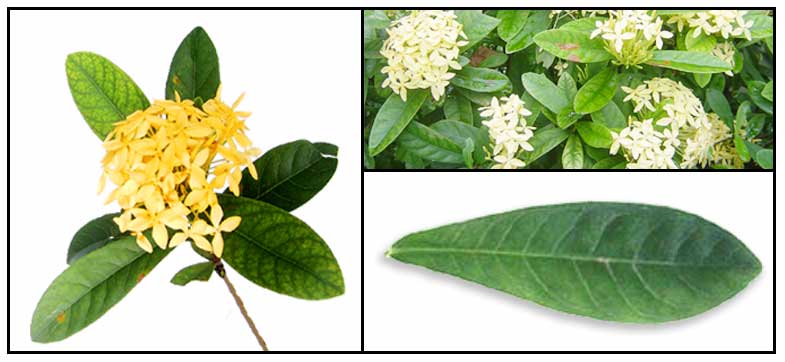
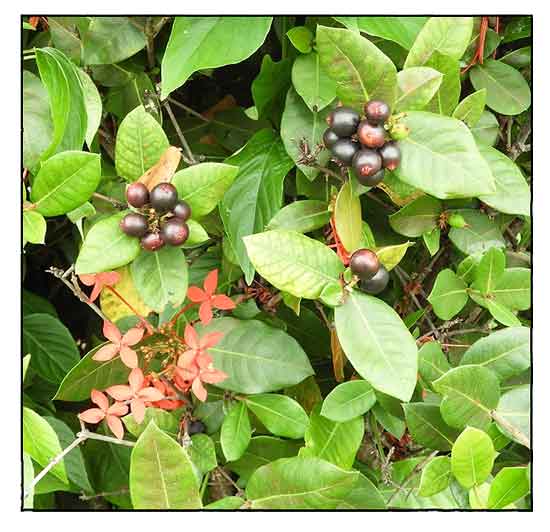
• Shrubs, 0.8-2 m tall; branches glabrous. Leaves opposite, sometimes apparently in whorls of 4 due to reduced stem internodes, sessile or petiolate; petiole to 5 mm, glabrous; blade drying leathery, oblanceolate, oblong-oblanceolate, obovate, elliptic-oblong, or lanceolate, 6-18 × 3-6 cm, glabrous on both surfaces, base cuneate to shortly truncate or rounded, apex obtuse or rounded to acute; secondary veins 7-9 pairs; stipules persistent, united around stem to almost interpetiolar, triangular to broadly triangular, 3-7 mm, glabrous to glabrescent, costate, acute and with arista 2-10 mm. Inflorescence terminal, congested-cymose to congested-corymbiform, many flowered, puberulent to hirtellous, subsessile to pedunculate; peduncle to 1.5 cm, often subtended by 2 reduced leaves or leaflike bracts; branched portion 1-4 × 1-5 cm (not including corollas); bracts triangular, 0.2-1 mm; pedicels to 2 mm. Flowers subsessile to pedicellate. Calyx glabrous; hypanthium obconic to ovoid, 1-1.5 mm; limb deeply lobed; lobes triangular to ligulate, 0.5-1 mm, acute or obtuse. Corolla red or reddish yellow, outside glabrous; tube 20-30 mm, glabrous in throat; lobes ovate, elliptic, or broadly elliptic, 5-7 × 4-5 mm, broadly obtuse to rounded. Drupe reddish black, subglobose and shallowly didymous, 6-7 × 6-7 mm, glabrous. (Flora of China) Distribution
Studies Availability |
 Gen info

Updated December 2023 / June 2018 / April 2014

 |
PHOTOS / ILLUSTRATIONS |
| Photos ©Godofredo Stuart / StuartXchange |
| OTHER IMAGE SOURCE: Ixora chinensis - flower / Fan Wen /CC BY-SA 4.0 International / Click on image or link to go to source page / Wikipedia |
| OTHER IMAGE SOURCE: Flowers of Ixora chinensis / Billjones94 /CC BY-SA 4.0 International / Click on image or link to go to source page / Wikipedia |
| OTHER IMAGE SOURCE: Ixora chinensis / Leon Levy Native Plant Reserve / Non-commercial use / Image modified / Click on image or link to go to source page / LEON LEVEY Native Plant Reserve |
| Additional
Sources and Suggested Readings (1) Ixora chinensis / No.73898 (2) Ixora chinensis Lam. / Catalogue of Life, China 2011 (3) Ixora chinensis / AgroForestryTree Database (4) Ixora chinensis / Synonyms / KEW: Plants of the World Online (5) Ixora chinensis Lamk. Flower Extract Health Drink / Buavaroon Srichaikul / Journal of Advanced Research in Health and Nursing, 2016; Vol 1, Issue 5 (6) Extraction and Isolation of active constituents from Ixora chinensis Lam. leaves / Dontha Sunitha, Kamurthy Hemalatha, Bhagavan R Manthripragada and Nandakishora Chary / Der Pharma Chemica, 2015; 7(10): pp 434-441 / ISSN: 0975-413X (7) Study on chemical constituents from Ixora chinensis / REN Sai-sai, LUO Peng, PAN Wei-gao, LIANG Chen-yan, LI Yao-hua, ZHOU / Chinese Traditional and Herbal Drugs. 2012-11 (8) Antioxidant Activity of Ixora chinensis / Rui Chen, Wei Su, Peiyuan Li, Lini Huo, Rumei Lu, Chengsheng Lu / Asian Journal of Chemistry; 2013; 25(4): pp 2323-2324 / DOI: 10.14233/ajchem.2013.13203 (9) Ixora chinensis / Philippine Traditional Knowledge Digital Library of Health (10) Research on the Chemical Constituents of Ixora chinensis / Wang Xi, Fan Wen Chang / Asia-Pacific Traditional Medicine, 2018; Issue 7: pp 55-57 |
• |
DOI: It is not uncommon for links on studies/sources to change. Copying and pasting the information on the search window or using the DOI (if available) will often redirect to the new link page. (Citing and Using a (DOI) Digital Object Identifier) |
| List of Understudied Philippine Medicinal Plants |
| New plant names needed The compilation now numbers over 1,300 medicinal plants. While I believe there are hundreds more that can be added to the collection, they are becoming more difficult to find. If you have a plant to suggest for inclusion, native or introduced, please email the info: scientific name (most helpful), local plant name (if known), any known folkloric medicinal use, and, if possible, a photo. Your help will be greatly appreciated. |
• |
 |
|
