|   Gen info Gen info
- Solanum mammosum is an annual in the family Solanaceae, and part of the genus Solanum, making a relative of the eggplant, tomato, and potato.
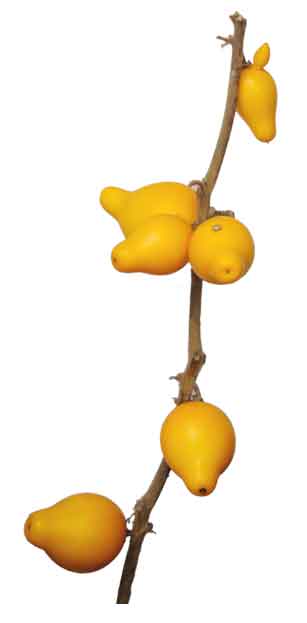
- Etymology: The genus name Solanum is derived from Latin solamen, "comfort, solace, or soothing", referring to is sedative and healing effects. The species epithet mammosum refers to the nipple-shaped fruit.
Botany
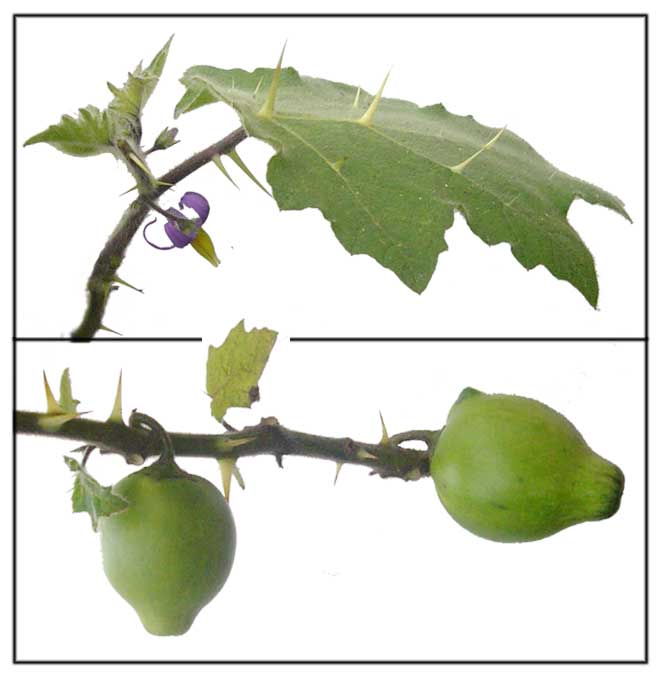
• Utong is a coarse and branched half-woody
plant, prickly or unarmed, growing to a height of 0.4 to 1 meter. Stems
are prickly and covered with soft short hairs. Leaves are ovate to oblong-ovate,
broad as they are long, 10 to 25 centimeters long, armed on both surfaces with long, stout spines, stellate-hairy beneath, and irregularly
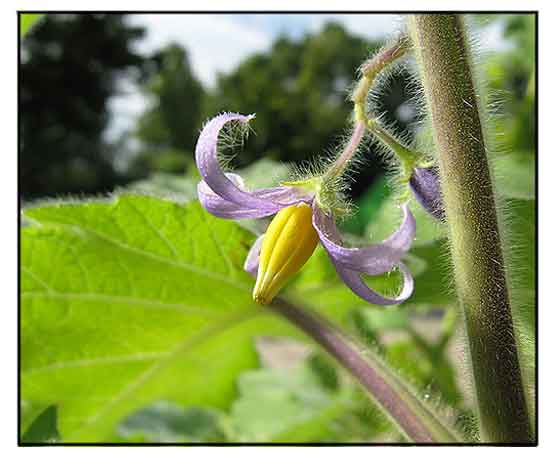
and shallowly lobed at the margin. Inflorescences are umbelliform and lateral, with 1 to 6 flowers. Flowers are axillary, about 2.5 centimeters
long, purplish or bluish. Fruit is fleshy, smooth, purple when ripe,
up to 25 centimeters long, extremely variable in shape, rounded, oblong, or
cylindric-oblong. Seeds are compressed, purple-brown, 2-4 millimeters in diameter. Fruit flesh is white.
Distribution
- Introduced into the Philippines from Tropical America.
-
In thickets and waste
places along the roads at low altitudes in Leyte; Zamboanga, Mindanao, and Jolo.
- Cultivated in some gardens in Manila and neighboring towns as a curiosity because of the shape of the fruit.
- Propagated by seeds.
Constituents
- Fruit contains trigonelline,
choline, vitamins A, B, and C; fat 0.1 percent, and protein 2.2 percent.
- Fruit considered toxic, containing solanine saponin, mallic and gallic acids.
- Fruit yields a glycoalkaloid, solamargine.
- Nutrient analysis per 1 cup/100 g fruit yielded: protein 0.96 g, total dietary fiber 0.78 g, total sugars 3.23 g, calcium 7 mg,
vitamin C 0.05 mg, and 4 ug of beta-carotene.
- S. mammosum fruit extract yielded secondary metabolites such as alkaloids, saponins, tannins, terpenoids, coumarins, cardiac glycosides, steroids-triterpenoids, flavonoids, and phenolic compounds. Total polyphenols and flavonoid content were 275 mg GAE/g extract and 676 mg QE/g extract, respectively.
(see study below) (16)
Properties
- Fruit considered purgative, phlegmatic, generative.
- Leaves are anodyne, narcotic.
- Studies have suggested repellent, insecticidal, antifungal, antiproliferative, antioxidant, antimalarial, molluscicidal, anticancer, larvicidal properties.
Parts used
Roots, leaves, fruits.
 Uses Uses
Edibility
- Caution: There are conflicting reports on the fruit's edibility. Some list it as inedible; some as toxic and poisonous; many list it as edible, with nutrient benefits to boot, with the caution to be eaten only when unripe.
-
Fruit makes an excellent vegetable, the elongated kind is most cultivated,
eaten before it ripens, before the seed hardens. (Some list it as inedible.)
- Good source of calcium, phosphorus, iron, and vitamin B.
- The green leaves are a good source of vitamin C.
Folkloric
- Root decoction taken
for asthma and as general stimulant.
- Leaves used for hemorrhoids.
- In Costa Rica, decoction of leaves used as remedy for diseases of the kidney and bladder.
- In El Salvador, seeds used as a remedy for colds.
- In Yucatan, decoction of leaves used for cleansing wounds.
- Root, boiled with sour milk and grain porridge used to treat syphilis.
- Juice of fruit with pounded leaves and roots used for a variety of skin
diseases.
- Roots, dried stalk, and leaves used in decoction for washing sores.
- Astringent for bladder hemorrhage.
- Decoction or infusion of leaves used for stomach problems.
- Burnt fruit used for liver problems.
- Fruit is cooling, and when bruised with vinegar, is used as a poultice
for abscesses and cracked nipples.
- Fruit used for phthisis, cough and loss of appetite.
- The peduncle (stalk of flower or fruit) when burned is used for piles,
toothache and intestinal hemorrhages.
- Seeds are used as stimulant but may cause dyspepsia and constipation.
- In Belize, leaf juices rubbed to afflicted areas with athlete's foot.
- In Bolivia, fruit used for scabies.
- In Peru, used in traditional medicine to treat fungal and respiratory disorders via topical application. (15)
 Others Others
- Decorative: Fruit collected ripe with the branches used for interior decoration.
- Repellent / Insecticide: Kofan people of Columbia and Ecuador use the plant as insect repellent especially against cockroaches. (7)
- Poison concerns: Parts of the plant are toxic. Species used as poison against cockroaches, rats, and insects. (Chanel et al, 2001) ( 11) In Columbia, identified as poisonous to cattle, causing prostration. (13)
- Rituals: Fruits and foliage use as floral arrangements for religious festivals. Fruits use during Chinese Lunar New Year celebrations with the fruit color symbolizing wealth. (Lim, 2013) (11)(12)
- Detergent: The juice of the fruit can be used as detergent, similar to soap nut.
Studies
• Antiproliferative / Indioside D: Study
isolated indioside D, a furostanol glycoside from Solanum mammosum and
was found to possess antiproliferative activity toward a panel of human cancer cell lines. Results showed indioside D induced apoptosis in HeLa cells via both intrinsic and extrinsic cell death pathways. (1)
• Anticancer / Saponins / Solamargine: Of saponins isolated from the fruit, solamargine showed highest toxicity towards HeLa cell line followed by inidioside D, protodioscin, solasonine and pseudoprotodioscin. (7)
• Antimalarial: In a study of 46 different species screened for antimalarial activity, Solanum mammosum fruit extract was one of those found moderately active. (2)
• Antioxidant Activity: Study by Weitwitayaklung and Phaechamud (2011) reported low antioxidant activity of S. mammosum fruit, with a total phenolic content of 3.08 g/100 g crude extract gallic acid. (7)
• Molluscicidal: Steroidal glycoalkaloid mixed from fruits, solasonine and solamargine and the stereoisomeric glycosidic alkaloid tomatine were toxic to Lymnaea cubensis and Biomphalaria glabratus.
(7)
• Solasodine in Steroid Production:Solasodine, present in Solanum mammosum, can be a potential alternative for the high-revenue synthesis of steroid hormones. Study reports on the use of added methyl jasmonate, cholesterol, and L-arginine into the modified liquid full-strength MS medium could influence the solasodine production in the hairy roots of S. mammosum. The amount of solasodine was five times higher than those without both elicit or and precursor treatment. The improved solasodine production with high biomass growth can reduce the production cost of steroid synthesis in the long run. (8)
• Microbicidal Synergism Against Potomac Catalina: The species Solarium mammosum, S. saponaria and Jatropha curcas have shown molluscicidal properties against Pomacea canaliculata. Study evaluated a mixture of aqueous extracts of the three plants for synergistic effect between them. All were diluted to 500 ppm. Mixes with best results on mortality were choses to determine the LD50. The formulations of S. saponaria (100%) and S. mammosum and S. saponaria (50%-50%) showed best results with LD 50 of 24.04 ppm and 17.78 ppm, respectively, with no significant statistical differences between each other to a confidence of 95%. While no synergistic effect was found between mixture of aqueous extracts of the three species, the mixing of Sapindus saponaria and Solanum mammosum can be useful in areas where the effectiveness of S. saponaria is restricted by environmental conditions, such as low availability of oxygen in the water. (9)
• Microbicidal Steroid Alkaloids: Steroidal alkaloids mixture from fruits (solasonine 1 and solamargine 2) and the stereoisomeric glycosidic alkaloid tomatine 3 are toxic at 10 and 25 ppm to Lymnaea cubensis and Biomphalaria glabratus, respectively Their aglycones solasodine 4 and tomatidine 5 obtained by hydrolysis of glycosides showed no toxicity to either mollusk. (14)
• Antifungal / Solamargine / Fruits: In Peru "teta de vaca" is traditionally used to treat fungal infections. In this study, the antifungal activity of TDV was determined against Trichophyton mentagrophyte and Candida albicans Bioautography-TLC-HRMS identified solamargine as the main compound responsible for the anti-T. mentagrophytes (MIC 64 µg/ml) and anti-C. albicans (MIC 64 µg/ml) activities at very low concentration (1.6 µg/ml). Solamargine significantly reduced procyanin production and biofilm formation. Results might the traditional use of fruits for treatment of fungal infections and respiratory disorders. (15)
• Insecticidal / Fruit fly / Fruit: Study evaluated the insecticidal activity of S. mammosum fruit extract against fruit fly, Drosophila melanogaster, as model The fruit extract exhibited lethal effect to 2nd instar and reduced pupae formation rate. The extract was more effective in suppression of pupae eclosion than Ascend (commercial pesticide). The activities of esterases and phosphatases were inhibited in Drosophila by intake of S. mammosum. Results suggest great potential as an insecticidal agent. (see constituents above) (16)
• Anticancer / Betulinic Acid / HeLa Cell Line: One of the natural compounds reported to have cytotoxic activity against various cancer cells with high selectivity is betulinic acid. Study evaluated the anticancer activity of acetone extract of S. mammosum as well as betulinic acid. TLC densitometry of the acetone extract yielded 1.2% w/w betulinic acid. MTT assay of the acetone extract showed anticancer activity against HeLa cancer cells with IC50 of 120.5 µg/mL, less active than betulinic acid with IC50 of 19.3 µg/mL. Both samples were non-toxic on Vero normal cells. (17)
• Silver Nanoparticles / Larvicidal Against Ae. aegypti / Fruit: Study reports on the green synthesis of silver nanoparticles using aqueous fruit extracts of S. mammosum and evaluated its insecticidal activity against 3rd instar Ae. aegypti larvae. Results showed both aqueous extract and AgNPs were toxic to the larvae, with the NPs exhibiting much higher level of toxicity than the extract alone, with LC50s of 0.06 ppm vs 1631.27 ppm, respectively. Results suggest a potential alternative source against insect vectors of human disease. (18)
• Gold and Silver Nanoparticles / Anti-SARS-CoV-2 Surrogates / Fruit, Leaves, and Essential Oil: Study evaluated and compared gold (AuNPs) and silver (AgNPs) for antiviral activity and affinity with the coronavirus spike protein using PhiX174 and enveloped Phi6 bacteriophages as models. The leaves were most effective on Phi6. FT-IR spectra showed presence of large proportion of polyphenolic compounds, and antioxidant analysis confirmed the antiradical activity. Results showed both the extract and NPs have greater antiviral effect on the surrogate Phi bacteriophage, which is an appropriate model for studyi8ng SARS-CoV-2. (19)
Toxicity
- Despite known toxicity, some reports list the fruits and leaves as palatable. (Lim, 2013) (12) (11)
Availability
- Wild-crafted.
- Seeds in the cybermarket.
|