| Gen info
Indigenous in Southeast
Asia; sometimes called the "fruit from heaven," believed to promote longevity, health and vitality.
Botany
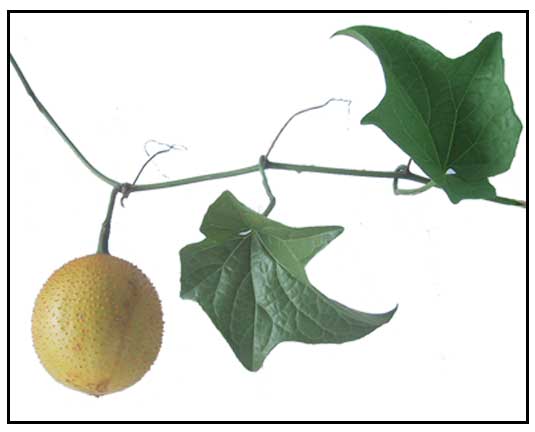
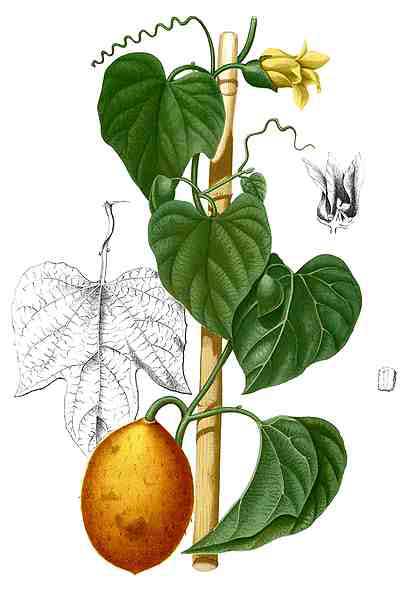
Balbas-bakiro is a coarse and dioecious vine
reaching a length of 15 meters, slightly hairy or nearly smooth, climbing
by tendrils. Leaves are broadly ovate, 8 to 18 centimeters long, deeply palmately
3-lobed, sometimes entire, with pointed tips and heart-shaped bases.
Male flowers occur singly in the leaf axils on peduncles 5 to 15 centimeters long.
Buds, enclosed by a large, green inflated bracteole which is inhabited by ants, open at full bloom and turn yellowish.
Peduncles of the female flowers are 2.5 to 5 centimeters long. Calyx is nearly
black with 5 acuminate lobes about 2 centimeters in diameter. Petals are pale yellow, oblong to oblong-ovate,
with a large dark-colored blotch at the base. The fruit is large, ovoid to rounded,
8 to 12 centimeters in diameter, yellow and roughened with scattered, tubercle-like spines. Seeds
are large, flattened, circular, embedded in an orange-yellow pulp.
 Distribution Distribution
- In thickets and secondary
forests at low and medium altitudes in Cagayan, Bontoc, Benguet, Ilocos Sur, La Union, Tarlac, Pangasinan, Rizal, Bulacan, Cavite, Laguna, Batangas, and Camarines Provinces in Luzon; and in Mindoro, Biliran, Panay, Guimaras, Camiguin de Misamis and Mindanao.
- Also occurs in India to China and Taiwan, through Malaya to the Moluccas.
Constituents
- Seeds contain no alkaloid.
- Yields a high ß-carotene and lycopene.
- Kernels contain 47 % oil (similar to Chinese tung oil - Aleurites cordata).
- Seeds contain a slightly bitter glucoside.
- High in phytonutrients: (1) Lycopene, relative to mass, 70 times that
found in tomatoes. (2) Beta-carotene, 10 times the amount in carrots
or sweet potatoes.
- Study yielded six compounds: Heptacosane, ursolic acid, oleanolic acid, 18-pentatriacontanone, stigmast-4-ene-3ß,6a-diol and stearic acid.
- Phytochemical analysis isolated two major saponins, gypsogenin 3-O-ß-D-galactopyranosyl(1>2)-[a-L-rhamnopyranosyl(1>3)]-ß-D-glucuronopyranoside (1) and quillaic acid 3-O-ß-D-galactopyranosyl(1>2)-[a-L--rhamnopyranosyl(1>3)]-ß-D-glucuronopyranoside (2). (see study below) (28)
- Study of Gac fruit parts (peel, pulp, seed, and aril) yielded significant amounts of carotenoids [(107.4 ± 4.5), (85.7 ± 4.4), (110.6 ± 2.1) mg/100 g dry weight (DW)], and relatively high levels of both phenolics [(27.3 ± 1.7), (28.9 ± 2.4), (30.8 ± 2.7) mg/100 g DW] and flavonoids [(38.1 ± 2.2), (8.8 ± 1.3), (24.5 ± 3.3) mg/100 g DW] were found in the fruit’s peel, pulp and aril, respectively. Seed yielded relatively high level of flavonoids [(18.1 ± 2.3) mg/100 g DW]. Lycopene and β-carotene were found to be significantly high (P < 0.05) in aril [(579.3 ± 22.7) and (621.0 ± 35.0) μg/g DW], followed by peel [(51.0 ± 7.5) and (210.0 ± 12.5) μg/g DW] and pulp [(37.6 ± 10.9) and (205.6 ± 22.1) μg/g DW)]. (see study below) (31)
- Study of roots yielded three saponins names momordins I, II, and III, determined on the basis of chemical and spectral analysis as
oleanolic acid 3-O-α-L-arabinopyranosyl (1→3)-β-D-glucuronopyranoside (momordin I), 28-O-β-D-glucopyranoside of momordin I (momordin II) and 3β-hydroxy-11α, 12α-epoxy-olean-28, 13-olide 3-O-α-L-arabinopyranosyl (1→3)-β-D-glucuronopyranoside (momordin III). (32)
- Reversed-phase HPLC analysis evaluated fruit tissues including seed
for carotenoid content. Mean values in aril tissues were 1342 μg trans-, 204 μg cis-, and 2227 μg total lycopene; 597 μg trans-, 39 μg cis-, and 718 μg total β-carotene; and 107 μg α-carotene/g FW. Mesocarp yielded 11 μg trans-, 5 μg cis-β-carotene/g FW, trace amounts of α-carotene, and no lycopene. Gac aril contained 22% fatty acids by weight, composed of 32% oleic, 29% palmitic, and 28% linoleic acids. Seeds contained primarily stearic acid (60.5%), smaller amounts of linoleic (20%), oleic (9%), and palmitic (5−6%) acids, and trace amounts of arachidic, cis-vaccenic, linolenic, and palmitoleic, eicosa-11-enoic acids, and eicosa-13-enoic (in one fruit only) acids. (34)
Properties
- Pectoral, aperient, abstergent,
constructive and resolvent.
- Considered resolvent, cooling.
- Fruit yields the highest amount of beta-carotene (vitamin A) of any known fruit or vegetable.
- Studies have suggested immune enhancing, immunomodulatory, antioxidant, abortifacient, antimicrobial, DNA protective, anti-inflammatory, antiproliferative, analgesic, antimutagenic, antihyperglycemic, anti-tyrosinase, anti-wrinkle properties.
Parts used
Roots, seeds, leaves.
Uses
Nutritional
- Fruit of pulp is edible. Fruit eaten by jungle tribes of Pahang.
- Young shoots and leaves eaten as vegetable.
- In Thailand, young fruits, shoots and flowers are ingredient of curry. After boiling, eaten with chili sauces and rice. Young shoots fried in oyster sauce
with shrimp and pork.
- Rice colorant: In Vietnam,
used for dish called "xoi gac" - a mixture of gac seed and
pulp with cooked rice with its distinct color and flavor.
- Gac is considered an excellent source of carotenoids, especially beta-carotene and lycopene. The lycopene in the seed membrane, reported at 308 ug/g, is about 10-fold higher than other lycopene-rich fruits and vegetables.
- Gac oil also yield high levels of vitamin E.
Folkloric
- Roots are used for treatment of head lice.
- In the Philippines, seeds, pulverized or decocted, are used as pectoral; also good for coughs.
- In India, plaster made from roots promote hair growth.
- Seeds and leaves are aperient and abstergent; used in hepatic and splenic obstructions, in unhealthy ulcerations, and lumbago. Externally, used for procidentia uteri et ani.
- Seeds are used for treatment of hemorrhoids.
- Seeds considered constructive and resolvent, used for glandular swelling of the neck, mammary abscesses, mesenteric enlargements, bruises, wounds, swellings
and ulcers. Used for chronic malaria, enlarged spleen, and fluxes.
- In Vietnam, the seed membranes are used
for relief of dry eyes and to promote healthy vision; also used to make
a tonic for children and lactating and pregnant women.
- In Chinese medicine, seeds known as "mubiezi," considered cooling and resolvent, used for liver and
spleen disorders, wounds, hemorrhoids, bruises, swelling and pus.
Others
- Soap: Roots used as a substitute
for soap; for lice infestation.
- Coloring: In Indo-China, the fruits is used for food coloring. In Vietnam, used to color rice for celebratory
occasions, like weddings, new years, masking the usual white color of
the rice, white considered the color of death.
- Illuminant: Oil from the seeds used as illuminant in Indo-China.
Studies
• Gac / Fruit Carotenoids:
Study analyzed samples of seed membrane and mesocarp for carotenoids and tocopherols. Average total carotenoid concentration in three gac fruit samples was 497 (±154) µg/g fresh material, with lycopene dominating and exceeding beta-carotene concentrations, 408 µg/g and 83 µg/g, respectively. Alpha-tocopherol concentration in the pulp was 76µg/g. (2)
• Immune Enhancing / Immuno-Modulatory:
Immunomodulatory
activity of a chymotrypsin inhibitor from Momordica cochinchinensis
seeds: A chymotrypsin-specific inhibitor (MCoCI)
was isolated from the seed of M. cochinchinensis. It was shown to possess
immuno-enhancing and anti-inflammatory effects that may explain some
of its therapeutic actions. (3)
• Gac: Gac with its high level of bioavailable
carotenoids may also promote prostate health and protect the eyes from
age-related macular degeneration and cataracts. (4)
• Antioxidant: Results of study on
the rat hepatocyte system suggest that M cochinchinensis possessed antioxidative
activity which explains some of its pharmacologic effects. (6)
• Antioxidant / Seeds: Study showed a chymotrypsin-specific potato type inhibitor from M cochinchinensis possessed antioxidative activity which may account for some of the pharmacologic effects of MC seeds.
• Adjuvant Immune Effect / Seeds: Study showed extract of C momordica seeds, when used ovalbumin in mice, may induce significantly higher specific antibody production than OVA alone. Results suggest ECMS is safe for injection and can be used as a potential vaccine adjuvant in the production of IgG2a in mice. (15)
• Momorcochin / Abortifacient: Study isolated a glycoprotein from the fresh root tubers of Momordica cochinchinensis. The protein was capable of inducing mid-term abortion in mice.(7)
• Antimicrobial: Crude, partially purified hexane and dichlormethane extracts showed antibacterial and antifungal activity. Results suggest a potential used as antimicrobial compound in traditional medicine. (9)
• Phytochemicals of Fruit Fractions / Antioxidant: Study showed the aril to have the highest contents of both lycopene and beta-carotene, while the yellow peel yielded the highest amount of lutein. Gallic acid and p-hydroxybenzoic acids were found in all fractions. Apigenin was the predominant flavonoid in the red pulp. Total phenolic and flavonoid content in the peel and pulp varied according to fruit development stage. (15)
• Immune Response Enhancement: Study evaluated the immunological effect of Mc extract of seeds on the immune response against Newcastle disease in chickens. Results showed enhancement of humoral immune response by the seed extract 14 days postimmunization. (14)
• Antimicrobial / Antioxidant: A methanolic extract exhibited significant antimicrobial activity against test organisms, particularly S. aureus and E. coli. Antioxidant activity was better than standard drug, ascorbic acid. (16)
• DNA Protective Activity / Fruit Extracts: GAC extracts from pulp, skin, seed membrane, and water were evaluated for cytotoxicity property. .Results showed GAC possesses DNA protective ability against H2O2 and UVC. The protective effect of GAC extracts against UVC was 20-30%. The degree of anti-oxidative damage activity in human TK6 cells of GAC extracts is SK95>SMW>SK50. (17)
• Attenuation of Diabetic Renal Damage: Study evaluated the preventive effect of a methanolic extract of M. cochinchinensis fruit on renal function in alloxan-induced diabetic rats. Results showed attenuation of diabetic renal damage, probably by its anti-oxidative action and anti-diabetic activity. (18)
• Proteinase Inhibitors: Study evaluated the effects of M. cochinchinensis proteinase inhibitors on several common meat-spoilage bacteria. Results showed the MCoPIs solution inhibited the growth of 4 studied bacteria: Bacillus cereus, Bacillus cereus 3, Bacillus cereus 81 and E. coli. Results indicate an potentiality for the solution for protection of meat from bacterial infection and prolonging meat freshness. (19)
• Anti-Inflammatory / Triterpenoidal Glycoside: Seeds yielded two triterpenoidal saponins: a new gypsogenin glycoside (1) and a quillaic acid glycoside (2). Compound 2 exhibited anti-inflammatory activity on RAW 264.7 cells, through inhibition of lipopolysaccharide-induced expression of nitric oxide and IL-6 via NF-kB pathway. (20)
• Plasma ß-Carotene and Retinol Supplementation in Children / Fruits: ß-carotene from xoi gac is a good source of provitamin A carotenoids, from which severely anemic children might benefit from routine xoi gac consumption. (See Uses/Nutritional above) (21)
• Antioxidant / Antimicrobial / Fruit: Study evaluated ethanolic extracts of three factions (peel, pulp and aril) of Gac fruit for antioxidant and antimicrobial activities. Highest antioxidant activities of ethanolic extract from the aril of ripe Gac fruits were 4.87 mg AAE/g FW and 0.016 mg AAE/g FW by DPPH and FRAP, respectively. On antimicrobial evaluation against six pathogenic microorganisms, E. coli ATCC 25922 and P. aeruginosa ATCC 27853 were most susceptible to the aril extract with MIC of 3.125 mg/mL. (23)
• Adjuvant Enhancement of Immune Response to
Fouth-and-Mouth Vaccine Response / Seeds: Study evaluated the adjuvant effect of a seed extract on vaccination of inactivated FMDV antigens in a guinea pig model and the effect of ECMS supplement in oil-emulsified FMD vaccines for immunopotentiation in pigs. Results showed ECMS and oil emulsion act synergistically as adjuvants to promote the production of FMDV- and VP1-specific immunoglobulin G (IgG) in guinea pigs. Results suggest an alternative way to improve swine FMD vaccination and improved an effective immune response. (24)
• Effects of Processing on Toxicity: Study evaluated the effects of pre- and post-processing of 95% ethanol extract on survival rate of mice. Results showed the survival rate with processed extract was higher in processed vs non-processed. The toxicity of M. cochinchinensis was significantly decreased by processing. (25)
• Comparative Antioxidant and Antimicrobial Activities / Ripe and Unripe Fruit: Comparative study showed the flesh acetone extract to yield the highest phenolics content in the unripe fruit (41.6 ± 0.240 mg GAE/100g FW) and the aril methanol extract of unripe fruit showed the best flavonoid content (73.7 mg FE/ 100 g FW [p<0.05]). The unripe flesh extract showed highest activity against tested microorganisms, especially E. coli. Results suggest a promising source of antimicrobial and antioxidant agents for pharmaceutical and food industry applications. (26)
• Saponins / Adjuvant Immune Effects: Plant-derived saponins have been found to have adjuvant effects on purified protein antigens. Saponin adjuvants have been reported to stimulate the secretion of a broad range of cytokines, suggesting they may act by triggering innate immunity. M. cochinchinensis crude saponins I and II may promote production of IL-2, IL-4, IL-5, IFN-y and TNF-a. They may enhance antibody responses to vaccination against FMD and may act synergistically with oil emulsion to promote immune responses
. (Also see study 24) (27)
• Antiproliferative on Human Lung Cancer Cells / Seeds: Study reports an ethanol extract of seeds reduced cell proliferation in four human cancer cell lines, AS49, H1264, H1299, and Calu-6. Phytochemical analysis isolated two major saponins, gypsogenin 3-O-ß-D-galactopyranosyl(1>2)-[a-L-rhamnopyranosyl(1>3)]-ß-D-glucuronopyranoside (1) and quillaic acid 3-O-ß-D-galactopyranosyl(1>2)-[a-L--rhamnopyranosyl(1>3)]-ß-D-glucuronopyranoside (2). Treatment with these compounds (1 and 2) decreased cell proliferation in all human lung cancer cell lines tested. The compounds also attenuated primary lung endothelial cell proliferation. Results suggest seeds have antiproliferative activity as well as angiostatic effect on lung endothelial cells. (see constituents above) (28)
• Suppression of Migration and Invasion of Human Breast Cancer Cells / Seeds: Study evaluated the effects of M. cochinchinensis seeds on regulation of breast cancer cell ZR-75-30 metastases and invasion. Results showed strong growth inhibitory effects on ZR-75-30 cells, and effective inhibition in a dose dependent manner The ESMC significantly inhibited the expression and secretion of MMP-2 and MMP-9 in ZR-75-30 cells. Results suggest potential for development of novel inhibitors for breast cancer. (29)
• Gac Seed Kernel Oil / Edibility Issues: Compared to other seed oils, GAC seed kernel yields a very high oil content. However, when extracted, the oil is not considered edible virgin oil due to high percentage of unsaponifiable matter. Gac seed oil extracted by SC-CO2 showed better oil qualities, including antioxidant capacity, color, peroxide value, free fatty acid value and unsaponifiable matter than the Soxhlet oil. Further refining is needed to achieve safety criteria prescribed for edible oils. (30)
• Antioxidant/ Fruits: Study identified the composition and antioxidant capacity of Gac fruit parts (peel, pulp, seed, and aril) grown in Malaysia. Antioxidant assays revealed that aril possessed the highest scavenging activity (IC50 = 865 μg/mL), while the peel possessed the highest ferric reducing power of 140 pmol FeSO4/μg. (see constituents above) (31)
• Suppression of Breast Cancer Growth by Cell Cycle Arrest and Apoptosis / Seeds: Study evaluated the potency and underlying mechanisms of action of an ethyl acetate extract of seed on breast cancer cells. Results showed marked growth inhibitory effect on cells. Cell cycle arrest in G2 phase following treatment was associated with marked increase in protein level of cyclin B1, cyclin E, and cyclin-dependent kinase 1 and a decrease in cyclin D1 expression. GC-MS analysis yielded various bioactive compounds that may be responsible for the inhibition of tumor cell growth and induction of apoptosis in the cancer cell line. Results suggest potential for development of novel therapies for breast cancer. (4)
• Mutagenicity and Antimutagenicity Studies on Fruit: Study showed water extracts from gac fruit showed no mutagenic activity and exhibited antimutagenic activity against nitrite-treated 1-AP especially from unripe pulp. (34)
• Effect on Hyperglycemia and Male Reproductive Damage in STZ-Induced
HG Mice / Aril: Study evaluated the effect of MC aril aqueous extract on male reproductive system of STZ induced hyperglycemia (HG) mice. Results showed GA (Gag aril) possessed antioxidant activity and could significantly reduce blood glucose levels and increase sperm concentration in HG mice. Study showed the GA extract can improve hyperglycemia and male reproductive damages in STZ induced hyperglycemic mice. (35)
• Central Analgesic Effect / Acute Toxicity Study /Fruit: Study evaluated fruit extracts of M. cochinchinensis and M. balsamina for analgesic activity by Eddy's hot plate and Tail immersion methods. Results showed petroleum ethers extracts of both plants have central analgesic activity, comparable to standard drug pentazocine. Acute toxicity study showed the extracts to be safe up to a dose of 2000 mg/kg with no mortality after to 14 days of extract administration. (36)
• Extraction of Bioactive Compounds / Microwave-Assisted (MAE) vs Ultrasonic Aqueous (UAE) vs Conventional Extraction / Seeds: Study showed MAE was best for extracting phenolics and the aqueous method for extracting saponins. Conventional extraction method was best for extracting trypsin inhibitors in defatted Gac seeds. (37)
• Non-Toxic Effect on Reproductive System of Male Mice/ Aril: Study investigated the toxic effects of aril extract on measures of sex hormone, body weight, reproductive organ structures, and sperm quality in male mice. Results showed MC aril extract was not toxic to the reproductive organs of male mice. (38)
• Extraction of Lycopene / Preparation of Nanolycopene / Aril: Study reports on the extraction of high purity lycopene from dried Gac aril using organic solvents. Average lycopene content in dried Gac was around 0.28-0.46%. Nanolycopene was prepared by emulsification/solvent evaporation method. (39)
• Antioxidant / Antityrosinase Activity / Anti-Wrinkle Cream Formulation: Study evaluated the antioxidant and anti-tyrosinase activities of Gac and an anti-wrinkle cream formulation. The antioxidant activity of the Gac extract was 5.85- and 11.75-fold higher than that of vitamin E in DPPH and ABTS assays, respectively. The Gac extract exhibited high tyrosinase inhibition (62.83% ± 1.99%), which was 1.51- and 2.06-fold greater than that of vitamins C and E, respectively. Acute skin tolerance testing indicated non-irritating properties. Clinical study revealed increase in cutaneous hydration, with decreased average roughness and increased smoothness. Results showed the formulated Gac extract to be an effective anti-wrinkle cream. (40)
• Increase in Plasma ß-Carotene and Retinol Concentrations / Fruit: In rural Vietnam, vitamin A deficiency is a concern. Among the indigenous fruits and vegetables, Gac has been identified as having the highest ß-carotene concentration. Locally. it is mixed with rice in a preparation called xoi gac. This study showed xoi gac is a good source of provitamin A carotenoids, and severely anemic children might benefit from routine xoi gac consumption. (42)
Availability
- Wild-crafted.
- Supplements, GAC oil capsules in the cybermarket
|