| Gen info
- Azanza is an Asian genus of shrubs in the family Malvaceae and tribe Gossypieae. It includes two species previously placed in Thespesia: Azanza lampas (Cav.) Alef, the type species, and Azanza thespesioides.
 Botany Botany
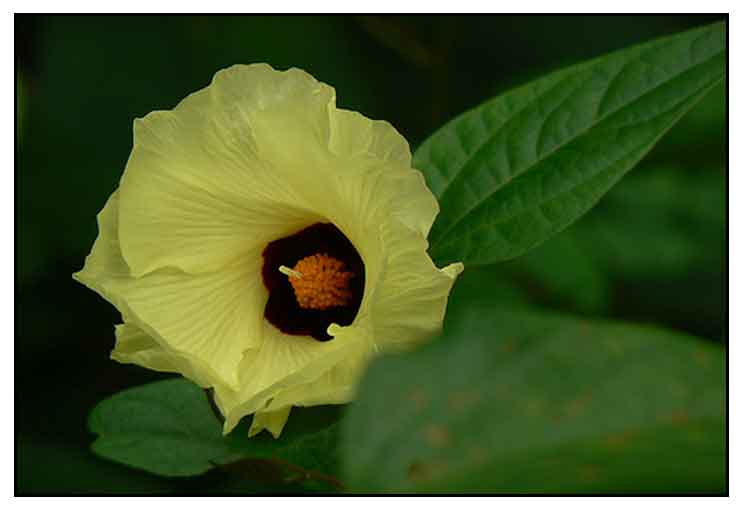
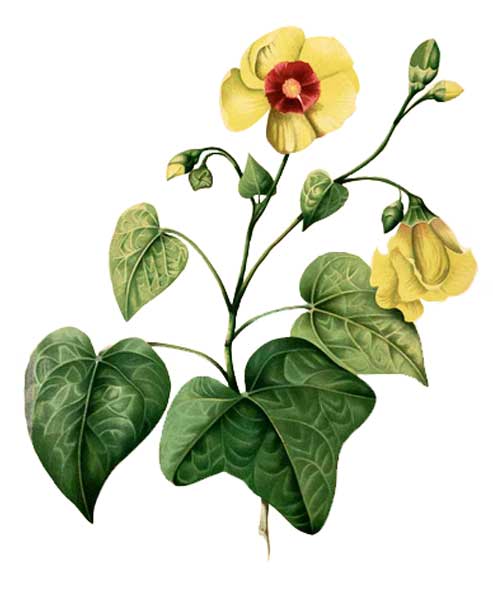
Bulak-bulakan is an erect, slightly branched shrub growing to 2 to 3 meters high. Leaves are ovate, 10-20 centimeters long, somewhat 3-lobed or nearly entire, green and nearly smooth in the upper surface, hairy beneath, pointed at the tip, and broad and heart-shaped at the base. Flowers are large and borne in threes in the apex of the branches or at the axils of the leaves. Calyx is green with 5 pointed lobes united below the middle. Corolla is bell-shaped, 6 to 8 centimeters long, yellow and dark-purple at the center. Capsules are ovoid, about 3 centimeters long, with 4 to 5 valves.
Distribution
- Native to the Philippines. (12)
-
In open places and thickets at low and medium altitudes.
- In Abra, Lepanto, Bontoc, La Union, Pangasinan, Bulacan, Rizal, Bataan, and Laguna Provinces in Luzon; and in Culion, Negros, and Panay.
- Also native to Assam, Bangladesh, Cambodia, China South-Central, China Southeast, East Himalaya, Hainan, India, Jawa, Laos, Lesser Sunda Is., Malaya, Maluku, Myanmar, Nepal, Sri Lanka, Sulawesi, Sumatera, Thailand, Vietnam, West Himalaya. (12)
 Constituents Constituents
- Coloring matter from the yellow petals contain quercetin and protocatechuic acid.
- Study has confirmed quercetin as the principal coloring matter of the flowers.
- Phytochemical screening of methanol and aqueous extracts of roots yielded flavonoids, phenolic acids, triterpenoids and tannins. (see study below) (13)
- Preliminary phytochemical screening of stems yielded glycosides, phenolic compounds, tannins, steroids, saponins, flavonoids, carbohydrates and proteins. (see study below) ( 15)
- Phytochemical screening of root extract yielded glycosides, phenolic compounds, and mucilage. (see study below) ( 1)
- Leaf and root extracts have yielded alkaloids, saponins, tannins, anthraquinones, and glycosides. Moisture content was 10.7% and 6.75%, total ash 17.72% and 9.54% in root and leaf, respectively. Leaves showed total phenolics and flavonoids of 154.42 mg GAE/g and 47.55 mg CE/g, respectively. Roots showed total alkaloids, tannins, and ascorbic acid or 158.86 mg PE/g, 78.89 mg TAE/g, and 274.34 µg/100g, respectively. ( 18)
Properties
- Studies have suggested antimicrobial, antioxidant, anti-lipoxygenase, antihyperlipidemic, hepatoprotective, antidiabetic, anthelmintic properties.
Parts utilized
Roots, stems, fruits.
 Uses Uses
Folkloric
- In India, roots and fruits used for gonorrhea and syphilis.
- Root paste used by the Korku tribe of Maharashtra and Nepal to cure jaundice.
- Stem of plant used traditionally for treatment of inflammation, hyperacidity, epistaxis, bronchitis, cough, dysentery, fever, sun stroke, carbuncles, and worms.
- In the Indian system of medicine, root juice used in various ailments and as health tonic.
- In Tamil Nadu, India, Kaatupoovarasu decoction of roots used for bone fractures. (19)
- In Ayurveda, used for leucorrhea and dysentery. (20)
- The Kokni tribe of Maharashtra, India use leaf juice for loose motions and leaf extract give for excessive white discharge in females. (21)
Others
- Fiber: Bast makes a weak rope.
- Dye: Yellow petals yield a coloring matter; study yielded quercetin and protocatechic acid.
- Cotton: Cotton from the seeds used to make clothing.
Studies
• Anthelmintic / Roots:
Study evaluated aqueous extract of T. lampas roots for anthelmintic activity using earthworms (Pheretima posthuma), tapeworms (Raillietina spiralis), and roundworms (Ascaridia galli). Piperazine citrate was used as reference standard drug. Results showed significant anthelmintic activity. (1)
• Antioxidant / Roots: Study showed in vitro antioxidant activity, with a relationship between extract concentration and percentage of inhibition of free radicals, metal chelating, reducing power and lipid peroxidation inhibition. (2)
• Hepatoprotective / Carbon Tetrachloride Toxicity: Study in carbon tetrachloride-induced hepatocellular damage, T. lampas exhibited a statistically significant reduction of elevated enzymes. Hepatoprotective effect was confirmed by histopathological liver exam. Results provide pharmacologic support for its folkloric use as a hepatoprotective agent. (3)
 • Antioxidant / Anti-Lipoxygenase Activity: Study of extracts of T lampas showed both antioxidant activity and anti-lipoxygenase activity. Ascorbic acid, gallic acid and indomethacin were used as reference standards for DPPH, ABTS, and anti-lipoxygenase assays. In both DPPH and ABTS assays, the extract showed significant scavenging activity with 72.28 µg/ml and 103.4 µg/ml IC50, respectively. Results elucidate a possible contribution of the radical scavenging effect on the lipoxygenase inhibitory mechanism. Lipoxygenases are critical in the biosynthesis of leukotrines which play an important role in the pathophysiology of inflammatory disease. (4) • Antioxidant / Anti-Lipoxygenase Activity: Study of extracts of T lampas showed both antioxidant activity and anti-lipoxygenase activity. Ascorbic acid, gallic acid and indomethacin were used as reference standards for DPPH, ABTS, and anti-lipoxygenase assays. In both DPPH and ABTS assays, the extract showed significant scavenging activity with 72.28 µg/ml and 103.4 µg/ml IC50, respectively. Results elucidate a possible contribution of the radical scavenging effect on the lipoxygenase inhibitory mechanism. Lipoxygenases are critical in the biosynthesis of leukotrines which play an important role in the pathophysiology of inflammatory disease. (4)
• Anti-Hyperlipidemic: Study established the lipid lowering properties of the aqueous extract of roots of Thespesia lampas. Total cholesterol, LDL, VLDL and triglycerides were significantly reduced, while HDL was significantly increased. (5)
• Hepatoprotective / Antioxidant / Stem: Study of stem extract showed significant antioxidant activity and hepatoprotection against carbon tetrachloride induced damages. (6)
• Hepatoprotective / Geraniin / Roots: Study evaluated the hepatoprotective activity of the butanol fraction of an alcohol extract of T. lampas root against paracetamol toxicity in rats. Study isolated a major principle, geraniin, which showed promising hepatoprotective activity against both CCl4 and paracetamol-induced liver damages in rats. (9)
• Antihyperglycemic / Antihyperlipidemic: Study evaluated methanol and aqueous extracts of TL for antihyperglycemic, antihyperlipidemic and spermatogenetic effects on STZ-induced diabetic rats. Results showed significant improvement in glucose tolerance in rats. The extract also exhibited anti-hyperlipidemic effects. (10)
• Anti-Diabetic / Roots: Methanol and aqueous extracts of roots of T. lam[as produced significant fall in blood glucose levels in alloxan induced diabetic rats. The extracts of T. lampas may have stimulating effect on the beta cells. (13)
• Lignocellulosic Fibers: Study reports on the extraction and characterization of novel lignocellulosic fibers from T. lampas, the effects of alkali treatment on composition, tensile properties, morphological and structural changes, and thermal degradation. Results suggest an alternative suitable source for composite construction. (14)
• Pharmacognostic Standardization of Stems: Chemomicroscopic evaluation of stems yielded lignin, starch grains, and calcium oxalate crystals. Study of behavioral characteristics of stem powder yielded steroids, starch, alkaloid, flavonoids, and proteins. Preliminary phytochemical screening yielded glycosides, phenolic compounds, tannins, steroids, saponins, flavonoids, carbohydrates and proteins. GC-MS analysis yielded fatty acids such as dodecanoic acid, tetradecanoic acid, n-hexadecanoic acid, and 9-tetradecenal. HPTLC fingerprinting yielded ß-sitosterol and quercetin. (15)
• Hepatoprotective / Paracetamol Induced Toxicity / Roots: Study evaluated the hepatoprotective activity of root extracts and fractions against paracetamol induced toxicity in male albino Wistar rats. The root extracts showed varying levels of hepatoprotection. The ethanol extract showed better activity compared to water and petroleum ether extracts. The n-butanol fraction (200 mg/kg) showed maximum hepatoprotective activity which was concentration dependent and comparable to 50 mg/kg of silymarin. The fraction also showed hepatoprotective action against CCl4-induced hepatic damage. (16)
Availability
Wildcrafted.
|