|
Gen info
- Laportea is a genus of plants in the family Urticaceae. They are herbaceous, annual or perennial, many with stinging hairs. The genus was names after the French naturalist Francis de Laporte de Castelnau. (16)
 Botany Botany
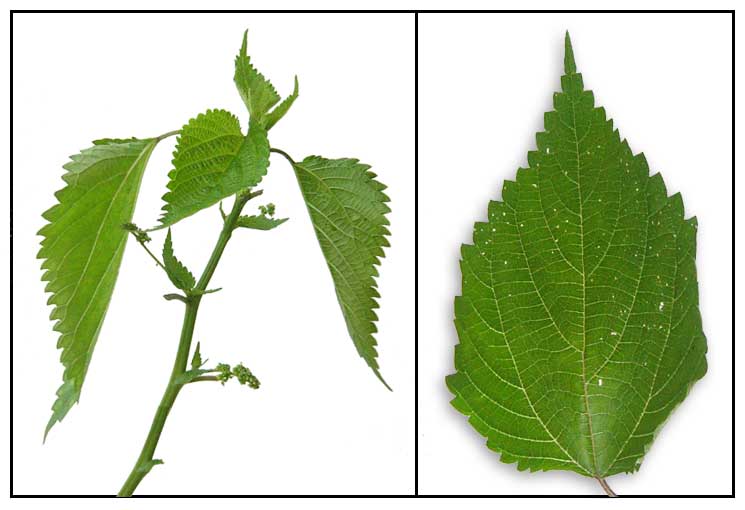
Lipang-aso is an erect plant, somewhat branched or simple annual herb, about 0.5 to 1.5 meters high.
Stems are green and succulent, the vegetative parts with scattered,
somewhat stinging, spreading hairs. Leaves are ovate, 5 to 15 centimeters long,
with tapering pointed tip, broad rounded base, and toothed margin,
with scattered hairs on both surfaces. Inflorescence is narrow,
axillary, slender, up to 20 centimeters in length, of numerous, short
paniculately arranged cymes. Flowers are small, crowded, greenish,
intermixed with numerous pedicels of fallen flowers. Perianth of the pistillate
flower is 1 to 1.5 centimeters long. Achenes are straw-colored, compressed
and about 1.5 to 1.8 millimeters long.
Distribution
- Native to the Philippines.
-
Chiefly in disturbed soil in and about towns throughout the Philippines.
- Also native to Andaman Is., Assam, Bangladesh, Bismarck Archipelago, Cambodia, Cameroon, Caroline Is., China South-Central, Ethiopia, Guinea-Bissau, India, Jawa, Kenya, Laccadive Is., Laos, Lesser Sunda Is., Malaya, Maldives, Maluku, Marianas, Marshall Is., Mozambique, Myanmar, New Guinea, Northern Territory, Oman, Queensland, Solomon Is., Sri Lanka, Sudan, Sulawesi, Taiwan, Tanzania, Thailand, Vietnam, Western Australia. (9)
Constituents
- Leaves yielded significant amount of carbohydrates (19.80 g/100g), proteins (31.30 g/100g), starch (15.40 g/100g), essential amino acids and minerals. Ethanol extracts of flowers and roots yielded high total phenolic (46.35 mg gallic acid equivalents/g of extract) and flavonoid contents (96.67 mg rutin equivalents/g of extract), respectively. (see study below) (10)
-
Study of methanol and aqueous extract of leaves yielded flavonoids, saponins, glycosides and alkaloids. Spectroscopic study yielded various groups of compounds: flavonoids, xanthophylls, and phycobilins
predominantly. (13)
- Study of Laportea interrupta fresh leaves for carotenoid content yielded 481.00 ± 32.70 µmol/g dried matter.
(15)
- Ethanol extract of whole plant yielded alkaloids, tannins, steroids, gums, flavonoids, glycosides, and reducing sugar. (see study below) (18)
Properties
- Plant, especially the leaves, is covered with minute, stinging hairs, which cause pronounced itching.
- Studies have suggested
antibacterial, neuropharmacologic, CNS stimulant, antioxidant, antipyretic, nematicidal, fetal-maternal beneficial, thrombolytic, membrane stabililzing, cytotoxic properties.
Parts
used
Leaves, roots, fruits.
 Uses Uses
Folkloric
- Leaves applied locally
for carbuncles.
- Decoction of root used as a diuretic; the effects probably due to the
potassium nitrate content in the leaves and roots.
- Decoction of roots used for asthma and coughs.
- In India, leaf-paste used
for boils; root extract, as diuretic.
-
In Mayurbhanj district of Orissa, India, fruits used for headache.
- In Bangladesh, F. interrupta roots are macerated along with the heads of fruits of Ananas comosus (pineapple), honey or salt, and made into small pills - taken daily in the morning, on an empty stomach for 7 days, for wasting of the body in women. (4)
- In West Papua, fresh, hairy leaves are rubbed on skin to produce a hot and itching feeling, to combat muscular pains and fatigue.
(7)
- In Manipur, India, leaf paste from crushed leaves of Laportea interrupta is mixed with a 10-day infusion of leaves of Nicotiana tabacum and the mixture is applied to various skin diseases.
(12)
- In Indonesia,
used for treatment of dermatitis: cooled decoction of boiled roots used for bathing; one cup of juice drunk twice daily.
(19)
The Manui tribe of central Sulawesi drink decoction of leaves for fever. (20)
Caution / Toxicity
• Contact Dermatitis: The plant, particularly
the leaves, is covered with minute, stinging hairs which cause
intense itching. The hairs resemble a hypodermic needle with
a large bulbous base, exuding a poisonous substance when the
tip is broken.
- Fruit is believed to be poisonous to horses.
Studies
• Neuropharmacologic Effect / CNS
Stimulant: Ethanolic extract of F. interrupta showed
CNS stimulating effects in mice, probably through interfering with cortical
functions or increasing the effects of some CNS stimulating neurotransmitters.(1)
• Nematicidal: Water extract of Fleurya interrupta was found to be nematicidal, with 100% mortality of root-knot larvae within 40 minutes.
(3)
• Neutraceuticals / Antioxidant / Antipyretic: Study evaluated the nutritional, antioxidant, and antipyretic properties of Laportea interrupta. Antioxidant assay showed the ethanol root extract with strong DPPH radical scavenging capacity (IC50 32.34 µg/mL), a 2,2′-azinobis(3-ethylbenzothiazoline-6-sulphonic acid) radical cation scavenging activity (1,072.57 µM trolox equivalents/g extract), and a ferric reducing ability (9,456.01 mM Fe(II)/g of extract.
Antipyretic study of ethanol root and leaf extracts by Brewer's yeast induced pyrexia showed 68.0 and 57.4%, respectively. (see constituents above)
(10)
• Pre-Gestational Benefit / Leaves: Study evaluated the potential of pre-gestational intake of Laportea interrupta leaf decoction as an aid for fetal-maternal health through its influence on embyronic implantation and growth, placental labyrinth vasculoangiogenesis, and junctional zone morphology in 8-week old female mice. High concentration treatment group showed increase in viable site ratios, increase in estimated embryo weight and implantation sites, placental labyrinth with very prominent blood vessels. Results suggested pre-gestational high concentration consumption showed a potential to support fetal-maternal health.
(11)
• Antibacterial / Antioxidant: Study evaluated various fractions of ethanol extracts of L. interrupta against gram-positive (S. aureus, Sarcina lutea, Bacillus subtilis, B. cereus) and gram-negative ( E. coli, S. typhi, S. dysenteriae V. mimicus and V. parahemolyticus) bacteria by disc diffusion technique. The fractionates showed potential antibacterial and DPPH free radical scavenging activities. Among the extracts the petroleum ether and chloroform fractions showed highest free radical scavenging activities with IC50s of 1.069 µg/ml and 1.711 µg/ml, respectively. (14)
• Nephroprotective / Gentamicin Toxicity: Study evaluated the nephroprotective properties of ethanolic extract of L. interrupta in gentamicin-induced renal injury and paracetamol-induced nephrotoxicity in rats. Biochemical analysis, histopathlogical studies were performed. Results showed significant decrease in gentamicin-induced nephrotoxicity. (17)
• Thrombolytic / Membrane Stabilizing / Cytotoxic: Study evaluated ethanol extracts and partitions of whole plant of L. interrupta for thrombolytic, membrane stabilizing and cytotoxic activities. The petroleum ether soluble fraction (PESF) showed highest thrombolytic activity (48%) with streptokinase as positive control to the clots. In brine shrimp lethality bioassay, the PESF showed significant lethality with LC50 value of 7.36 µg/ml. Different partitionates protected hemolysis of RBC induced by hypotonic solution and heat as compared to standard acetyl salicylic acid. (see constituents above) (18)
Availability
Wild-crafted. |


_(2788869693).jpg)